Bilingual edition: English is preserved and Chinese follows each unit. Terminology uses the confirmed v20260916 glossary; automated semantic review remains traceable.
中英双语版:英文原文完整保留,中文紧随对应单元;术语采用 v20260916 确认表,自动语义审校结果可追溯。

The Mean

平均值

The value you expect to get in a statistical experiment is the mean. If you toss a coin 10 times, you expect to get 5 heads and 5 tails. The mean is often called the "expected value" or the "expectation value". You expect this value because the probability of getting "heads" is 0.5 and if you toss 10 times you should get 5. To formalize this particular example of the mean, if p is the probability and n the number of events, then the mean is a = np. This is the form of the mean when the probability can be expressed by the binomial distribution.

在统计实验中,你期望得到的值是平均值。如果你抛一枚硬币10次,你期望得到5次正面和5次反面。平均值通常被称为“期望值”或“期望值”。你期望这个值是因为得到“正面”的概率是0.5,如果你抛10次,你应该得到5次。为了正式化这个平均值的例子,如果p是概率,n是事件数,那么平均值是a = np。这是当概率可以用二项分布表示时平均值的形式。

To formalize the concept a bit more, if for an experiment with discrete outcomes xi for which the probability is P(xi), then the mean is given by

为了更明确地表述这一概念,若一个实验有离散的可能结果x_i,其概率为P(x_i),则均值由下式给出:

a = ΣxiP(xi)

For the case of continuous variables where the probability is expressed in terms of a distribution function, the mean takes the form
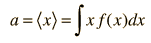
对于连续变量的情况,当概率以分布函数形式表达时,平均值的形式为

Mean particle energy from Boltzmann distribution
玻尔兹曼分布中的平均粒子能量
Mean value for binomial distribution
二项分布的均值
Mean lifetime for particle decay
质点衰变的平均寿命
Index

Applied statistics concepts
索引应用统计学概念
 
HyperPhysics*****HyperMath*****Algebra
HyperPhysics ***** HyperMath ***** 代数
R Nave
Go Back
返回


The Mean of the Binomial Distribution

二项分布的期望值

The mean value of the binomial distribution is a = np where n is the number of events and p is the probability for each event.

二项分布的期望值为 a = np,其中 n 是事件数,p 是每个事件的概率。
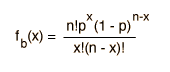
Binomial distribution:
二项分布:
Mean:
平均值:

This seems a very simple expression for the mean of such a complicated function, but the result agrees with our intuition. If you throw a die, hoping to throw a "2", then the probability is 1/6. If you throw it 6 times, you would expect to get one throw with value "2". The mean or expected value for 6 throws is (1/6)(6) = 1. For such a simple expression, the proof that it is in fact the mean is rather involved. The following approach is after Appendix D of Rohlf's Modern Physics.

这种表达式看起来对于如此复杂的函数来说非常简单,但结果与我们的直觉相符。如果你掷一个骰子,希望掷出一个‘2’,那么概率是1/6。如果你掷6次,你期望得到一次‘2’。对于6次掷骰子来说,期望值或平均值是(1/6)(6) = 1。对于这样一个简单的表达式,证明它确实是一个平均值的过程却相当复杂。以下方法是根据Rohlf的《现代物理》附录D提出的。

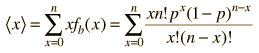
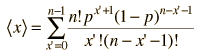
From the definition of the mean using a distribution function, the binomial mean is

根据分布函数定义的均值,二项式均值为

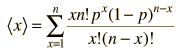
The goal is to reduce this expression to just np. Since the first term in the sum is zero, since x=0, we can replace the sum with a sum starting from 1.

目标是将这个表达式简化为np。由于求和中的第一项为零(因为x=0),我们可以将求和从1开始。

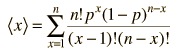
Now cancel the common factor of x appearing in numerator and denominator.

现在消去分子分母中共同出现的x因子

Since the summation index is a dummy variable, we make the change of variables x' = x - 1.

由于求和索引是虚变量,我们进行变量替换 x' = x - 1。

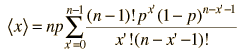
Now factor out np.

现在提取np

The terms in the summation above are just the binomial function for n-1 trials, and you are summing it over all values of x - so that sum must be just 1. The expression then reduces to the desired expression for the mean.

上述求和中的各项只是对于n-1次试验的二项式函数,你是在所有x值上对它求和——因此这个总和必须等于1。因此,该表达式就简化为所需的均值表达式。
Mean of the
binomial distribution.
二项分布的期望值。

Since the Gaussian and Poisson distributions are approximations to the binomial distribution, this expression for the mean applies to them as well.

由于高斯分布和泊松分布是二项分布的近似,因此这个关于均值的表达式也适用于它们。
Index

Applied statistics concepts

Reference
Rohlf
App. D.
索引应用统计学概念参考Rohlf附录D
 
HyperPhysics*****HyperMath*****Algebra
HyperPhysics ***** HyperMath ***** 代数
R Nave
Go Back
返回