Permutations
排列
The permutation relationship gives you the number of ways you can choose r objects or events out of a collection of n objects or events.
排列关系给出了从n个对象或事件中选择r个对象或事件的种数。
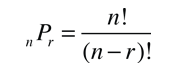
As in all of basic probability, the relationships come from counting the number of ways specific things can happen, and comparing that number to the total number of possibilities. If you are making choices from n objects, then on your first pick you have n choices. On your second pick, you have n-1 choices, n-2 for your third choice and so forth. As illustrated before for 5 objects, the number of ways to pick from 5 objects is 5! .
正如基础概率中所见,这些关系来源于计算特定事件发生的方式数,并将该数目与总的可能性数目进行比较。如果你从n个物体中进行选择,第一次选择有n种可能,第二次选择有n-1种可能,第三次选择有n-2种可能,依此类推。如前所述,对于5个物体,从5个物体中选择的排列数为5!。
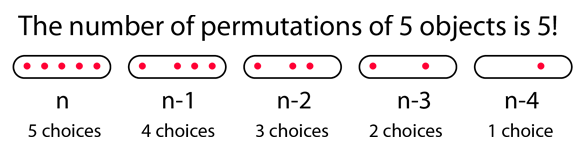
Note that your choice of 5 objects can take any order whatsoever, because your choice each time can be any of the remaining objects. So we say that there are 5 factorial = 5! = 5x4x3x2x1 = 120 ways to arrange five objects. In general we say that there are n! permutations of n objects.
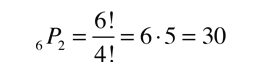
Now if you are going to pick a subset r out of the total number of objects n, like drawing 5 cards from a deck of 52, then a counting process can tell you the number of different ways you can do that. For the first pick, you have n choices, then n-1 and so on down to n-r+1 for the last pick. The number of ways you can do it is then
现在如果你要从总共有n个物体中选出一个子集r,比如从52张牌的牌堆中抽5张牌,那么一种计数过程可以告诉你有多少种不同的方式可以做到这一点。第一次选择有n种选择,接着是n-1,依此类推,直到最后一次选择有n-r+1种选择。因此,可以这样做的方式数目为

which can be expressed in the standard form
这可以表示为标准形式
The number of permutations of r objects out of n is sometimes what you need, but it has the drawback of overcounting if you are interested in the number of ways to get distinguishable collections of objects or events. For the purposes of card playing, the following ways of drawing 3 cards are equivalent:
从n个对象中取出r个的排列数有时是你需要的,但它有一个缺点,就是如果你关心的是获得可区分的对象或事件的组合数时,会导致重复计数。在纸牌游戏中,以下方式抽3张牌是等效的:

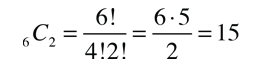
So the permutation relationship overcounts the number of ways to choose this combination if you don't want to make a distinction between them based on the order in which they were chosen. The factor of overcounting in this case is 6 = 3!, the number of permutations of 3 objects. The number of distinguishable collections of r objects chosen from n is obtained by dividing the permutation relationship by r! . It is usually written
因此,如果不考虑选择顺序的区别,这种排列关系会高估组合数。这种过度假设的因子是6=3!,即3个物体的排列数。从n个物体中选出r个可区分集合的数量是通过将排列关系除以r!得到的。通常写作
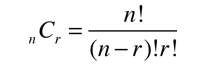
请注意,你选择5个物体的顺序可以是任何顺序,因为每次选择都可以是剩余的任何一个物体。所以,我们说有5! = 5×4×3×2×1 = 120种方法来排列五个物体。一般来说,我们说有n!种n个物体的排列方式。 This quantity nCr is called the "combination" and represents the probability of picking r distinguishable outcomes out of n without regard to the order of picking each outcome.
For a group of n objects or events which are broken up into k subsets, the above relationship is generalizable to give the number of distinguishable permutations of the n objects.
对于被分成k个子集的n个物体或事件组,上述关系可以推广为给出n个物体的可区分排列数。
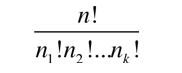
Here the terms in the denominator are the populations of the k subsets. An application of this relationship is in determining the number of possible energy states in an energy distribution for distinguishable particles.
分母中的项是k个子集的数目。这种关系的应用之一是确定可区分粒子的能量分布中的可能能量态数目。
这个量n C r被称为“组合”,表示从n个中不考虑抽取顺序地选出r个可区分结果的概率。 |