Bilingual edition: English is preserved and Chinese follows each unit. Terminology uses the confirmed v20260916 glossary; automated semantic review remains traceable.
中英双语版:英文原文完整保留,中文紧随对应单元;术语采用 v20260916 确认表,自动语义审校结果可追溯。

The distribution of 9 units of energy among 6 identical particles

9个单位的能量在6个相同的粒子之间分配

The distributions of particles with the number of ways each distribution can be produced according to Maxwell-Boltzmann statistics where each particle is presumed to be distinguishable.

根据麦克斯韦-玻尔兹曼统计,粒子的分布情况取决于每种分布能被产生的方式数,假设每个粒子都是可区分的。

The total number of different distributions is 26, but if the particles are distinguishable, the total number of different states is 2002.

总的不同的分布数目是26,但如果粒子是可区分的,总的不同的状态数目是2002。
Show how the numbers are obtained
展示数字是如何得到的
Graph of the distribution
分布图
Einstein-Bose example
爱因斯坦-玻色例子
Fermi-Dirac example
费米-狄拉克示例
Index

Reference
Blatt
Ch. 11
索引参考Blatt第11章
 
HyperPhysics***** Quantum Physics
HyperPhysics ***** 量子物理
R Nave
Go Back
返回


How many ways can you distribute 9 units of energy among 6 identical particles?

将9个单位的能量分配给6个相同的粒子,有多少种方法?

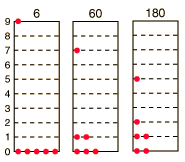
The three distributions of particles at left each have the same energy, the same kind of particles, and the same number of particles, yet the distribution at the right is 30 times more likely than the one at the left. Why is this? For the distinguishable particles which are presumed by the Maxwell-Boltzmann distribution, it matters not only how many particles are in each state, but which particles are in each state.

左边的三个粒子分布具有相同的能量、相同的粒子种类和相同的粒子数目,然而右边的分布比左边的分布更可能30倍。为什么会出现这种情况?对于被麦克斯韦-玻尔兹曼分布所假设的可区分粒子来说,不仅粒子在每个状态中的数量重要,粒子在每个状态中的具体身份也至关重要。

Blatt uses the term "macrostate" to describe the characterization of the system which gives just the number of particles in each state; the diagram above shows three of the 26 possible macrostates for this system. The term "microstate" is used for the more detailed characterization in which the specific energy level for each particle is given. The macrostate at left has only 6 microstates, because there are only 6 ways to put one particle in level 9 and the other 5 in level 0. But there are 180 ways to achieve the macrostate at right, so if every distribution is presumed to be equally likely, then the system is 30 times more likely to be found in the right hand macrostate.

Blatt使用“宏观态”一词来描述系统的一个特征,即仅给出每个态中粒子的数量;上图显示了该系统26种可能的宏观态中的三种。“微观态”一词用于更详细的描述,其中每个粒子的具体能级都被指定。左边的宏观态只有6个微观态,因为只有一种方式将一个粒子放在第9级,其余5个放在第0级。但右边的宏观态有180种实现方式,所以如果假设每种分布都等概率,则系统更可能处于右边的宏观态,可能性是30倍。

The number of distinguishable ways to produce each distribution is given by

产生每种分布的可区分方式数目由以下公式给出

So for the three macrostates pictured above, the numbers of microstates are

对于上面所示的三个宏观状态,微观状态的数量是

(Recall that 0!=1 so that the unoccupied states do not affect the calculation.)

(注意0!=1,因此未被占据的状态不影响计算。)

Now to establish the distribution function for the number of particles in each energy state, the number of particles in each state must be averaged over all of the microstates. For each macrostate, the number of particles in a given energy level is multiplied by the number of microstates. The sum of those products is divided by the total number of microstates, which is 2002 in this case.

现在要建立每个能级中粒子数的分布函数,每个状态中的粒子数必须在所有微态上进行平均。对于每个宏观态,给定能级中的粒子数乘以微态数目。这些乘积之和除以总微态数目,这里是2002。

The number of microstates (the multiplicity W) for q units of energy among N equally probable states can be mathematically evaluated from the expression

q单位的能量在N个等概率状态中分配时的微观状态数(即简并度W)可以从表达式数学地计算得出

which for this case becomes

在本例中变为
Evaluate the average for each energy state.
计算每个能态的平均值。
Compare with Bose-Einstein example
与玻色-爱因斯坦示例比较
Index

Reference
Blatt
Ch. 11
索引参考Blatt第11章
 
HyperPhysics***** Quantum Physics
HyperPhysics ***** 量子物理
R Nave
Go Back
返回


The average distribution of 9 units of energy among 6 identical particles

9个单位的能量在6个相同粒子间的平均分布

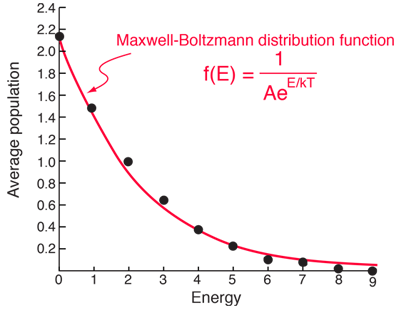
There are 26 possible distributions of 9 units of energy among 6 particles, and if those particles are assumed to be distinguishable, there are 2002 different specific configurations of particles. In Blatt's language, there are 26 macrostates and 2002 microstates. To get a distribution function of the number of particles as a function of energy, the average population of each energy state must be taken. The average for each of the 9 states is shown below, and the plot of those averages as a function of energy.

有26种可能的将9个单位能量分配给6个粒子的方式,如果这些粒子被认为是可区分的,那么就有2002种不同的粒子具体配置。用Blatt的语言来说,有26个宏观态和2002个微观态。要得到粒子数作为能量函数的分布函数,必须取每个能量态的平均人口。下面显示了每个9个状态的平均值,这些平均值作为能量函数的图示也已绘制出来。
Energy
level
能级
Average
number
平均数
0
2.143
1
1.484
2
0.989
3
0.629
4
0.378
5
0.210
6
0.105
7
0.045
8
0.015
9
0.003

It is remarkable that the distribution obtained with only 6 particles so closely approximates the Maxwell-Boltzmann distribution. The derivation of the distribution function is a formidable mathematical problem which uses the calculus of variations to derive the most probable distribution under the constraints of constant energy and constant number of particles.

令人惊讶的是,仅用6个粒子得到的分布与麦克斯韦-玻尔兹曼分布非常接近。该分布函数的推导是一个艰巨的数学问题,它使用变分法在能量和粒子数恒定的约束下推导出最可能的分布。
Compare with Bose-Einstein example
与玻色-爱因斯坦示例比较
Compare with Fermi-Dirac example
与费米-狄拉克示例对比
Index

Reference
Blatt
Ch. 11
索引参考Blatt第11章
 
HyperPhysics***** Quantum Physics
HyperPhysics ***** 量子物理
R Nave
Go Back
返回