Lifting Mass
提升质量
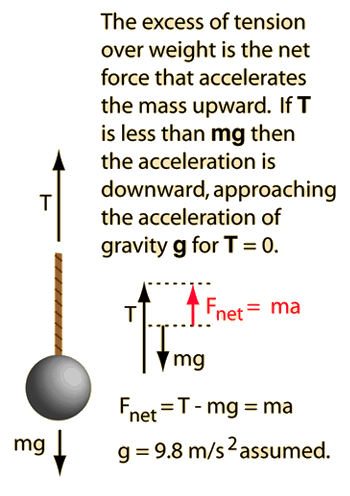
Though a straightforward application of Newton's second law, many find this problem deceptive. The common misconception which is carried into it is that the tension in the rope must equal the weight of the hanging object. When the mass is accelerated, that is not so. You may change the data and then click on either tension or acceleration in the equation below to calculate its value.
尽管可以直接应用牛顿第二定律,但许多人仍认为这个问题具有欺骗性。将这一误解带入问题中的是,认为绳子的张力必须等于悬挂物体的重量。当物体加速时,并非如此。你可以更改数据,然后点击下面方程中的张力或加速度来计算其值。
mass x acceleration = tension - weight
质量乘以加速度等于张力减去重量
 |
See elevator problem见电梯问题
对于质量为 m= kg 的物体,绳子必须承受其重量 = mg = 牛顿才能使其静止悬停。如果加速度是 a= m/s²,那么需要一个净力= 牛顿来加速该质量。这需要张力为 T= 牛顿。请注意,只有在加速度为零时,张力才等于重量;如果加速度为负(向下),则张力小于重量。如果你输入的向下加速度大于 9.8 m/s²,将得到负的张力,这表明必须迫使它向下以获得比自由落体加速度更大的加速度。 中文译文中的待填/计算数值依次对应:1:m 2:w 3:ac 4:nf 5:t。实际数值以上方原输入框为准。 |
Newton's laws
Standard mechanics problems
索引 牛顿运动定律 标准力学问题
| HyperPhysics***** Mechanics
力学 | R Nave |
返回