Bilingual edition: English is preserved and Chinese follows each unit. Terminology uses the confirmed v20260916 glossary; automated semantic review remains traceable.
中英双语版:英文原文完整保留,中文紧随对应单元;术语采用 v20260916 确认表,自动语义审校结果可追溯。

RuBisCO

RuBisCO(专名或术语)

The enzyme ribulose-1,5-bisphosphate carboxylase/oxygenase, most commonly known by the shorter name RuBisCO or just rubisco is used in the Calvin cycle to catalyze the first major step of carbon fixation. RuBisCO is thought to be the most abundant protein in the world since it is present in every plant that undergoes photosynthesis and molecular synthesis through the Calvin cycle. Moore, et al.'s summary includes the assessment that rubisco makes up 20-25% of the soluble protein in leaves and is made on the Earth at the rate of about 1000 kg/s. They estimate that every person on Earth is supported by about 44 kg of rubisco!

这种酶,即核糖-1,5-二磷酸羧化酶/加氧酶,通常被称为RuBisCO或rubisco,用于卡尔文循环中催化碳固定的第一步。由于RuBisCO存在于所有进行光合作用和通过卡尔文循环进行分子合成的植物中,因此被认为是有史以来地球上最丰富的蛋白质。Moore等人总结指出,rubisco在叶片可溶性蛋白质中占20-25%,并且以每秒约1000千克的速度在地球上合成。他们估计,地球上每个人大约都依赖于44千克的rubisco!

"RuBisCO catalyzes either the carboxylation or oxygenation of ribulose-1,5-bisphosphate (known as RuBP) with carbon dioxide or oxygen. What makes it unique and different to every other enzyme is the fact that it can survive on its own without the need of the plant so even if it is dead it remains and helps decomposition. This is due to it not being affected by temperature or pH. "(Wikipedia)

RuBisCo has a molecular weight of 490,000 Daltons and is composed of eight large subunits and eight small subunits. The large subunits are coded in the chloroplast itself, while the small units are coded in the nucleus of the cell.

RuBisCo的分子重量为490,000道尔顿,由八个大的亚基和八个小的亚基组成。大的亚基在叶绿体中编码,而小的亚基则在细胞的细胞核中编码。
RuBisCO wiki
RuBisCO维基
RuBisCO可以催化ribulose-1,5-二磷酸(称为RuBP)与二氧化碳或氧气的羧化或氧化反应。与其他酶不同,RuBisCO能够独立生存,不需要植物的支撑,即使它死亡后仍能帮助分解。这是因为它不受温度或pH值的影响。(Wikipedia)
Index

Organic chemistry concepts

Chemistry concepts

Reference
Karp
Ch 3

Moore, et al.
Ch 7
索引 有机化学概念 化学概念 参考 Karp 第3章 Moore 等人 第7章
 
HyperPhysics*****Chemistry
HyperPhysics ***** 化学
R Nave
Go Back
返回


Carbon-Fixing in Plants

植物的碳固定

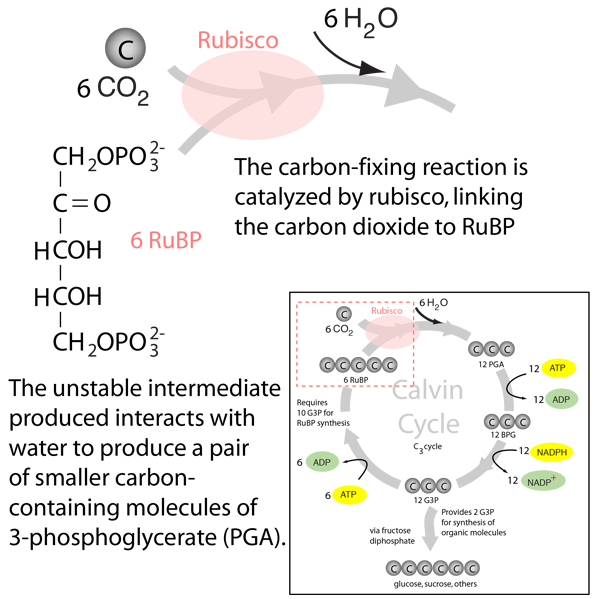
Carbohydrates in plants are produced from carbon dioxide and water with the energy of photosynthesis. The compound RuBP is part of the Calvin cycle in which this occurs. The large enzyme rubisco catalyzes the reaction that begins the chain of fixing carbon in plants.

植物中的碳水化合物是由二氧化碳和水在光合作用的能量作用下产生的。RuBP 是参与这一过程的卡尔文循环中的化合物。大酶 rubisco 催化了植物中固定碳反应链的起始反应。

The catalytic reaction with RuBP and carbon dioxide through a short-lived intermediary almost instantaneously produces two molecules of glycerate 3-phosphate (3PGA).

RuBP wiki
RuBP 词条
通过RuBP和二氧化碳催化反应,几乎立即生成两个分子的3-磷酸甘油酸(3PGA)。
Index

Organic chemistry concepts

Chemistry concepts

Reference
Karp
Ch 3
索引 有机化学概念 化学概念 参考 Karp 第3章
 
HyperPhysics*****Chemistry
HyperPhysics ***** 化学
R Nave
Go Back
返回


Formation of 3-phospoglycerate (PGA)

3-磷酸甘油酸的形成

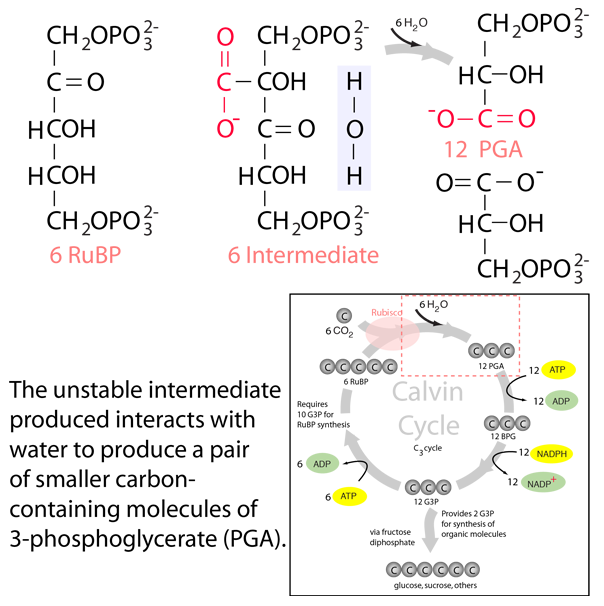
The reaction of carbon dioxide with RuBP in the Calvin cycle that is catalyzed by rubisco produces an unstable intermediate. It reacts with water to split into two copies of 3-phospoglycerate (PGA).

RuBP wiki
RuBP 词条
在卡尔文循环中,二氧化碳与RuBP反应,该反应由rubisco催化,产生一个不稳定的中间体。它与水反应,分解为两个3-磷酸甘油酸(PGA)分子。
Index

Organic chemistry concepts

Chemistry concepts

Reference
Karp
Ch 3
索引 有机化学概念 化学概念 参考 Karp 第3章
 
HyperPhysics*****Chemistry
HyperPhysics ***** 化学
R Nave
Go Back
返回


Steps to BPG and G3P

生成BPG和G3P的步骤

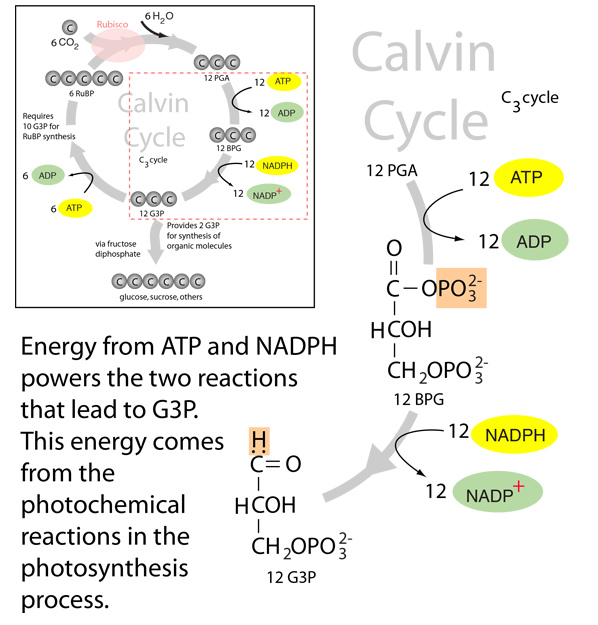
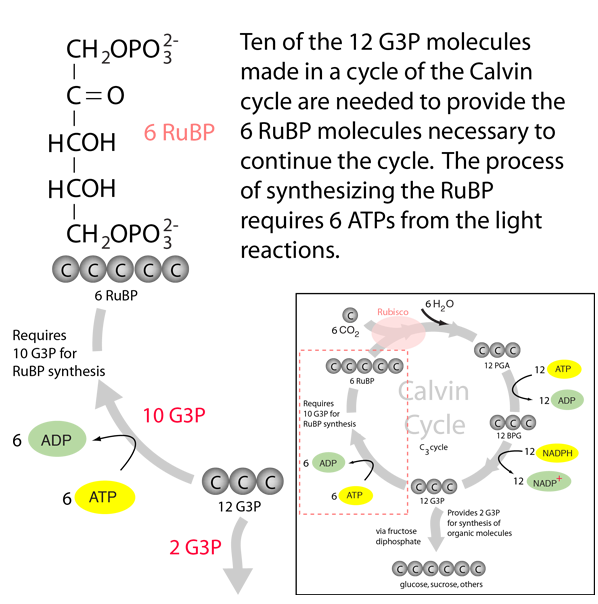
The next two steps in the Calvin cycle lead to glyceraldehyde 3-phosphate (G3P or GAP). The first of these steps uses energy from ATP to phosphorylate the 12 PGA molecules to form 12 1,3-bisphosphoglycerate (BPG) molecules. The next step uses three electrons provided by NADPH to reduce the BPG to form 12 molecules of glyceraldehyde 3-phosphate (G3P or GAP).

卡文循环的下一步骤导致生成甘油醛 3-磷酸 (G3P 或 GAP)。其中第一步利用 ATP 提供的能量将 12 个 3-磷酸甘油酸 (PGA) 分子磷酸化,形成 12 个 1,3-二磷酸甘油酸 (BPG) 分子。下一步则利用由 NADPH 提供的三个电子将 BPG 还原,形成 12 分子的甘油醛 3-磷酸 (G3P 或 GAP)。

The ATP and NADPH used in the Calvin cycle represent the high energy output of of the light dependent reactions of photosynthesis.

在卡尔文循环中使用的ATP和NADPH代表光合作用光反应的高能输出。
Index

Organic chemistry concepts

Chemistry concepts

Reference
Karp
Ch 3
索引 有机化学概念 化学概念 参考 Karp 第3章
 
HyperPhysics*****Chemistry
HyperPhysics ***** 化学
R Nave
Go Back
返回


Calvin Cycle Output for Sucrose Synthesis

卡文循环蔗糖合成输出

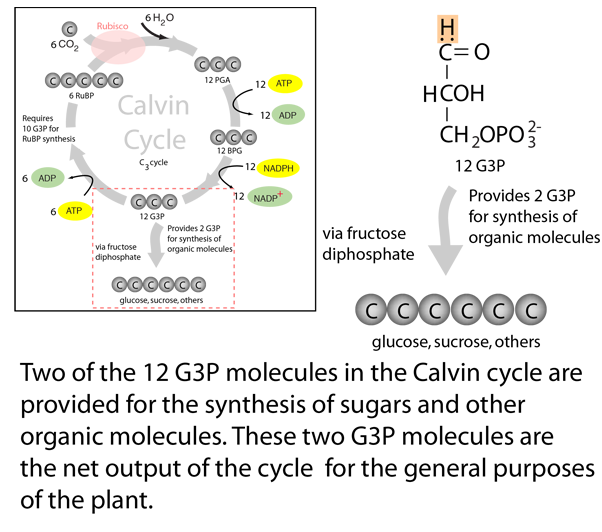
The net output of the Calvin cycle for the synthesis of sugars and other molecules is 2 G3P molecules out of the 12 produced in the cycle. The source of energy for this synthesis is from the light reactions.

卡尔文循环合成糖和其他分子的净产物是12个分子中产生出2个G3P分子。这种合成的能源来自光反应。
Index

Organic chemistry concepts

Chemistry concepts

Reference
Karp
Ch 3
索引 有机化学概念 化学概念 参考 Karp 第3章
 
HyperPhysics*****Chemistry
HyperPhysics ***** 化学
R Nave
Go Back
返回


Synthesis of RuBP for the Calvin Cycle

卡尔文循环中RuBP的合成

The final step in the Calvin cycle is to resynthesize the six molecules of RuBP used in the carbon-fixing reaction catalyzed by rubisco. The source of energy for this synthesis is ATP from the light reactions.

卡尔文循环的最后一步是利用光反应产生的ATP重新合成六个RuBP分子,这些分子在rubisco催化的碳固定反应中被使用。
Index

Organic chemistry concepts

Chemistry concepts

Reference
Karp
Ch 3
索引 有机化学概念 化学概念 参考 Karp 第3章
 
HyperPhysics*****Chemistry
HyperPhysics ***** 化学
R Nave
Go Back
返回


RuBP

Rribulose 1,5-biphosphate

核糖-1,5-二磷酸

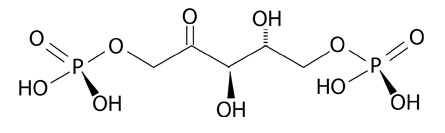
RuBP (ribulose 1,5-biphosphate) is a five-carbon sugar which reacts with CO2 in the first step of the Calvin cycle for fixing carbon in photosynthetic systems. That reaction is catalyzed by the large enzyme rubisco . The catalytic reaction with RuBP and carbon dioxide through a short-lived intermediary almost instantaneously produces two molecules of glycerate 3-phosphate (3PGA).

RuBP wiki
RuBP 词条
RuBP(核糖-1,5-二磷酸)是一种五碳糖,它在光合作用系统中固定碳的卡尔文循环的第一步中与CO₂反应。该反应由大型酶rubisco催化。RuBP与二氧化碳通过一个短暂存在的中间体几乎瞬间生成两个分子的3-磷酸甘油酸(3PGA)。
Index

Organic chemistry concepts

Chemistry concepts

Reference
Karp
Ch 3
索引 有机化学概念 化学概念 参考 Karp 第3章
 
HyperPhysics*****Chemistry
HyperPhysics ***** 化学
R Nave
Go Back
返回