Tennis Ball Impact on Eye网球撞击眼睛
A blow to the eye by a tennis ball can cause more damage than one might expect because of the transmission of the pressure to the back of the eye. 网球击打眼睛时,由于压力传递到眼球后部,可能造成比预期更严重的损伤。
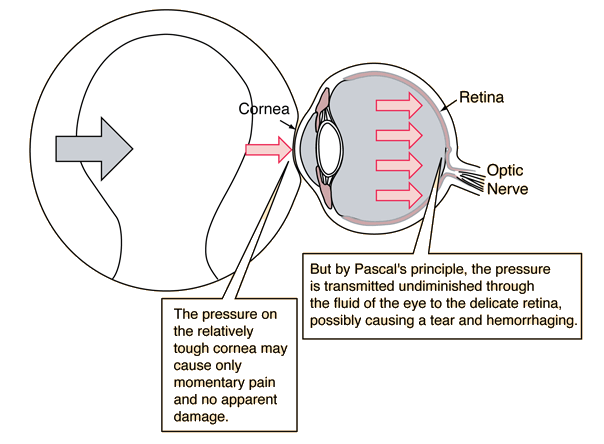
![]() A doctor I knew used an orange to demonstrate the dangers of a blow to the eye. He would hold the orange in one hand and strike it sharply with the palm of his other hand on one side. The peeling of the orange on the side opposite the blow would split. By Pascal's principle, we know that pressure exerted on one part of an enclosed static fluid will transmit undiminished to all parts of the fluid. The pressure transmitted through the orange to its back side was enough to rupture the peeling, while the side on which the blow occurred suffered no apparent damage. By this example he sought to communicate the danger to the retina from a frontal blow on the cornea of the eye. 我认识的一位医生用一个橙子来演示对眼睛的打击的危险性。他一只手拿着橙子,另一只手的掌心猛烈地击打橙子的一侧。橙子被击打的那一侧的果皮会裂开。根据帕斯卡原理,我们知道作用在封闭静止流体某一部分的压强会无损地传递到流体的其他所有部分。通过橙子传递到其背面的压强足以使果皮破裂,而被击打的那一侧却几乎没有损伤。通过这个例子,他试图传达对视网膜的危险性,即对角膜的正面打击可能造成的伤害。
|
Index Pascal's principle concepts 索引:帕斯卡原理概念 | ||
|
Go Back
返回 |
Ah! Pascal!啊!帕斯卡!
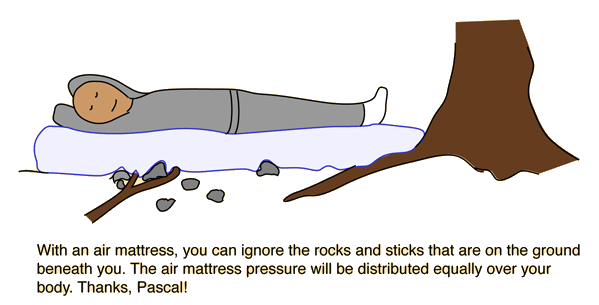
An air mattress takes advantage of Pascal's principle to protect you from the bumpy ground, rocks, and limbs. The pressure is equal on all the parts of your body which are in contact with the air matress. The same principle applies to a water bed since Pascal's principle applies to enclosed static fluids. The principle is used in clinical beds which reduce the incidence of ulcers on patients confined to bed for a lengthy period. 空气床垫利用帕斯卡原理来保护你免受崎岖地面、岩石和肢体的伤害。你的身体与空气床垫接触的所有部分的压力都相等。同样的原理也适用于水床,因为帕斯卡原理适用于封闭的静止流体。该原理也被用于临床床,以减少长期卧床患者发生溃疡的发病率。
![]() Another variation for hospital beds used for long-term care is the use of very fine particles in the mattress. They have almost fluid properties and approximate Pascal's principle behavior, but can be agitated with a source of vibration to give a gentle massage to the patient's skin. 另一种用于长期护理的病床变种是在床垫中使用非常细的颗粒。它们具有几乎流体的性质,并能近似表现出帕斯卡原理的行为,但可以通过振动源使其产生对患者皮肤的温和按摩。
|
Index Pascal's principle concepts 索引:帕斯卡原理概念 | ||
|
Go Back
返回 |
Hydraulic Brakes液压刹车
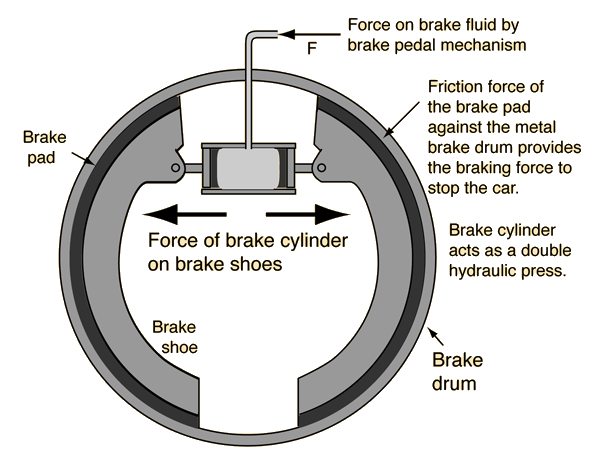
The wheel cylinder of hydraulic drum brakes acts as a double hydraulic press in that the pressure in the input line from the brake pedal is exerted in both directions on the movable wheel cylinder pistons. In both directions, this multiplies the force on the fluid by the ratio of the area of the cylinder to the area of the supply line. 液压鼓式刹车的轮缸相当于一个双作用液压压机,因为来自刹车踏板的输入管路中的压力同时作用于可移动轮缸活塞的两个方向。在两个方向上,这会将作用在流体上的力乘以缸体面积与供油管面积的比值。
![]() Besides the muliplication of force achieved, Pascal's principle guarantees that the pressure is transmitted equally to all parts of the enclosed fluid system. This gives straight-line braking unless there is a fluid leak or something to cause a significant difference in the friction of the surfaces. 除了力的乘积之外,帕斯卡原理保证了压力会均匀传递到封闭流体系统的所有部分。这使得制动呈直线进行,除非有流体泄漏或某种因素导致表面摩擦显著不同。
A practical problem with four-wheel hydraulic brakes is that the front of the car will tend to "dive" upon braking. This means that the front of the car tends to drop because the braking force on the front wheels in particular acts to produce a torque that rotates the front of the car downward. This tendency is alleviated somewhat with "anti-dive" brakes which have more braking force exerted by the rear wheels than the front. This is accomplished by making the rear wheel cylinders larger than those in the front wheels. This gives a larger force multiplication with those rear "hydraulic presses" with the same pressure, keeping the straight-line braking but exerting more of it with the rear wheels. 四轮液压刹车的一个实际问题是,刹车时汽车的前部会倾向于‘下沉’。这意味着,由于前轮特别受到的制动力会产生一个使汽车前部向下旋转的力矩。这种倾向可以通过‘防下沉’刹车来部分缓解,这种刹车的后轮施加的制动力比前轮更大。这是通过使后轮缸体比前轮缸体更大来实现的。在相同压力下,这给后轮的‘液压压机’提供了更大的力放大效果,保持直线刹车,但更多地由后轮施加。
|
Index Pascal's principle concepts 索引:帕斯卡原理概念 | ||
|
Go Back
返回 |