Pascal's Principle帕斯卡原理
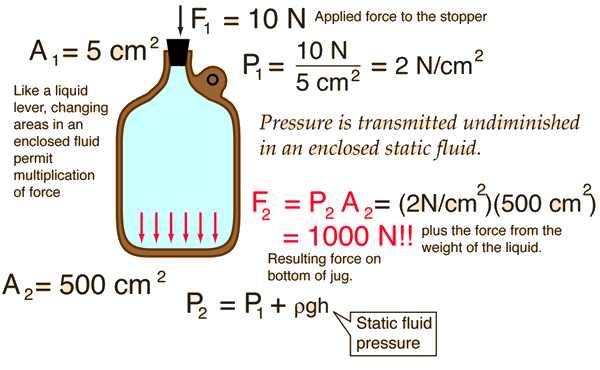
Pressure is transmitted undiminished in an enclosed static fluid.压力在封闭的静止流体中传递时不衰减。
Any externally applied pressure is transmitted to all parts of the enclosed
fluid, making possible a large multiplication of force (hydraulic press principle). The pressure at the bottom of the jug is equal to the externally applied pressure on the top of the fluid plus the static fluid pressure from the weight of the liquid.
How to drop the bottom out of a bottle如何从瓶底倒出底部 任何外加的压强都会传递到封闭流体的各个部分,从而可能产生较大的力(液压机原理)。桶底的压强等于作用在流体顶部的外加压强加上来自液体重量的静压强。 |
Index Pascal's principle concepts 索引:帕斯卡原理概念 | ||
|
Go Back
返回 |
Hydraulic Press液压机
|
Index Pascal's principle concepts 索引:帕斯卡原理概念 | ||
|
Go Back
返回 |
Hydraulic Press Calculation液压机计算
|
Index Pascal's principle concepts 索引:帕斯卡原理概念 | ||
|
Go Back
返回 |
Automobile Hydraulic Lift汽车液压举升
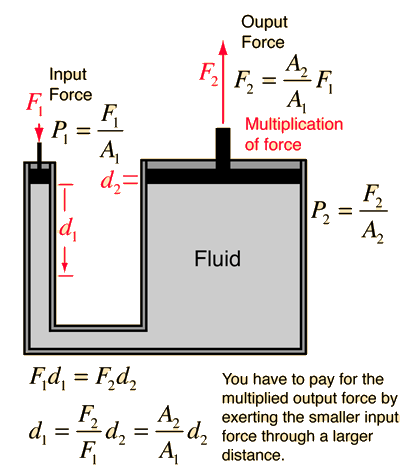
A hydraulic lift for automobiles is an example of a force multiplied by hydraulic press, based on Pascal's principle. The fluid in the small cylinder must be moved much further than the distance the car is lifted. 汽车液压举升机是液压压机的一个例子,基于帕斯卡原理,力被液压压机放大。小缸中的流体必须移动的距离远大于汽车被举升的距离。
![]() For example, if the lift cylinder were 25 cm in diameter and the small cylinder were 1.25 cm in diameter, then the ratio of the areas is 400, so the hydraulic press arrangement gives a multiplication of 400 times the force. To lift a 6000 newton car, you would have to exert only 6000 N/400 = 15 N on the fluid in the small cylinder to lift the car. However, to lift the car 10 cm, you would have to move the oil 400 x 10cm = 40 meters. This is practical by pumping oil into this small cylinder with a small compressor. 例如,如果提升缸的直径为25厘米,而小缸的直径为1.25厘米,那么两者的面积比为400,因此液压压机的布置可以将力放大400倍。要举起一辆6000牛顿的汽车,只需在小缸中的流体上施加6000牛顿除以400,即15牛顿的力即可。然而,要将汽车举起10厘米,就必须将油移动400乘以10厘米,即40米。这通过使用小压缩机将油泵入这个小缸中是可行的。
Calculation计算 |
Index Pascal's principle concepts 索引:帕斯卡原理概念 | ||
|
Go Back
返回 |