What is 20/20 Vision?
什么是20/20视力?
Visual acuity is typically measured with the use of a standard eye chart called the Snellen chart. It was devised by Dr. Hermann Snellen, a Dutch Ophthalmologist, in 1862. It was originally used at a standard distance of 6 meters, which in U.S. common units is about 20 feet.
视觉敏锐度通常通过一种称为Snellen图表的标准眼图来测量。该图表由荷兰眼科医生Dr. Hermann Snellen于1862年设计。它最初在6米的标准距离上使用,这在美式常用单位中约为20英尺。
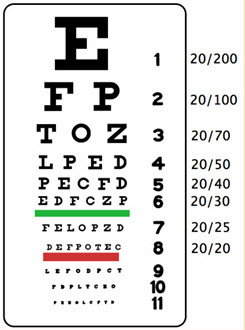
Snellen Chart from Wikipedia
Snellen 图表来自维基百科 | Where such units are used, normal vision came to be characterized by the fraction 20/20, which corresponded to being able to distinguish the letters on the fourth line up from the bottom at a distance of 20 feet. The E on the chart has a standard height of 88 mm and the other letters are scaled accordingly. The basic scheme is that the letters two rows down are half the size, and two rows up twice the size. The nominal designations of visual acuity as a number ratio could be based on which lines you could read. If you could just resolve the letters two rows up from the normal vision line at 20 feet, your acuity would be labeled 20/40 and if you could resolve two lines down it would be labeled 20/10.
在使用此类单位时,正常视力被表示为分数20/20,这表示在20英尺距离上能够辨认出图表底部第四行的字母。图表上的字母E的标准高度为88毫米,其他字母则相应地进行缩放。基本方案是,两行下方的字母大小为一半,两行上方的字母大小为两倍。视觉敏锐度的名义数字表示可以基于你能辨认的行数。如果你在20英尺距离上只能辨认出正常视力行的两行上方的字母,你的视力则被标记为20/40;如果你能辨认出两行下方的字母,则被标记为20/10。 |
Another way of saying it is that if you vision is 20/40, you can just resolve at 20 feet what a person with normal vision could resolve at 40 feet. A visual acuity of 20/200 with the best possible correction with lenses is a nominal condition for being considered legally blind.
另一种说法是,如果你的视力是20/40,那么你可以在20英尺处分辨出正常视力者在40英尺处能分辨的细节。使用眼镜的最佳矫正下,视力为20/200是被认定为法律上失明的名义条件。
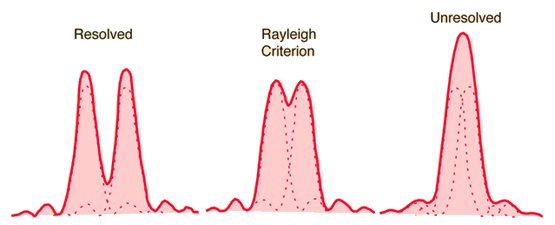
If the above describes the standard for normal vision, what are the factors which limit the resolution of human vision? To examine whether diffraction is the limiting factor, it is interesting to compare this standard of resolution with the limits imposed by diffraction. If the E on the chart (20/200) is 88mm high, then the 20/20 line would have letters of height 8.8 mm.
如果上述内容描述了正常视力的标准,那么哪些因素限制了人类视力的分辨率?为了检验衍射是否是限制因素,有趣的是将这一分辨率标准与衍射所施加的限制进行比较。如果图表上的E(20/200)高度为88mm,那么20/20线的字母高度应为8.8mm。

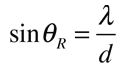
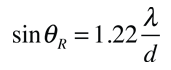
The Rayleigh criterion for diffraction-limited vision for an iris diameter of 5 mm and a wavelength of 500 nm is:
直径为5毫米的虹膜在波长为500纳米时的瑞利判据为:

So 20/20 is about 12x the Rayleigh criterion. Ackerman reports that the
data show:
所以20/20大约是瑞利标准的12倍。阿克曼报告说数据表明:

This is another example of the remarkable nature of human senses: the most acute vision is within about a factor of two of the physical limits imposed by diffraction!
这是人类感官 remarkable 性质的另一个例子:最敏锐的视觉大约在衍射所限制的物理极限的两个数量级之内!
According to a British standard quoted by Wikipedia, the minimum illumination for Snellen charts should be 480 lux. If the illumination is increased, the iris will constrict more and the diffraction at the smaller aperture would tend to diminish the acuity. However, the smaller aperture also reduces the effects of any aberrations in the lens, which would act to increase visual acuity. The conventional wisdom is that persons see better in bright light, suggesting that the gain in overcoming aberrations is greater than the loss from diffraction.
根据维基百科引用的英国标准,Snellen图表的最小照度应为480勒克斯。如果照度增加,虹膜会更明显收缩,较小的孔径处的衍射会倾向于降低视力的敏锐度。然而,较小的孔径也减少了透镜中的任何像差效应,这会起到增加视觉敏锐度的作用。传统观点认为人在明亮的光线下看得更好,这表明克服像差的收益大于衍射造成的损失。
|