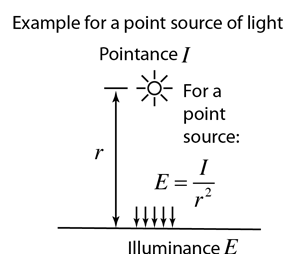
Luminous Power Per Unit Area of Surface
|
![]() Examples of common illuminance levels from Wikipedia at right. 来自维基百科的常见光照度水平示例。 | ![]() |

| Include surface angle
包含表面角度 |
| HyperPhysics***** Light and Vision
HyperPhysics ***** 光与视觉 | R Nave |
Lux勒克斯
The lux is defined as a lumen per square meter and is a unit of illuminance. An equivalent term is luminous flux density. As such, it measures the amount of visible light striking a surface. The standard symbol for it is Ev. It must take into account the sensitivity of the eye for the wavelengths of light involved, but that is taken care of in establishing the number of lumens. 勒克斯定义为每平方米的流明,是光照度的单位。等效术语是光通量密度。因此,它测量的是照射到表面上的可见光的量。其标准符号为E_v。它必须考虑眼睛对所涉及光波长的灵敏度,但这一点已在确定流明数时得到处理。
Most light meters measure this quantity, and it is the quantity most commonly used to state requirements for architectural lighting. 大多数光度计测量这个量,而这个量是最常用于表述建筑照明要求的量。
Suggested illuminance levels from nzdl 从nzdl建议的光照度水平 |
Index Photometry concepts Vision concepts Reference: Williamson & Cummins 索引 通光概念 视觉概念 参考:Williamson & Cummins | ||
|
Go Back
返回 |
Nit氮
The nit is the unit of luminance and is defined as a candela per square meter. The unit could be written as cd/m2 or lm/m2sr. It is most often used to characterize the "brightness" of flat emitting or reflecting surfaces. Palmer gives the following examples: laptop computer screens 100 to 250 nits, while those which are sunlight-readable must have more than 1000 nits. Typical CRT monitors are said to have luminances of 50-125 nits. nit 是光亮度的单位,定义为每平方米坎德拉(cd/m²)或每平方米流明每球面度(lm/m²·sr)。它最常用于描述平面发光或反射表面的‘亮度’。Palmer 给出了一些例子:笔记本电脑屏幕的亮度为 100 到 250 nits,而能够阅读阳光的屏幕必须具有超过 1000 nits 的亮度。典型的 CRT 显示器通常具有 50-125 nits 的光亮度。
The standard symbol for the luminance in nits is Lv. 光亮度的标准符号是L v,单位为尼特。
|
Index Photometry concepts Vision concepts Reference: Williamson & Cummins 索引 通光概念 视觉概念 参考:Williamson & Cummins | ||
|
Go Back
返回 |