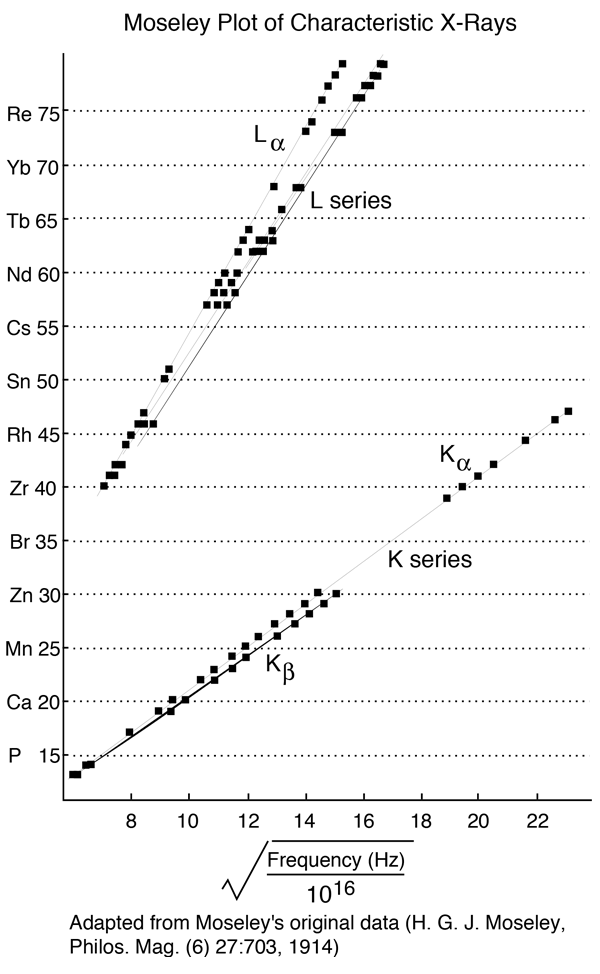
![]() When the square root of the frequencies of the characteristic x-rays from the elements is plotted against the atomic number, a straight line is obtained. In his early 20's, Moseley measured and plotted the x-ray frequencies for about 40 of the elements of the periodic table. He showed that the K-alpha x-rays followed a straight line when the atomic number Z versus the square root of frequency was plotted. With the insights gained from the Bohr model, we can write his empirical relationship as follows: 当元素的特征X射线的频率平方根与原子序数作图时,可以得到一条直线。20多岁时,莫塞莱测量并绘制了周期表中约40种元素的X射线频率。他证明了K-alpha X射线在原子序数Z与频率平方根作图时呈直线关系。借助对玻尔模型的洞察,我们可以将他的经验关系式写成如下形式:

![]()
|
Index
索引 | ||||
|
Go Back
返回 |
Moseley's Modeling of X-ray Frequencies莫塞利对X射线频率的建模
Moseley's empirical formula for K-alpha x-rays when adapted to the Bohr model becomes 当莫塞莱的经验公式适应到玻尔模型时,对于K-α特征X射线而言变为
![]() The implication of this relationship is that the single electron in the K-shell before the emission is almost 100% effective in shielding the nucleus so that the electron from the L-shell sees an effective nuclear charge of Z-1. We can use this relationship to calculate approximate quantum energies and wavelengths for K-alpha x-rays. 这种关系的含义是,在发射前,K壳层中的单个电子几乎完全有效地屏蔽了原子核,因此L壳层的电子感受到的有效核电荷为Z-1。我们可以利用这种关系来计算K-alpha特征X射线的量子能量和波长。
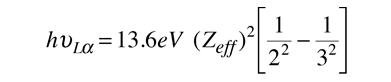
For example, this calculation for Z=42 gives a wavelength of 0.0722 nm for the molybdenum K-alpha x-ray whereas the measured value is 0.0707 nm. So the agreement is reasonable for K-alpha x-rays even though the upper level of the transition experiences some shielding which is unaccounted for in this model. For transitions ending in higher shells, the shielding situation becomes much more complex. From the Bohr model, we might write an equation for an L-alpha x-ray as 对于终止于更高壳层的跃迁,屏蔽情况变得更为复杂。根据玻尔模型,我们可以写出一个L-αX射线的方程为
![]() Moseley found that his data for the L-alpha x-rays fit the empirical relationship 莫塞莱发现他的L-α特征X射线数据符合经验关系式
![]() 例如,对于Z=42的计算,钼的K-α X射线波长为0.0722 nm,而测量值为0.0707 nm。因此,尽管过渡的上能级经历了一些屏蔽效应,这种效应在该模型中未被考虑,但K-α X射线的符合情况还是合理的。 so that the best fit to the data was with Z-7.4, indicating a shielding corresponding to 7.4 electrons on the average inside the M-shell from which the electron originated. 使得数据的最佳拟合为Z-7.4,表明存在7.4个电子的屏蔽,这些电子平均位于M壳层内,电子起源于该壳层。
|
Index
索引 | ||||
|
Go Back
返回 |
Moseley's Investigation of X-rays莫赛尔对X射线的调查
Henry G. J. Moseley (1887-1915) was described by Rutherford as his most talented student. When he was in his early 20's, he measured and plotted the x-ray frequencies for about 40 of the elements of the periodic table. He showed that the K-alpha x-rays followed a straight line when the atomic number Z versus the square root of frequency was plotted. His data (the Moseley plot) is still a standard feature of physics textbooks. 亨利·G·J·莫斯利(1887-1915)被卢瑟福描述为他的最优秀的学生。在他20多岁的时候,他测量并绘制了元素周期表中约40种元素的X射线频率。他证明了K-alpha X射线在原子序数Z与频率平方根绘制的图中呈直线关系。他的数据(莫斯利图)仍然是物理教材中的标准内容。
At the time when he was working, most physicists regarded the atomic weight A as the key to ordering the periodic table, rather than the atomic number Z. For example, nickel, with atomic weight 58.7 was placed ahead of cobalt, atomic weight 58.9, in the periodic table. Moseley's work showed that cobalt had an atomic number of 27 and nickel 28. Potassium (Z=19, A=39.10) and Argon (Z=18, A=39.95) were also reversed when listed by atomic weight order. Moseley predicted the existence of an element at Z=72 (Hafnium) which was subsequently discovered in Bohr's laboratory in Copenhagen. 在他工作的时候,大多数物理学家认为原子量A是排列元素周期表的关键,而不是原子序数Z。例如,原子量为58.7的镍被放在原子量为58.9的钴之前在周期表中。莫赛尔的工作表明钴的原子序数为27,镍为28。当按原子量排列时,钾(Z=19, A=39.10)和氩(Z=18, A=39.95)的顺序也被颠倒了。莫赛尔预测了原子序数为72的元素(铪)的存在,该元素后来在波尔的哥本哈根实验室中被发现。
Moseley volunteered for combat duty during World War I and was killed in action at age 27 during the attack on Gallipoli in the Dardenelles. 莫塞利在第一次世界大战期间自愿承担战斗任务,27岁的时候在达达尼尔海峡的加里波利进攻战中阵亡。
|
Index
索引 | ||
|
Go Back
返回 |