Bilingual edition: English is preserved and Chinese follows each unit. Terminology uses the confirmed v20260916 glossary; automated semantic review remains traceable.
中英双语版:英文原文完整保留,中文紧随对应单元;术语采用 v20260916 确认表,自动语义审校结果可追溯。

Particle in Finite-Walled Box

有限壁盒中的粒子

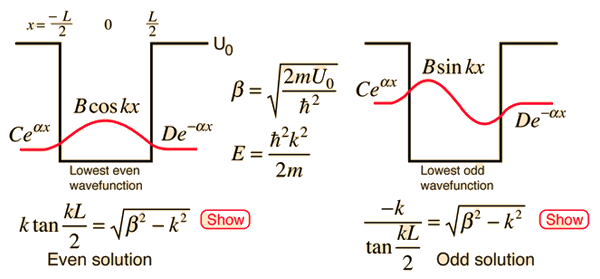
Given a potential well as shown and a particle of energy less than the height of the well, the solutions may be of either odd or even parity with respect to the center of the well. The Schrodinger equation gives trancendental forms for both, so that numerical solution methods must be used.

给定如图所示的势阱,若粒子的能量低于势阱的高度,则解可能关于势阱中心具有奇宇称或偶宇称。薛定谔方程给出两种情况的超越方程,因此必须采用数值解法。
Index

Schrodinger equation concepts
索引:薛定谔方程概念
 
HyperPhysics***** Quantum Physics
HyperPhysics ***** 量子物理
R Nave
Go Back
返回


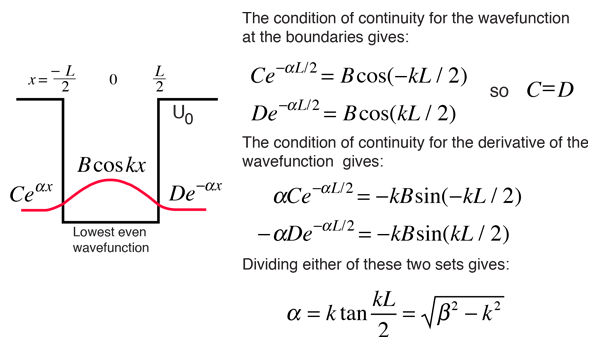
Even Solution, Finite Box

有限势阱的偶解

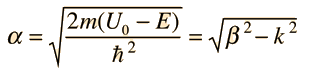
This last step makes use of the substitution that was used in the setup of the finite well problem:

这一步利用了在有限深势阱问题中所使用的替换:

The standard constraints on the wavefunction require that both the wavefunction and its derivative be continuous at any boundary. Applying such constraints is often the way that the solution is forced to fit the physical situation.

标准的波函数约束要求波函数及其导数在任何边界处都必须连续。应用这些约束通常是使解符合物理情况的方式。

Numerical solution for ground state

地面态的数值解
Index

Schrodinger equation concepts
索引:薛定谔方程概念
 
HyperPhysics***** Quantum Physics
HyperPhysics ***** 量子物理
R Nave
Go Back
返回


Numerical Solution for Ground State

基态的数值解

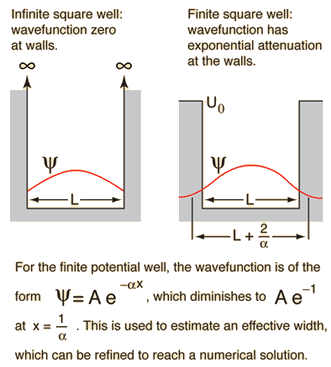
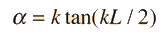
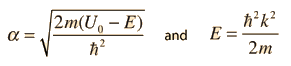
The ground state solution for a finite potential well is the lowest even parity state and can be expressed in the form

有限势阱的基态解是最低的偶宇称态,可以表示为
where
.
Since both sides of the equation are dependent on the energy E for which you are solving, the equation is trancendental and must be solved numerically.

One way to estimate the ground state energy of a finite potential well is to use the infinite well energy to produce a trial attenuation factor α. Then the value of α can be refined by iteration to get an effective well width and a numerical solution for the energy.

估算有限势阱的基态能量的一种方法是使用无限势阱的能量产生一个试算衰减因子α。然后通过迭代确定α的值,以获得有效的势阱宽度和能量的数值解。
其中,由于方程两边都依赖于你所求解的能量 E,因此该方程是超越方程,必须数值求解。
For well width L = x 10^ m = nm= fermi,

and mass = x 10^ kg = me = mp = MeV/c2,

the infinite well ground state (n=1) energy is E = x 10^ joule = eV= MeV, = GeV.

For potential U0 = x 10^ joule = eV= MeV,
a first estimate of the attenuation coefficient = x10^m-1 .
This gives a refined effective well width of L = x 10^ m = nm= fermi,
and a refined ground state energy estimate:
E = x 10^ joule = eV= MeV, = GeV.

This calculation process works best when the potential is very large compared to the calculated energy. To evaluate the convergence, the process can be repeated.

Iteration
迭代
Effective well width (m)
有效势阱宽度(米)
Estimate of energy (eV)
能量估计 (eV)
1
x10^x10^
2
x10^x10^
3
x10^x10^
4
x10^x10^
对于宽度为 L = x 10^ m = nm= fermi,质量 = x 10^ kg = m e = m p = MeV/c² 的无限深势阱,其基态(n=1)能量为 E = x 10^ 焦耳 = eV= MeV,= GeV。对于势能 U₀ = x 10^ 焦耳 = eV= MeV,衰减系数的初步估计为 x10^ m⁻¹。这给出了修正后的有效势阱宽度为 L = x 10^ m = nm= fermi,以及修正后的基态能量估计:E = x 10^ 焦耳 = eV= MeV,= GeV。该计算过程效果最佳当势能远大于计算出的能量时。为了评估收敛性,可以重复该过程。
中文译文中的待填/计算数值依次对应:1:lb 2:lp 3:nm 4:fm 5:mb 6:mp 7:em 8:pm 9:mmev 10:eib 11:eip 12:ev 13:mev 14:gev 15:ub 16:up 17:uev 18:umev 19:alpb 20:alpp 21:lb2 22:lp2 23:nm2 24:fm2 25:eb 26:ep 27:ev2 28:mev2 29:gev2 30:l1b 31:l1p 32:e1b 33:e1p 34:l2b 35:l2p 36:e2b 37:e2p 38:l3b 39:l3p 40:e3b 41:e3p 42:l4b 43:l4p 44:e4b 45:e4p。实际数值以上方原输入框为准。
Index

Schrodinger equation concepts
索引:薛定谔方程概念
 
HyperPhysics***** Quantum Physics
HyperPhysics ***** 量子物理
R Nave
Go Back
返回


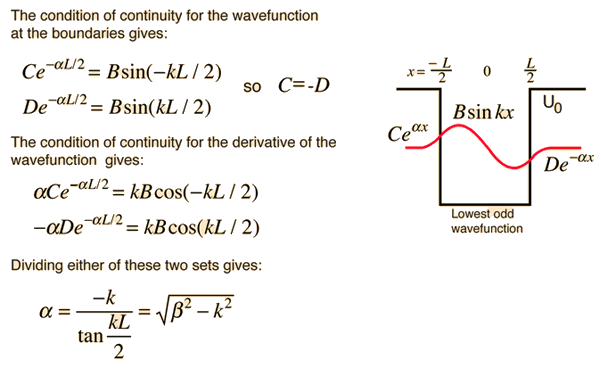
Odd Solution, Finite Box

奇解,有限势箱

This last step makes use of the substitution that was used in the setup of the finite well problem:

这一步利用了在有限深势阱问题中所使用的替换:

The standard constraints on the wavefunction require that both the wavefunction and its derivative be continuous at any boundary. Applying such constraints is often the way that the solution is forced to fit the physical situation.

标准的波函数约束要求波函数及其导数在任何边界处都必须连续。应用这些约束通常是使解符合物理情况的方式。
Index

Schrodinger equation concepts
索引:薛定谔方程概念
 
HyperPhysics***** Quantum Physics
HyperPhysics ***** 量子物理
R Nave
Go Back
返回


Parity and the Particle in a Box

宇称与箱中粒子

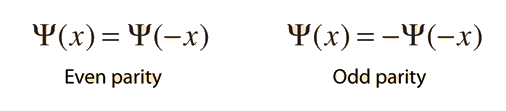
In the one-dimensional case, parity refers to the "evenness" or "oddness" of a function with respect to reflection about x=0.

在一维情况下,宇称指的是函数关于x=0反射的‘偶性’或‘奇性’。

The particle in a box problem can give some insight into the importance of parity in quantum mechanics. The box has a line of symmetry down the center of the box (x=0). Basic considerations of symmetry demand that the probability for finding the particle at -x be the same as that at x. The condition on the probability is given by:

粒子在盒中的问题可以提供一些关于量子力学中宇称重要性的见解。盒子在中心有一条对称轴(x=0)。对称性的基本考虑要求在-x处找到粒子的概率与在x处找到粒子的概率相同。概率的条件由以下条件给出:

This condition is satisfied if the parity is even or odd, but not if the wavefuntion is a linear combination of even and odd functions. This can be generalized to the statement that wavefunctions must have a definite parity with respect to symmetry operations in the physical problem.

这一条件若波函数是偶函数或奇函数的线性组合时则不满足,但若宇称为偶或奇时则满足。这可以推广为:波函数必须相对于物理问题中的对称操作具有确定的宇称。
Index

Schrodinger equation concepts
索引:薛定谔方程概念
 
HyperPhysics***** Quantum Physics
HyperPhysics ***** 量子物理
R Nave
Go Back
返回