Bilingual edition: English is preserved and Chinese follows each unit. Terminology uses the confirmed v20260916 glossary; automated semantic review remains traceable.
中英双语版:英文原文完整保留,中文紧随对应单元;术语采用 v20260916 确认表,自动语义审校结果可追溯。

Particle in a Box

盒中粒子
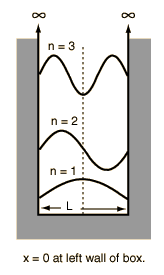
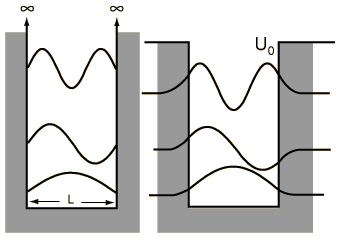
Assume the potential U(x) in the time-independent Schrodinger equation to be zero inside a one-dimensional box of length L and infinite outside the box. For a particle inside the box a free particle wavefunction is appropriate, but since the probability of finding the particle outside the box is zero, the wavefunction must go to zero at the walls. This constrains the form of the solution to

假设在时间无关的薛定谔方程中,势能U(x)在长度为L的一维盒内为零,而在盒外为无限大。对于处于盒内的粒子,使用自由粒子的波函数是合适的,但由于粒子在盒外出现的概率为零,因此波函数必须在盒的边界处趋于零。这限制了解的形式为

which requires
这需要
... (Compare to string modes)
(与弦模式相比)
and after normalization, the wavefunction is
归一化后,波函数是
Discussion of significance
意义的讨论
Quantized energies
量化能量
Containment energies
Containment energies(专名或术语)
Finite-walled box
有限壁的盒子
3-D particle in box
三维箱中粒子
Index

Schrodinger equation concepts
索引:薛定谔方程概念
 
HyperPhysics***** Quantum Physics
HyperPhysics ***** 量子物理
R Nave
Go Back
返回


Normalization, Particle in Box

归一化,箱中粒子

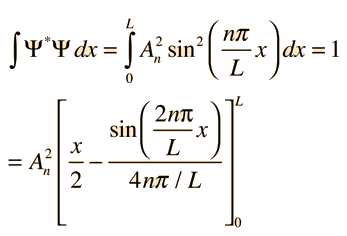
For the particle in a box with infinite walls, the probability must be equal to one for finding it within the box. The condition for normalization is then

对于无限墙内的粒子,其在盒内找到它的概率必须等于一。归一化条件则为
The sin terms drop out, leaving
正弦项消失,留下
... (Show form of integration)
(积分形式)
so the normalized wavefunctions are:
因此,归一化的波函数为:
Index

Schrodinger equation concepts
索引:薛定谔方程概念
 
HyperPhysics***** Quantum Physics
HyperPhysics ***** 量子物理
R Nave
Go Back
返回


Particle in Finite-Walled Box

有限壁盒中的粒子

For the finite potential well, the solution to the Schrodinger equation gives a wavefunction with an exponentially decaying penetration into the classicallly forbidden region.

对于有限深势阱,薛定谔方程的解给出一个波函数,其在经典禁域内呈指数衰减。

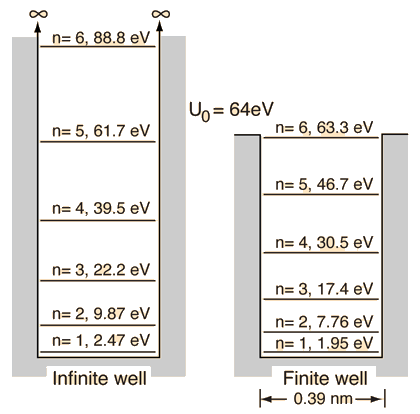
Confining a particle to a smaller space requires a larger confinement energy. Since the wavefunction penetration effectively "enlarges the box", the finite well energy levels are lower than those for the infinite well.

将粒子限制在更小的空间中需要更大的束缚能量。由于波函数的穿透效应实际上‘扩大了盒子’,有限深势井的能量级低于无限深势井的能量级。

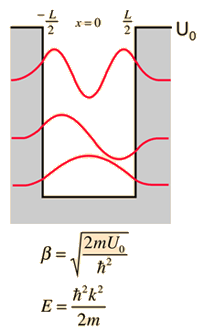
Setup of problem

问题设置

Energy level example

能量电平示例
Index

Schrodinger equation concepts
索引:薛定谔方程概念
 
HyperPhysics***** Quantum Physics
HyperPhysics ***** 量子物理
R Nave
Go Back
返回


Particle in Finite-Walled Box

有限壁盒中的粒子

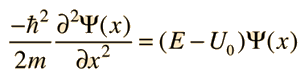
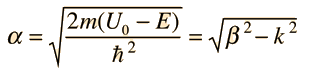
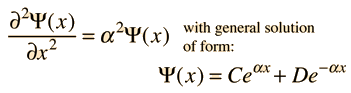
For a potential which is zero over a length L and has a finite value for other values of x, the solution to the Schrodinger equation has the form of the free-particle wavefunction for -L/2 < x < L/2 and elsewhere must satisfy the equation

With the substitution
this may be written in the form:

对于一个在长度L内为零,而在其他x值处有有限值的势,薛定谔方程的解形式为自由粒子的波函数,在 -L/2 < x < L/2 区间内,其余区域必须满足方程。通过代换,此式可写成:

Comparison with infinite well

与无限深势井的比较

Solution from fitting boundary conditions

从边界条件拟合中得到的解
Index

Schrodinger equation concepts
索引:薛定谔方程概念
 
HyperPhysics***** Quantum Physics
HyperPhysics ***** 量子物理
R Nave
Go Back
返回


Finite Well Energy Levels

有限深势阱的能级

The energy levels for an electron in a potential well of depth 64 eV and width 0.39 nm are shown in comparison with the energy levels of an infinite well of the same size.

一个势阱深度为64 eV、宽度为0.39纳米的电子的能量级与相同尺寸的无限深势阱的能量级进行比较。

Solution from fitting boundary conditions

从边界条件拟合中得到的解
Index

Schrodinger equation concepts

References: Rohlf Sec 7-3
Blatt, Sec. 7-6.
索引薛定谔方程概念 参考文献:Rohlf 第7-3节,Blatt,第7-6节。
 
HyperPhysics***** Quantum Physics
HyperPhysics ***** 量子物理
R Nave
Go Back
返回