Varieties of Wave Equations波动方程的种类
Early in the 20th century, electrons were shown to have wave properties, and the wave-particle duality became a part of our understanding of nature. The mathematics for describing the behavior of such electron waves might be expected to be similar to that for describing classical waves, such as the wave on a stretched string 20世纪初,电子被证明具有波动性质,波粒二象性成为我们理解自然的一部分。描述这类电子波行为的数学可能预期与描述经典波动(如绷紧弦上的波动)的数学相似。
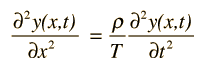
![]() or a plane electromagnetic wave 或一个平面电磁波
![]() The wave equation developed by Erwin Schrodinger in 1926 shows some similarities in its one-dimensional form: 1926年埃尔文·施罗德inger发展出的波动方程在一维形式上表现出一些相似之处:
![]() |
Index Schrodinger equation concepts 索引:薛定谔方程概念 | ||
|
Go Back
返回 |
The Postulates of Quantum Mechanics量子力学的公理
|
Index Schrodinger equation concepts 索引:薛定谔方程概念 | ||
|
Go Back
返回 |
The Wavefunction Postulate波函数公理
It is one of the postulates of quantum mechanics that for a physical system consisting of a particle there is an associated wavefunction. This wavefunction determines everything that can be known about the system. The wavefunction is assumed here to be a single-valued function of position and time, since that is sufficient to guarantee an unambiguous value of probability of finding the particle at a particular position and time. The wavefunction may be a complex function, since it is its product with its complex conjugate which specifies the real physical probability of finding the particle in a particular state. 量子力学的一个公理是,对于由一个粒子组成的物理系统,存在一个与之对应的波函数。这个波函数决定了关于该系统的所有可知信息。这里假设波函数是位置和时间的单值函数,因为这足以保证在特定的位置和时间找到粒子的概率具有明确的值。波函数可能是一个复数函数,因为它是其与复共轭的乘积,这指定了粒子处于特定状态时的实物理概率。
![]() Constraints on the wavefunction对波函数的限制 |
Index Schrodinger equation concepts Postulates of quantum mechanics 索引:薛定谔方程概念、量子力学公理 | ||
|
Go Back
返回 |
Constraints on Wavefunction对波函数的限制
In order to represent a physically observable system, the wavefunction must satisfy certain constraints: 为了表示一个物理可观测的系统,波函数必须满足某些条件:
|
Index Schrodinger equation concepts 索引:薛定谔方程概念 | |||||
|
Go Back
返回 |
Probability in Quantum Mechanics量子力学中的概率
The wavefunction represents the probability amplitude for finding a particle at a given point in space at a given time. The actual probability of finding the particle is given by the product of the wavefunction with its complex conjugate (like the square of the amplitude for a complex function). 波函数表示在给定时间和空间中的某个点找到粒子的概率振幅。粒子实际出现的概率由波函数与其复共轭的乘积给出(类似于复函数的振幅平方。)
![]() Since the probability must be = 1 for finding the particle somewhere, the wavefunction must be normalized. That is, the sum of the probabilities for all of space must be equal to one. This is expressed by the integral 由于在任何地方找到粒子的概率必须等于1,波函数必须被归一化。也就是说,所有空间中概率的总和必须等于1。这通过积分来表达。
Part of a working solution to the Schrodinger equation is the normalization of the solution to obtain the physically applicable probability amplitudes. 求解薛定谔方程的一部分是将解标准化,以获得物理上适用的概率振幅。 |
Index Schrodinger equation concepts 索引:薛定谔方程概念 | ||
|
Go Back
返回 |
Normalization Examples归一化示例
In order to use the wavefunction calculated from the Schrodinger equation to determine the value of any physical observable, it must be normalized so that the probability integrated over all space is equal to one. 为了使用由薛定谔方程计算出的波函数来确定任何物理可观测量的值,该波函数必须被归一化,使得其在所有空间内积分的概率等于一。
![]() ![]() |
Index Schrodinger equation concepts 索引:薛定谔方程概念 | ||
|
Go Back
返回 |
