Bilingual edition: English is preserved and Chinese follows each unit. Terminology uses the confirmed v20260916 glossary; automated semantic review remains traceable.
中英双语版:英文原文完整保留,中文紧随对应单元;术语采用 v20260916 确认表,自动语义审校结果可追溯。

Electromagnetic Waves in a Cubical Cavity

立方腔中的电磁波

Electromagnetic standing waves in a cavity at equilibrium with its surroundings cannot take just any path. They must satisfy the wave equation in three dimensions:

在与环境平衡的腔体内,电磁驻波不能取任何路径。它们必须满足三维波动方程:
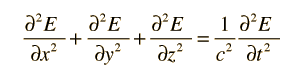
The solution to the wave equation must give zero amplitude at the walls, since a non-zero value would dissipate energy and violate our supposition of equilibrium. To form a standing wave, the reflection path around the cavity must produce a closed path. The boundary conditions can be met with a solution of the form:

波方程的解必须在壁处给出零振幅,因为非零值会导致能量耗散并违反我们对平衡状态的假设。要形成驻波,围绕腔体的反射路径必须形成一个闭合路径。边界条件可以通过以下形式的解来满足:

Substituting this solution into the wave equation above gives

将此解代入上述波动方程中得到
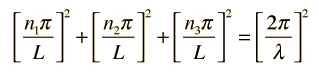
which simplifies to

这简化为
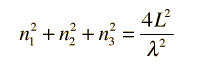
How many modes of this wavelength?

这种波长有多少种模式?

Development of the Rayleigh-Jeans Law

瑞利-琼斯定律的建立
Index

Rayleigh- Jeans references

Blackbody radiation concepts
索引:瑞利-金斯参考文献 黑体辐射概念
 
HyperPhysics***** Quantum Physics
HyperPhysics ***** 量子物理
R Nave
Go Back
返回


How many modes in the cavity?

腔内有多少种模式?
From the standing wave solution to the wave equation we get the condition
.

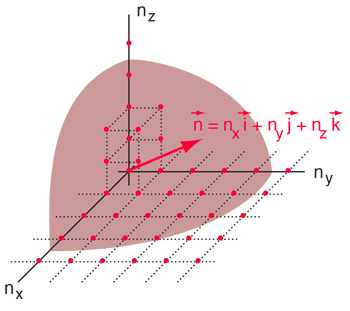
The Rayleigh scheme for counting modes.
After Richtmyer, et al.

瑞利模式计数方案。参考Richtmyer等人
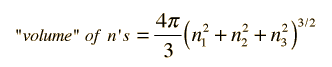
We need to evaluate the number of modes which can meet this condition, which amounts to counting all the possible combinations of the integer n values. An approximation can be made by treating the number of combinations as the volume of a three-dimensional grid of the values of n, an "n-space". Using the relationship for the volume of a sphere, with the n values specifying the coordinates along three "n" axes, gives

我们需要评估满足这一条件的模式数量,这相当于计算所有可能的整数n值的组合。可以通过将组合数近似为n值的三维网格的体积,即“n空间”来处理。利用球体体积的关系,其中n值指定三个“n”轴上的坐标,可以得到
.

This has a couple of problems, however. In using a sphere, we have used both positive and negative values of n, whereas the wave equation solution uses only positive definite values. Therefore we must take 1/8 th of the volume above. Another technical problem is that you can have waves polarized in two perpendicular planes, so we must multiply by two to account for that. Then the volume can be taken to be a measure of the number of modes, becoming a very good approximation when the size of the cavity is much greater than the wavelength as in the case of electromagnetic waves in finite cavity. Using the relation obtained for the values of n, this becomes

然而,这存在几个问题。在使用球体时,我们同时使用了正负两种n值,而波动方程的解只使用了正定值。因此,我们必须取上方八分之一的体积。另一个技术问题是,波可以被极化在两个垂直的平面内,所以必须乘以二以考虑这一点。然后,体积可以被视为模式数的度量,当腔体尺寸远大于波长时,如电磁波在有限腔体中的情况,这成为一个非常好的近似。利用所获得的n值关系,这便成为

How many modes per unit wavelength?

每单位波长有多少模式?

Development of the Rayleigh-Jeans Law

瑞利-琼斯定律的建立
从波方程的驻波解中我们得到条件。
Index

Rayleigh- Jeans references

Richtmyer, et al.
Ch. 5

Blackbody radiation concepts
索引 雷利-金斯参考 Richtmyer 等,第5章 黑体辐射概念
 
HyperPhysics***** Quantum Physics
HyperPhysics ***** 量子物理
R Nave
Go Back
返回


How many modes per unit wavelength?

每单位波长有多少模式?

Having developed an expression for the number of standing wave modes in a cavity, we would like to know the distribution with wavelength. This may be obtained by taking the derivative of the number of modes with respect to wavelength.

在推导出腔体中驻波模式数的表达式后,我们希望知道其随波长的分布情况。这可以通过对模式数对波长的导数来获得。

The negative sign here reveals that the number of modes decreases with increasing wavelength. Now to get the number of modes per unit volume per unit wavelength, we can simply divide by the volume of the cubical cavity.

这里的负号表明,波长越长,模式数越少。现在要得到单位体积单位波长内的模式数,只需将上述结果除以立方腔的体积。

Note that this does not involve approximating a sphere with a cube! The sphere we used in calculating the number of modes was a sphere in "n-space", allowing us to count the number of possible modes. Also, the use of a cubical cavity for the calculation just allows us to reduce the geometrical complexity of the development, but the final result obtained is independent of cavity geometry.

请注意,这并不涉及将球体近似为立方体!我们在计算模式数时所用的球体是在‘n空间’中的球体,这允许我们计算可能的模式数。此外,使用立方腔进行计算只是为了简化几何复杂性,但最终得到的结果与腔体几何无关。

How much energy per unit volume?

单位体积的能量是多少?

Development of the Rayleigh-Jeans Law

瑞利-琼斯定律的建立
Index

Rayleigh- Jeans references

Blackbody radiation concepts
索引:瑞利-金斯参考文献 黑体辐射概念
 
HyperPhysics***** Quantum Physics
HyperPhysics ***** 量子物理
R Nave
Go Back
返回


How much energy per unit volume?

单位体积的能量是多少?

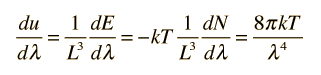
Assigning energy to the electromagnetic standing waves in a cavity draws on the principle of equipartition of energy. Each standing wave mode will have average energy kT where k is Boltzmann's constant and T the temperature in Kelvins. Letting u represent the energy density:

将电磁驻波分配到腔体中,依据能量等分原理。每个驻波模式将具有平均能量kT,其中k是玻尔兹曼常数,T是开尔文温度。令u表示能量密度:

This is an important relationship in classical electromagnetic cavity theory. It can also be expressed in terms of the frequency ν by making use of the chain rule and the wave relationship:

这是经典电磁腔理论中的一个重要关系。它也可以通过链式法则和波关系用频率ν来表达:

The minus sign here just reminds us that a decrease with wavelength implies an increase with increasing frequency. The magnitude of the energy density dependence on frequency is given by:

这里的负号只是提醒我们,波长的减小意味着频率的增加。能量密度对频率的依赖程度由下式给出:

Note that this is the classical result which was used in the Rayleigh-Jeans Law, but led to the ultraviolet catastrophe. It produces good agreement in the low frequency limit, but for higher frequencies the Planck radiation formula must be used.

请注意,这是经典的结果,曾用于瑞利-金斯定律,但导致了紫外灾难。它在低频极限下有良好的一致性,但对更高频率,必须使用普朗克辐射公式。

How much radiated energy per unit wavelength?

单位波长的辐射能量是多少?

Development of the Rayleigh-Jeans Law

瑞利-琼斯定律的建立
Index

Rayleigh- Jeans references

Blackbody radiation concepts
索引:瑞利-金斯参考文献 黑体辐射概念
 
HyperPhysics***** Quantum Physics
HyperPhysics ***** 量子物理
R Nave
Go Back
返回


Radiated Energy as a Function of Wavelength

波长的辐射能

If we consider energy radiated perpendicular to a small increment of area, then it must be noted that half of the energy density in the waves is going toward the walls and half is coming out if the system is in thermal equilibrium. Evaluating the power seen at a given observation point requires a consideration of the geometry:

如果我们考虑垂直于小面积增量的辐射能量,则必须注意,在热平衡状态下,波中的能量密度有一半传向墙壁,另一半则向外传出。评估给定观测点处的功率需要考虑几何因素:
For perpendicular radiated energy

but at an angle θ, the effective area will be Acosθ and the effective speed will be c cosθ, so the radiated energy will be reduced to

但当角度为θ时,有效面积将为Acosθ,有效速度将为c cosθ,因此辐射的能将减少到

For a given observation point near a radiating surface, the power will be the average power from all directions, and the average gives another factor of 1/2.

对于一个靠近辐射表面的观察点,功率将是来自所有方向的平均功率,而平均值又引入了一个1/2的因素。

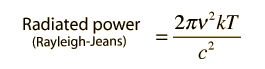
Having averaged over all angles, the calculated radiated power per unit wavelength is finally

对所有角度求平均后,最终计算出的单位波长的辐射功率为

More detailed development of the c/4 factor
更详细的c/4因子发展

This is the Rayleigh-Jeans formula. The fact that it failed to predict the spectral distribution from hot objects was one of the major unresolved issues in physics at the beginning of the 20th century.
To express this in terms of frequency, an application of the chain rule as was done above with the energy density yields a radiated power per unit frequency:

这是瑞利-金斯公式。它无法预测热物体的频谱分布这一事实,是20世纪初物理学中未解决的主要问题之一。用频率来表达的话,像上面那样应用链式法则,将能量密度转换为辐射功率,可以得到单位频率的辐射功率:

Development of the Rayleigh-Jeans Law

瑞利-琼斯定律的建立
垂直辐射的能
Index

Rayleigh- Jeans references

Blackbody radiation concepts
索引:瑞利-金斯参考文献 黑体辐射概念
 
HyperPhysics***** Quantum Physics
HyperPhysics ***** 量子物理
R Nave
Go Back
返回