The Bug-Rivet Paradox
The bug-rivet paradox is a variation on the twin paradox and is similar to the pole-barn paradox in that the ideas of simultaneity in relativity must be addressed. The fact that two events are simultaneous in one frame of reference does not imply that they are simultaneous as seen by an observer moving at a relativistic speed with respect to that frame.
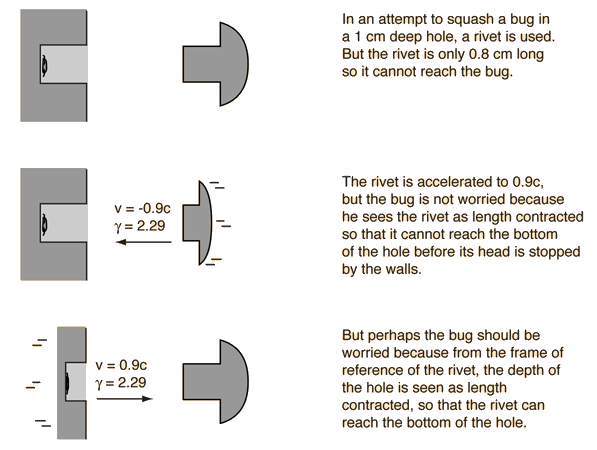
To calculate the times for the two frames of reference, consider the rivet entering the hole and set t=t'=0 at that instant and x=x'=0 to establish the coordinate system. In the events described below, x' and t' refer to the rivet frame while x and t refer to the bug frame. The relativity factor γ = 2.29 and the Lorentz transformation is used to transform quantities from one frame to the other.
Rivet frame of reference
The rivet is considered to the be the reference frame, and x' and t' are used for positions and times.
|
The end of the rivet hits the bottom of the hole before the head of the rivet hits the wall. So it looks like the bug is squashed. 铆钉末端在铆钉头碰到墙之前已经进入了孔底。因此看起来虫子被压扁了。
|
Transforming the times to the bug's frame of reference:
|
The bug disagrees with this analysis and finds the time for the rivet head to hit the wall is earlier than the time for the rivet end to reach the bottom of the hole. The paradox is not resolved. 这只虫子不同意这一分析,认为rivet头击中墙的时间早于rivet尾端到达孔底的时间。这个悖论并未得到解决。
|
Bug frame of reference
铆钉前端进入孔内:t = 0 |
All this is nonsense from the bug's point of view. The rivet head hits the wall when the rivet end is just 0.35 cm down in the hole! The rivet doesn't get close to the bug. 从虫子的角度看,这一切都是胡说八道。当铆钉头击中墙壁时,铆钉末端才刚进入孔中0.35厘米!铆钉根本无法接近虫子。
|
Transforming the times measured in the bug's frame of reference to the rivet frame:
|
Transforming times from the bug frame to the rivet frame gives a time for the end to reach -0.35 cm before the rivet head hits, and even suggests that it reaches the bottom of the hole before the rivet head hits. The paradox is not resolved. 将虫洞参考系中的时间转换为铆钉参考系,得到一个结果:钉头撞击前,钉尾到达孔底的时间为-0.35 cm,甚至暗示钉尾在钉头撞击前已到达孔底。这个悖论仍未得到解决。
|
| The Pole-Barn Paradox
杆仓悖论 |
| HyperPhysics***** Relativity
HyperPhysics ***** 相对论 | R Nave |