Four-vectors in Relativity
In the literature of relativity, space-time coordinates and the energy/momentum of a particle are often expressed in four-vector form. They are defined so that the length of a four-vector is invariant under a coordinate transformation. This invariance is associated with physical ideas. The invariance of the space-time four-vector is associated with the fact that the speed of light is a constant. The invariance of the energy-momentum four-vector is associated with the fact that the rest mass of a particle is invariant under coordinate transformations.
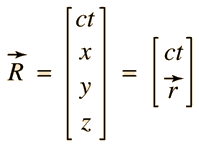
The space-time 4-vector is defined by 时空四矢量定义为
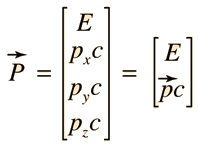
 | The energy-momentum 4-vector is defined by 能动量4矢量定义为
 |
|
The scalar product of two space-time 4-vectors is defined by 两个时空四矢量的标量积定义为
 and the scalar product of two energy-momentum 4-vectors by 并用两个能量-动量4矢量的标量积来
 Note that this differs from the ordinary scalar product of vectors because of the minus sign. That minus sign is necessary for the property of invariance of the length of the 4-vectors. 请注意,这与向量的普通标量积不同,因为有负号。这个负号对于保持4向量长度的不变性是必要的。
| |
The length of the space-time 4-vector squared is given by 四维矢量的时空长度平方由
 The length of a 4-vector is invariant, being the same in every inertial frame. This invariance is associated with the constancy of the speed of light. This expression can be seen to be the equation of a sphere, with light propagating outward from the origin at speed c in all directions so that the radius of the sphere at time t is ct. 4-矢量的长度是不变的,它在每一个惯性系中都相同。这种不变性与光速恒定有关。这个表达式可以看作是球面方程,光从原点向所有方向以速度c传播,因此在时间t时,球面的半径为ct。
| The length of the energy-momentum 4-vector is given by 能动量4矢量的长度由
 The length of this 4-vector is the rest energy of the particle. The invariance is associated with the fact that the rest mass is the same in any inertial frame of reference. 这个4矢量的长度是粒子的静止能量。不变性与这样一个事实有关,即静质量在任何惯性参考系中都是相同的。
|
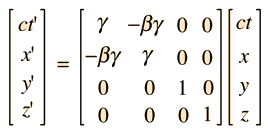
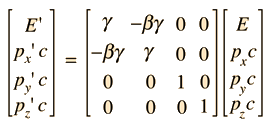
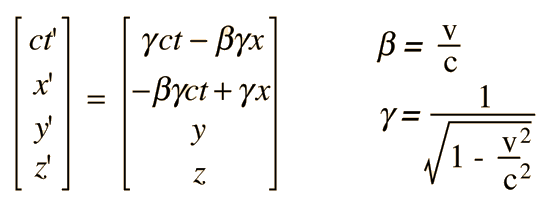
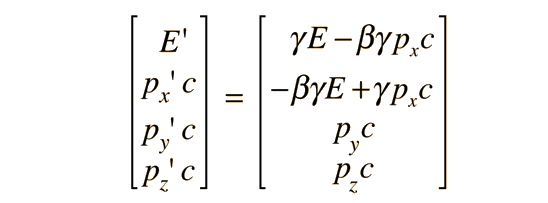
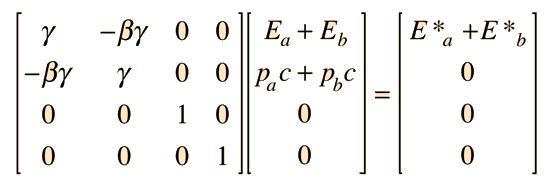
| Lorentz transformation in 4-vector form
洛伦兹变换(4矢量形式) |
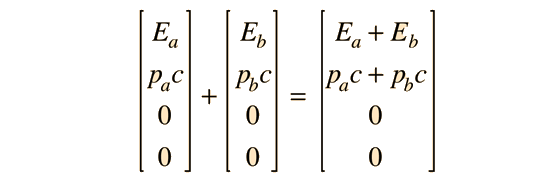
| Four-vector sum for momentum-energy
动量-能量四矢量和 |
Reference
Rohlf
Sec 4-4
| HyperPhysics***** Relativity
HyperPhysics ***** 相对论 | R Nave |