Bilingual edition: English is preserved and Chinese follows each unit. Terminology uses the confirmed v20260916 glossary; automated semantic review remains traceable.
中英双语版:英文原文完整保留,中文紧随对应单元;术语采用 v20260916 确认表,自动语义审校结果可追溯。

Vertical Rocket

垂直火箭
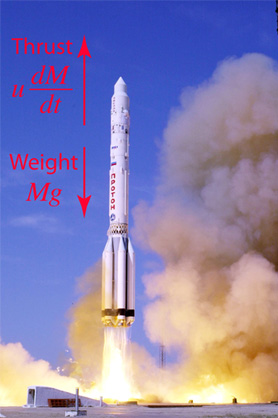
Develop expressions

推导表达式

Under the influence of the rocket thrust and gravity, the rocket velocity can be calculated as follows:

For exhaust velocity u = m/s
and burn rate dM/dt = kg/s
the rocket thrust is x10^ N.
For rocket mass = kg
and fuel mass = kg, the time of burn
is seconds and the velocity at burnout is calculated from

which gives vburnout = m/s.
在火箭推力和重力的影响下,火箭的速度可以这样计算:对于喷气速度 u = m/s 和燃烧率 dM/dt = kg/s,火箭推力为 x10^ N。对于火箭质量 = kg 和燃料质量 = kg,燃烧时间是秒,燃烧结束时的速度由上述计算得出,得到燃烧结束时的速度 v burnout = m/s。
中文译文中的待填/计算数值依次对应:1:u 2:br 3:fb 4:fp 5:mr 6:mf 7:tb 8:vb。实际数值以上方原输入框为准。
Fowles and Cassiday give as example data for a satellite launch a low orbit velocity of about 8 km/s, an initial velocity of about 0.5 km/s from the rotation of the earth near the equator, and an exhaust velocity of 2.5 km/s. You could use this data above to confirm that you could get only about 5 percent of the total initial mass into orbit. They suggest that effective ejection speeds for most rocket fuels are on the order of 2 to 4 km/s.
Fowles 和 Cassiday 给出一个卫星发射的例子数据:近地轨道的速度约为 8 km/s,地球赤道附近由于地球自转带来的初始速度约为 0.5 km/s,推进剂的喷射速度约为 2.5 km/s。你可以利用上述数据确认,仅能将总初始质量的约 5% 带入轨道。他们指出,大多数火箭燃料的有效喷射速度通常在 2 到 4 km/s 的范围内。
Index

Rocket propulsion
索引 火箭推进
 
HyperPhysics***** Mechanics ***** Newton's laws
HyperPhysics ***** 力学 ***** 牛顿运动定律
R Nave
Go Back
返回