Rocket in Space
空间中的火箭
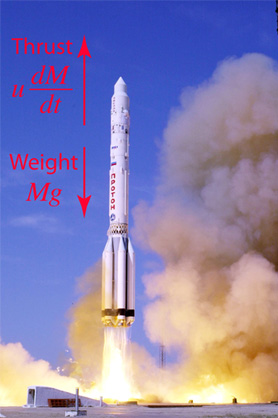
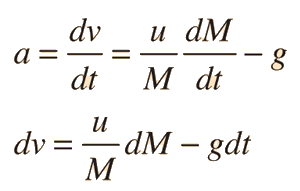
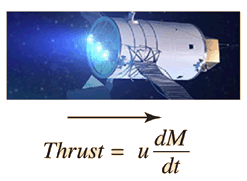
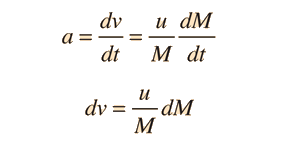
Under the influence of the rocket thrust in a gravity-free environment , the acceleration is
计算 |
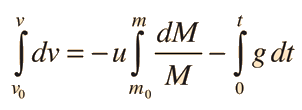
Integrating from the initiation of thrust to an arbitrary time t
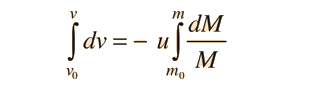
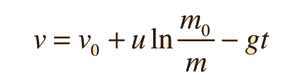
从推力开始到任意时间t的积分 gives the velocity at time t:
给出时间t时的速度: 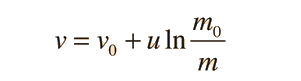 |
The above is the standard "rocket in space" scenario where you typically calculate the velocity after a given time of thrusting in terms of the amount of fuel burned and exhausted. If you want a specific expression for velocity in terms of time, that can be developed in terms of the exhaust rate as a function of time. If the burn rate is constant at Δm/Δt then the velocity as an explicit function of time would be
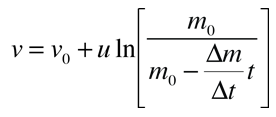
上述情况是标准的‘火箭在空间中’场景,通常会根据燃烧的燃料量和排出的燃料来计算推力作用一段时间后的速度。如果你想用时间来表达速度的特定表达式,可以基于时间函数的排气速率来推导。如果燃烧速率恒定为Δm/Δt,则速度作为时间的显式函数为 For a variable burn rate, the denominator would become an integral.
对于可变燃烧速率,分母将变为一个积分。
在无重力环境中,火箭推力引起的加速度是 |
Index
Rocket propulsion
索引 火箭推进 |