Cosmic Cliffs from the James Webb Telescope
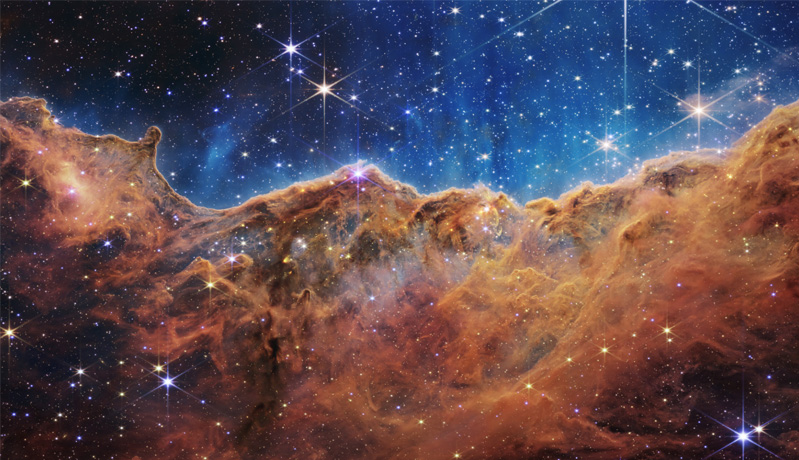
Image of a region called Cosmic Cliffs, the edge of a cavernous area of the star-forming region NGC 3324 in the Carina Nebula. The Carina Nebula is located in the Milky Way Galaxy, but this image revealed hundreds of stars not previously observed because of the massive amounts of dust which obscured them. The infrared imagery of the Webb telescope could detect them. Captured in infrared light by the Near-Infrared Camera (NIRCam) on NASA's James Webb Space Telescope, this image reveals previously obscured areas of star birth. NIRCam - with its crisp resolution and unparalleled sensitivity - unveils hundreds of previously hidden stars, and even numerous background galaxies.
The Carina Nebula is roughly 7,600 light-years away from Earth. The cavernous area has been carved from the nebula by the intense ultraviolet radiation and stellar winds from extremely massive, hot, young stars located in the center of the bubble, above the area shown in this image. The high-energy radiation from these stars is sculpting the nebula's wall by slowly eroding it away.
The "steam" that appears to rise from the celestial "mountains" is actually hot, ionized gas and hot dust streaming away from the nebula due to intense, ultraviolet radiation.
References:
Cosmic Cliffs from the Webb Telescope.
James Webb Images
Solar System Concepts
Telescopes
| HyperPhysics********** Astrophysics
HyperPhysics ********** 天体物理学 | R Nave |