Ganymede
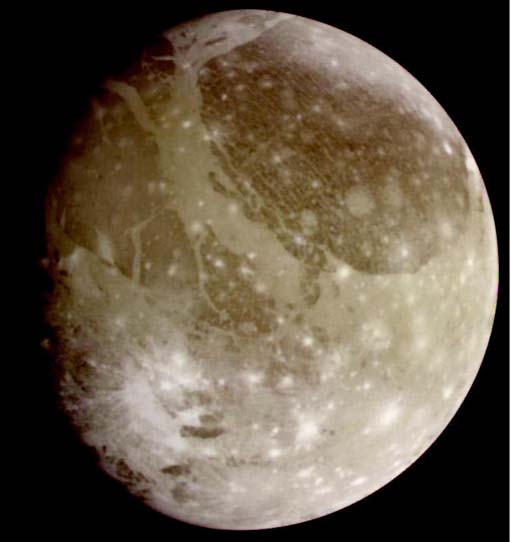
This is a natural color view of Ganymede from the Galileo spacecraft during its first encounter with the satellite. North is to the top of the picture and the sun illuminates the surface from the right. The dark areas are the older, more heavily cratered regions and the light areas are younger, tectonically deformed regions. The brownish-gray color is due to mixtures of rocky materials and ice. Bright spots are geologically recent impact craters and their ejecta. The finest details that can be discerned in this picture are about 13.4 kilometers across. The images which combine for this color image were taken beginning on June 26, 1996.
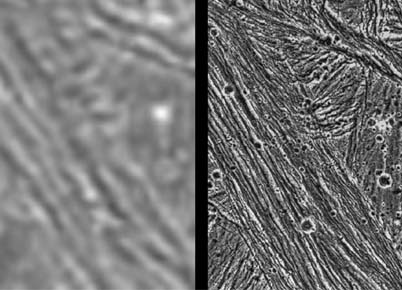 | These images demonstrate the dramatic improvement in the
resolution of pictures that NASA's Galileo spacecraft is
returning compared to previous images of the Jupiter system.
这些图像展示了NASA“伽利略”号飞船返回的图像在分辨率上的显著提升,相比之前对木星系统的图像。 |
The frame at left was taken by the Voyager 2 spacecraft when it flew by in 1979, with a resolution of about 1.3 kilometers (0.8 mile) per pixel. The frame at right showing the same area was captured by Galileo during its first flyby of Ganymede on June 27, 1996; it has a resolution of about 74 meters (243 feet) per pixel, more than 17 times better than that of the Voyager image.
In each of the above frames, north is to the top, and the sun illuminates the surface from the lower left nearly overhead (about 77 degrees above the horizon). The area shown, at latitude 10 degrees north, 167 degrees west, is about 35 by 55 kilometers (25 by 34 miles). The image was taken June 27 when Galileo was 7,448 kilometers (4.628 miles) away from Ganymede.
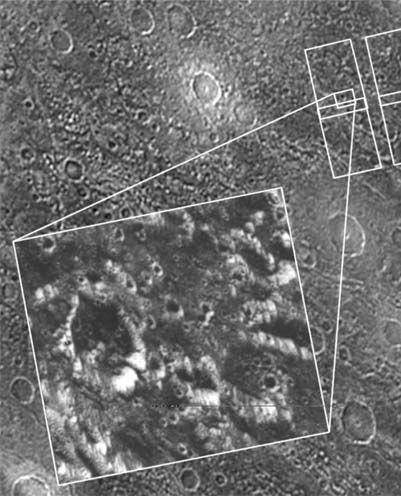 | View of the Galileo Regio region on Ganymede showing fine details of the
Galileo image fit into the larger scale, but much lower resolution view of
the region taken 17 years earlier by Voyager. The broad curved furrow
patterns are characteristic of the darker regions of this moon. North is to
the top of the picture and the sun illuminates the surface from almost
overhead in the Galileo picture.
伽利略区的 Ganymede 表面视图显示了 Galileo 拍摄的高分辨率图像,该图像被纳入到17年前由 Voyager 拍摄的较低分辨率的更大尺度视图中。宽广的弯曲沟壑模式是该卫星暗区的特征。图中上方为北方,Galileo 拍摄的图像中太阳几乎从正上方照射到表面。 |
Ganymede is one of the four largest moons of Jupiter. These moons are called the "Galilean moons" because they were first observed by Galileo.
Ganymede is in fact the largest moon in the solar system, even exceeding the planets Mercury and Pluto in size. It orbits at about 15 Jupiter radii . It's overall density is only about 2000 kg/m^3, suggesting that it must contain a lot of ice throughout. It is modeled as having an iron/iron sulfide core like Io and Europa, but it is evidently smaller in proportion to the volume since the density is much lower. As the images show, it is cratered extensively. The less-cratered regions are presumed to be younger surfaces.
The dark region at the top of the first image is called Galileo Regio. It is seen to be one of the older parts, original icy highlands. The brigher, younger areas can be considered to be like the Moon's maria, except formed by upwelling water rather than the upwelling molten lava on the Moon. The extensive system of grooves and ridges has no counterpart on the Moon, and are evidence of some early tectonic activity.
Galileo discovered a weak magnetosphere around Ganymede, the first moon to show a magnetic field.
Jupiter Concepts
Solar System Illustration
Solar System Concepts
References
Chaisson & McMillan,
Ch 11.
| HyperPhysics********** Astrophysics
HyperPhysics ********** 天体物理学 | R Nave |