Galileo Mission
伽利略任务
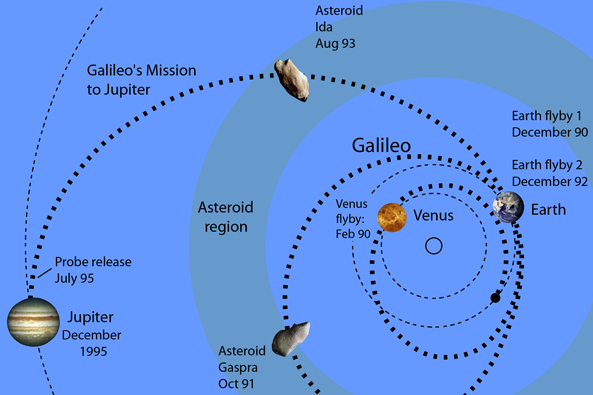
Launched on October 19, 1989, the Galileo spacecraft was designed for a study of Jupiter. After six years and about 2.5 billion miles, it reached Jupiter on December 7, 1995. The distance between to orbits of Earth and Jupiter is about 390 million miles. A 23 month survey of the Jupiter system was scheduled. The total cost of the mission is about $1.6 billion.
1989年10月19日发射的伽利略探测器旨在研究木星。经过六年约25亿英里的飞行,它于1995年12月7日到达木星。地球和木星轨道之间的距离约为390 million miles。计划对木星系统进行为期23个月的探测。整个任务的总费用约为$1.6 billion。
Originally scheduled to be launched from the space shuttle in 1985, it would have been at Jupiter in 1987. Launch delays, the 1986 Challenger disaster, and the movement of the planets put it on a much slower and more circuitous path to Jupiter.
最初计划于1985年从航天飞机发射,那时它将在1987年到达木星。发射延误、1986年挑战者号航天飞机失事以及行星的运动,使它采取了一条更加缓慢且绕远的路径前往木星。
Galileo has been boosted in its journey by gravity-assist maneuvers around Venus in 1990, around the Earth in 1990 and 1992, and around the asteroid Gaspra in 1991. It also had a close flyby of the asteroid Ida, at which it discovered a tiny moon of Ida, about 1 mile in diameter.
伽利略探测器在1990年飞掠金星时,受到引力助推的影响;1990年和1992年又飞掠地球;1991年还飞掠了小行星Gaspra。它还近距离飞过小行星Ida,并在此发现了Ida的一个小卫星,直径约1英里。
In 1994, Galileo was the only instrument in position to view the actual impacts of Comet Shoemaker-Levy 9 with the surface of Jupiter.
1994年,伽利略是唯一能够观测到彗星谢尔曼-利维9号撞击木星表面的实际冲击的仪器。
The journey of Galileo was plagued with difficulties like the failure of the main antenna to deploy. This forced the rewrite of the spacecraft's onboard software to make use of the backup antenna. An onboard recorder stored information for slower transmission to the Earth from the smaller antenna.
伽利略任务的旅程充满困难,例如主天线无法展开。这迫使重新编写航天器上的软件,以利用备用天线。 onboard 记录器存储了通过较小天线向地球缓慢传输的信息。
The Jupiter probe was separated from the spacecraft in July, 1995 in preparation for the encounter with Jupiter in December. Galileo entered orbit around Jupiter on December
7, 1995.
木星探测器于1995年7月脱离航天器,为1995年12月与木星的相遇做准备。伽利略号于1995年12月7日进入木星轨道。
| Images from Galileo:
伽利略的图像: | Moon
月球 |
|