Jupiter's Moons
木星的卫星
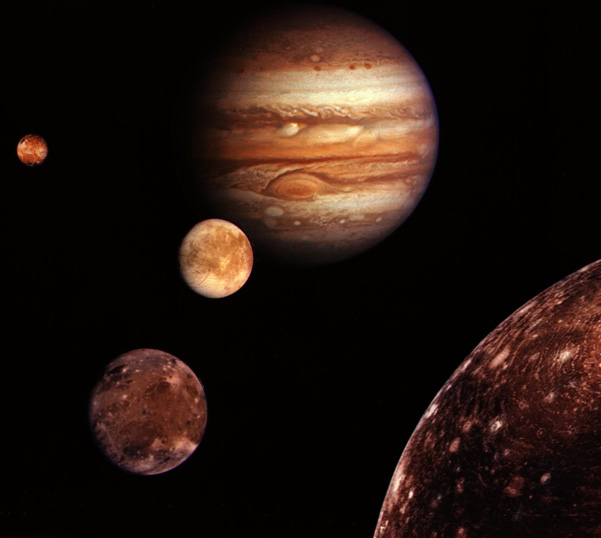 Montage of Jupiter and the Galilean satellites Io, Europa, Ganymede and Callisto. The images are not to scale, but are in their relative positions. At upper left, the reddish Io is nearest Jupiter. Then Europa in center, then Ganymede and Callisto at the lower right. Image credit NASA, Jet Propulsion Laboratory. These images are from Voyager I.
|
| Name
名称 | Distance from Jupiter
木星距离 | Orbit Period
轨道周期 | Size
尺寸 |
| 106 m | Jupiter radii
木星半径 | (days)
天数 | (Longest
diameter, km)
(最长直径,公里) |
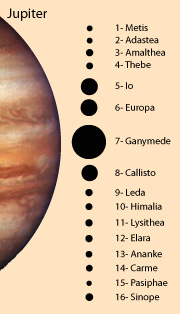
| Metis
梅蒂斯 | 128 | 1.79 | 0.29 | 40 |
| Adastea
阿斯塔埃亚 | 129 | 1.80 | 0.30 | 20 |
| Amalthea
阿马尔蒂亚 | 181 | 2.54 | 0.50 | 260 |
| Thebe
Thebe(专名或术语) | 222 | 3.10 | 0.67 | 100 |
| Io
伊奥 | 422 | 5.90 | 1.77 | 3640 |
| Europa
欧罗巴 | 671 | 9.38 | 3.55 | 3130 |
| Ganymede
金星 | 1,070 | 15.0 | 7.15 | 5270 |
| Callisto
卡利斯托 | 1,880 | 26.3 | 16.7 | 4800 |
| Leda
莱达 | 11,100 | 155 | 239 | 10 |
| Himalia
希穆利亚 | 11,500 | 161 | 251 | 170 |
| Lysithea
利西忒亚 | 11,700 | 164 | 259 | 24 |
| Elara
埃尔拉 | 11,700 | 164 | 260 | 80 |
| Ananke
安克 | 21,200 | 297 | 631* | 20 |
| Carme
卡迈尔 | 22,600 | 316 | 692* | 30 |
| Pasiphae
帕西菲埃 | 23,500 | 329 | 735* | 36 |
| Sinope
辛诺佩 | 23,700 | 332 | 758* | 28 |
* Indicates retrograde orbit.
* 表示逆行轨道。 |
| The four largest moons are comparable to the Earth's Moon in size. They are referred to as the Galilean moons. Their orbits are direct (in the same direction as the planet's rotation), their orbits are roughly circular, and they lie close to Jupiter's equatorial plane. Io and Europa have thick rocky mantles surrounding iron/iron sulfide cores. Ganymede and Callisto are less dense, with water and water ice accounting for as much as half of their masses. Ganymede does have a small metallic core, as evidenced by the fact that it has a magnetic field, but Callisto is apparently a largely undifferentiated mixture of rock and ice.
最大的四个卫星在大小上与地球的月球相当。它们被称为伽利略卫星。它们的轨道是直接的(与行星自转方向相同),轨道大致是圆形的,并且位于木星赤道平面附近。木卫一和木卫二有围绕铁/铁硫化物核心的厚岩层。木卫三和木卫四密度较低,水和冰占其质量的大部分,可达一半。木卫三确实有一个小的金属核心,这一点从它具有磁场这一点可以得到证明,而木卫四似乎主要由岩石和冰组成。 | Additional Data for the Galilean Moons
伽利略卫星的附加数据
| Name
名称 | Mass
(Earth moon masses)
质量(地球月球质量) | Density
kg/m3
密度 kg/m³ |
| Io
伊奥 | 1.22 | 3500 |
| Europa
欧罗巴 | 0.65 | 3000 |
| Ganymede
金星 | 2.02 | 1900 |
| Callisto
卡利斯托 | 1.46 | 1900 |
|
The outer moons are in two groups of four each at about the same orbit radius. The moons of the inner group move in eccentric, inclined orbits at about 11 million kilometers, and those of the outer group move in eccentric orbits at about 22 million kilometers which are retrograde to the planets rotation. It is likely that each group came from the breakup of a single body which was captured by Jupiter's gravity.
外侧卫星分成两组,每组四个,轨道半径大约相同。内侧组的卫星轨道是偏心且倾斜的,约在1100万公里处;外侧组的卫星轨道也是偏心的,约在2200万公里处,且方向与行星自转方向相反。很可能每组都来自一个天体的解体,该天体被木星的引力捕获。
木星及其伽利略卫星木卫一、木卫二、木卫三和木卫四的拼图。这些图像比例不准确,但展示了它们相对于木星的位置。在左上角是红色的木卫一,最靠近木星;中间是木卫二;然后是木卫三和木卫四在右下角。图片由NASA,喷气推进实验室提供。这些图像来自旅行者一号。 |
Index
Solar System Illustration
Solar System Concepts
References
Chaisson & McMillan,
Ch 11.
索引 太阳系示意图 太阳系概念 参考文献 Chaisson & McMillan,第11章。 |