Gaspra
Gaspra is one of the larger asteroids and gained publicity in 1991 when the spacecraft Galileo swung by it on October 29 in a slingshop maneuver to gain energy as a part of its planned Jupiter mission. Referred to as 951 Gaspra, this asteroid is an irregular body with dimensins about 19x12x11 kilometers (12x7.5x7 miles).
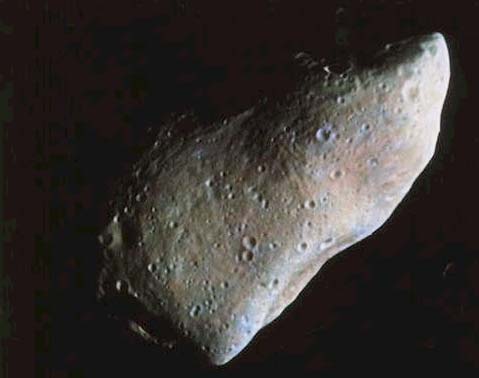
This picture of 951 Gaspra is an enhanced image based on data from the Galileo spacecraft as it approached on October 29, 1991. The base image is a black and white image upon which are superimposed subtle color variations constructed from violet, green, and near-infrared(1000nm) images taken in an earlier sequence. The subtle color variations have been artificially exaggerated; the surface looked fairly homogeneous. However, the subtle changes were there and were correlated with significant surface features. The bluish areas represent regions of slightly higher albedo, which also absorb somewhat more strongly in the 1000 nm band, probably due to the mineral olivine. These bluish areas tend to be associated with some of the crisper craters and ridges. The slightly reddish areas, apparently concentrated in topographic lows, represent regions of somewhat lower albedo and weaker absorption near 1000 nm. In general, such patterns can be explained in terms of greater exposure of fresher rock in the brighter bluish areas and the accumulation of some regolith materials in the darker reddish areas.
Solar System Illustration
Solar System Concepts
| HyperPhysics********** Astrophysics
HyperPhysics ********** 天体物理学 | R Nave |