Asteroids

NASA Image from Ceres site
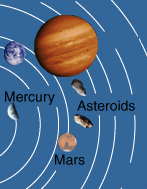
Asteroids are small rocky bodies, most of which orbit the Sun between Mars and Jupiter. Their orbits are typically more eccentric than those of the planets. The largest asteroid, Ceres, is 940 kilometers in diameter and has about 1/10000 the mass of the Earth. With over 7000 asteroids catalogued, the total number may exceed 100,000. However, their combined mass is less than 1/10 that of the Earth's Moon. Ceres and the second-largest asteroid, Vesta, were visited by the Dawn spacecraft.
 |
All solid bodies in our Solar Systen show craters where they have collided with asteroids and comets. 太阳系中的所有固体天体都显示出陨石和彗星碰撞形成的陨坑。
A few asteroids cross the Earth's orbit. The most notable of these are Apollo, Icarus, Adonis, and Eros. Hector has an orbit similar to that of Jupiter, and Hidalgo has a large elliptical orbit which extends from about the orbit of Mars out well beyond the orbit of Jupiter. 一些小行星穿越地球的轨道。其中最著名的是阿波罗、伊卡洛斯、阿多尼斯和 eros。赫克托的轨道类似于木星的轨道,而希达戈的轨道是一个很大的椭圆轨道,从火星的轨道延伸到木星轨道之外。
Asteroid Gaspra was used in slingshot maneuver with Galileo in 1991 on the way toward ultimate rendevouz with Jupiter. Galileo also provided a close view of asteroid Ida. 小行星Gaspra曾被用于伽利略探测器的引力弹弓 maneuver,于1991年在前往木星最终会合的途中。伽利略还提供了小行星Ida的近距离观测。
Another class of asteroids travel in a synchronous orbit with Jupiter and are called Trojan asteroids. 另一类小行星以同步轨道绕木星运行,被称为特洛伊小行星。 |
The vast majority of the meteorites that hit the Earth are thought to come from the asteroid belt.
Asteroids are classified from their observed reflectivity, with C-type asteroids making up about 75% of them. C-type or carbonaceous asteroids are dark from the high content of carbon in them. S-type asteroids contain silicate and are more reflective - they make up about 15% of the asteroids. Most of the remaining asteroids are called M-type and contain large fractions of iron and nickel. The C-type asteroids are supposed to be very primitive material that has not been significantly heated or changed chemically since they were formed some 4.6 billion years ago.
References:
NASA/Asteroids
Chapter 9 of Planetary Sciences by de Pater and Lissauer is a detailed treatment of asteroids.
Solar System Illustration
Solar System Concepts
Reference
Chaisson and McMillan
Ch 14
| HyperPhysics********** Astrophysics
HyperPhysics ********** 天体物理学 | R Nave |