Giotto Spacecraft
|
The Giotto mission was designed to study Halley's Comet. The spacecraft encountered the
comet on March 13, 1986, at a distance of 0.89 AU from the sun and 0.98 AU from the Earth and an angle of 107 degrees from the comet-sun line. The 1.5 m dish antenna, operating in the X-band was pointed toward the Earth. The goal was to come within 500 km of Halley's comet at closest encounter.
The actual closest approach was measured at 596 km.
乔托任务的设计目的是研究哈雷彗星。航天器于1986年3月13日遇到彗星,距离太阳0.89个天文单位,距离地球0.98个天文单位,与彗星-太阳连线形成107度角。1.5米的抛物面天线在X波段工作,指向地球。目标是在最近接近时距离哈雷彗星500公里。实际最近接近距离测量为596公里。 |
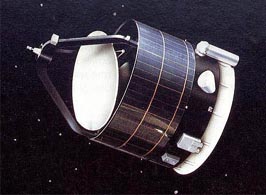 NASA 图示 |
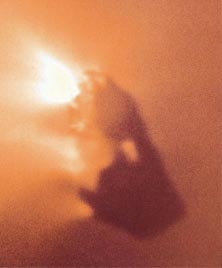 NASA 图像 |
Nucleus of Halley's Comet哈雷彗星的核
With such a long history of observations, we were well prepared for Halley's 1986 visit. The Soviet spacecraft Vega 2 traveled through the comet's coma, passing within 8000 km of the nucleus. With data obtained from that encounter, spacecraft Giotto was navigated to within 600 km of the nucleus and obtained our first direct images of a comet nucleus. Giotto's images showed the nucleus to be an irregular object, something like a potato, with dimensions 15 km long and up to 10 km wide. If the common "dirty snowball" view applies at all, this was a very dirty one, appearing almost jet black. The visible jets coming from the dark nucleus were not uniform, but emanated from several small vents on the sunlit side. These vents could actually produce measurable changes in the comet's orbit, and were our first clue about the origin of observed small departures of comet orbits from Kepler's laws. 凭借如此悠久的观测历史,我们已为哈雷彗星1986年的来访做好了准备。苏联航天器维加2号穿越了彗星的彗发,飞过距离彗核仅8000公里的地方。借助这次相遇获得的数据,航天器吉奥蒂奥被导航至距离彗核仅600公里处,并获得了彗核的首张直接影像。吉奥蒂奥的影像显示,彗核是一个不规则的天体,形状类似土豆,尺寸为15公里长,宽达10公里。如果“脏雪球”观点在某种程度上适用,那么这颗彗核则非常脏,看起来几乎呈黑色。从黑色彗核发出的可见喷流并不均匀,而是从阳光照射的一面几个小孔喷出。这些孔洞实际上可以产生可测量的彗星轨道变化,并成为我们理解观测到的彗星轨道偏离开普勒定律的起源的第一个线索。
|
The major objectives of the mission were to: (1) obtain color photographs of the nucleus; (2) determine the elemental and isotopic composition of volatile components in the cometary coma, particularly parent molecules; (3) characterize the physical and chemical processes that occur in the cometary atmosphere and ionosphere; (4) determine the elemental and isotopic composition of dust particles; (5) measure the total gas-production rate and dust flux and size/mass distribution and derive the dust-to-gas ratio; and, (6) investigate the macroscopic systems of plasma flows resulting from the cometary-solar wind interaction.
| Comet Discussion
彗星讨论 |
Solar System Illustration
Solar System Concepts
Reference
Chaisson & McMillan,
Ch 14.
| HyperPhysics********** Astrophysics
HyperPhysics ********** 天体物理学 | R Nave |