Halley's Comet
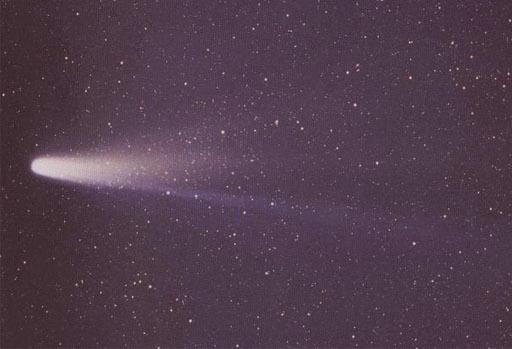
The comet named after British astronomer Edmund Halley is arguably the most famous of all comets, having been observed in 1531, 1607, 1682, 1758, 1834 ,1910 and 1986. Halley entered the picture in 1705, realizing that the appearance of 1682 was the same comet as those observed on the previous two dates listed above. Surmising that the comet was following the same laws which governed planetary orbits, he calculated the orbit corresponding to a 76 year period and predicted its return in 1758. Though he did not live to see it, the return of the comet in 1758 was a triumph for orbit calculations based on Newton's laws and led to the naming of the comet after Halley. Subsequent to Halley's analysis, historical research showed that Halley's comet had been observed at every passage since 240 BC.
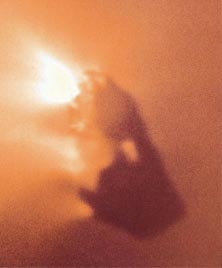 |
Nucleus of Halley's Comet哈雷彗星的核
With such a long history of observations, we were well prepared for Halley's 1986 visit. The Soviet spacecraft Vega 2 traveled through the comet's coma, passing within 8000 km of the nucleus. With data obtained from that encounter, spacecraft Giotto was navigated to within 600 km of the nucleus and obtained our first direct images of a comet nucleus. Giotto's images showed the nucleus to be an irregular object, something like a potato, with dimensions 15 km long and up to 10 km wide. If the common "dirty snowball" view applies at all, this was a very dirty one, appearing almost jet black. The visible jets coming from the dark nucleus were not uniform, but emanated from several small vents on the sunlit side. These vents could actually produce measurable changes in the comet's orbit, and were our first clue about the origin of observed small departures of comet orbits from Kepler's laws. 凭借如此悠久的观测历史,我们已为哈雷彗星1986年的来访做好了准备。苏联航天器维加2号穿越了彗星的彗发,飞过距离彗核仅8000公里的地方。借助这次相遇获得的数据,航天器吉奥蒂奥被导航至距离彗核仅600公里处,并获得了彗核的首张直接影像。吉奥蒂奥的影像显示,彗核是一个不规则的天体,形状类似土豆,尺寸为15公里长,宽达10公里。如果“脏雪球”观点在某种程度上适用,那么这颗彗核则非常脏,看起来几乎呈黑色。从黑色彗核发出的可见喷流并不均匀,而是从阳光照射的一面几个小孔喷出。这些孔洞实际上可以产生可测量的彗星轨道变化,并成为我们理解观测到的彗星轨道偏离开普勒定律的起源的第一个线索。
|
| Comet Discussion
彗星讨论 |
Solar System Illustration
Solar System Concepts
Reference
Chaisson & McMillan,
Ch 14.
| HyperPhysics********** Astrophysics
HyperPhysics ********** 天体物理学 | R Nave |