Ida and Moon伊达与月亮
Ida is an asteroid which became much more familiar with its close encounter with the planetary explorer spacecraft Galileo. In 1993, Galileo's rendevous with Ida brought the surprise discovery that Ida had its own satellite: a tiny moon about 1.5 km in diameter orbiting at a distance of about 90 km. The moon was named Dactyl. 伊达是一颗小行星,因与行星探测器伽利略飞船的近距离相遇而变得更为为人所知。1993年,伽利略与伊达的会合带来了意外的发现:伊达本身拥有一颗卫星,即一颗直径约1.5公里、轨道距离约90公里的 tiny moon,该卫星被命名为达克利。
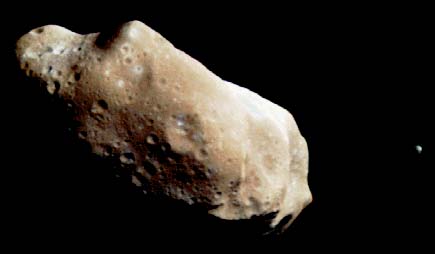
![]() This color picture is made from images taken by the imaging system on the Galileo spacecraft about 14 minutes before its closest approach to Ida on August 28, 1993. The range from the spacecraft was about 10,500 km. The images are from the sequence in which Ida's moon was originally discovered. The maximum dimension of Ida is about 60 km. 这张彩色图片是1993年8月28日伽利略探测器飞掠伊达卫星时,由探测器上的成像系统在距离伊达约14分钟前拍摄的图像序列中的一部分。探测器与伊达的距离约为10,500公里。这些图像来自伊达卫星最初被发现的序列。伊达的最大尺寸约为60公里。
This picture is made from images through the 410 nm (violet), 756 nm (infrared) and 968 nm (infrared) filters. The color is enhanced in the sense that the camera is sensitive to near-infrared wavelengths of light beyone human vision; a natural color picture of this asteroid would appear mostly gray. Shadings in this image indicate changes in illumination angle on the many steep slopes of this irregular body as well as subtle color variations due to differences in the physical state and composition of the soil (regolith). 这张图片是通过410纳米(紫色)、756纳米(红外线)和968纳米(红外线)滤光片拍摄的图像。颜色增强的意思是,相机对人眼无法看到的近红外线波长的光敏感;如果这颗小天体以自然颜色呈现,它将主要呈现灰色。图像中的阴影表明了由于这颗不规则天体上众多陡峭斜坡的光照角度变化以及土壤(风化层)物理状态和成分差异引起的细微颜色变化。
There are brighter areas, appearing bluish in the picture, around the small bright crater near the center of the asteroid, and near the upper righthand limb. This is a combination of more reflected blue light and greater absorption of near infrared light, suggesting a difference in the abundance of iron-bearing minerals in these areas. 图片中靠近小陨石坑附近以及右上边缘区域,出现了更明亮的区域,呈现出蓝色调。这可能是由于更多的蓝光反射和近红外光的更大吸收,表明这些区域铁矿物的丰度存在差异。
From the analysis of the binary orbit of the moon Dactyl around Ida, Petit* determined the mass of Ida to be about 2.2 x 10⁻¹⁴ solar masses or 4.3 x 10¹⁶ kg and its density to be 2.7 +/- .4 g/cm3. 从月球Dactyl围绕Ida的二体轨道分析中,Petit*确定Ida的质量约为2.2 x 10 -14太阳质量或4.3 x 10 16 kg,其密度为2.7 +/- 0.4 g/cm³。
*Petit, J.-M., Durda, D.D., Greenberg, R., Hurford, T.A., & Geissler, P.E. 1997, The Long-Term Dynamics of Dactyl's Orbit, Icarus,139, 177-197
Sources
源
NASA图像 *Petit, J.-M., Durda, D.D., Greenberg, R., Hurford, T.A., & Geissler, P.E. 1997, Dactyl轨道的长期动力学, Icarus,139, 177-197 |
Index Solar System Illustration Solar System Concepts 索引 太阳系示意图 太阳系概念 | ||
|
Go Back
返回 |
Closeup of Asteroid Ida小行星伊达的特写
![]() The Galileo imaging system captured this picture of the limb of the asteroid 243 Ida about 46 seconds after its closest approach on August 28, 1993, from a range of only 2,480 kilometers. It is the highest-resolution image of an asteroid's surface ever captured, and shows detail at a scale of about 25 meters per pixel. 伽利略成像系统于1993年8月28日小行星243伊达最近接近时,在距离仅2480公里处,于接近事件后46秒拍摄了这张小行星伊达边缘的图片。这是有史以来拍摄到的最高分辨率的小行星表面图像,每像素的细节尺度约为25米。
Prominent in this view is a 2-kilometer-deep "valley" seen in profile on the limb. This high-resolution view shows many small craters and some grooves on the surface of Ida, which give clues to understanding the history of this heavily impacted object. 在这一视角中,一个深度为2公里的‘峡谷’在边缘处的侧视图中显得突出。这一高分辨率图像显示了伊达表面许多小陨坑和一些沟壑,这些特征为了解这个遭受强烈撞击天体的历史提供了线索。
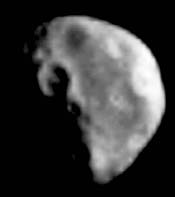
Ida's moon is approximately egg-shaped, measuring about 1.2x1.4x1.6 kilometers (.75x.87x1 miles). The moon was about 90 kilometers away from Ida at the time of this image. 伊达的卫星大约呈椭球状,尺寸约为1.2×1.4×1.6公里(0.75×0.87英里)。在拍摄这张照片时,卫星距离伊达约90公里。
This image is the most detailed picture of the recently discovered natural satellite of asteroid 243 Ida taken by the Galileo spacecraft's solid state imaging camera during its encounter with the asteroid on August 28, 1993. Shuttered through the camera's broadband clear filter as part of a 30-frame mosaic designed to image the asteroid itself, this frame fortuitously captured the previously unknown moon at a range of about 3,900 km (2,400 miles), just over 4 minutes before the spacecraft's closest approach to Ida. Each picture element spans about 39 meters (125 ft) on the surface of the moon. 这张图片是1993年8月28日伽利略探测器与小行星243伊达相遇时,由其固态成像相机拍摄的,目前所知最详细的伊达小行星自然卫星的图像。该图像通过相机的宽带清晰滤光片拍摄,作为一组30帧拼接图像的一部分,旨在拍摄小行星本身。这张图像意外地在距离约3900公里(2400英里)处捕捉到了此前未知的卫星,距离探测器最接近伊达仅4分钟多一点。每像素在月球表面覆盖约39米(125英尺)。
NASA 图像 |
Index Solar System Illustration Solar System Concepts 索引 太阳系示意图 太阳系概念 | ||
|
Go Back
返回 |