Bilingual edition: English is preserved and Chinese follows each unit. Terminology uses the confirmed v20260916 glossary; automated semantic review remains traceable.
中英双语版:英文原文完整保留,中文紧随对应单元;术语采用 v20260916 确认表,自动语义审校结果可追溯。

Messenger Spacecraft to Mercury
信使飞船前往水星

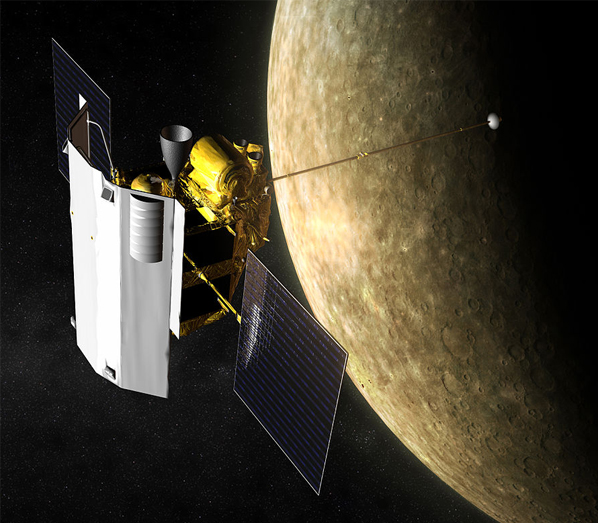
NASA artist conception of Messenger in orbit about Mercury

MESSENGER was a NASA robotic spacecraft that orbited the planet Mercury between 2011 and 2015, studying Mercury's chemical composition, geology, and magnetic field. The name is derived from "MErcury Surface, Space ENvironment, GEochemistry, and Ranging".

MESSENGER 是一艘由NASA运营的机器人航天器,于2011年至2015年间环绕水星运行,研究水星的化学组成、地质构造和磁场。其名称源自“MErcury Surface, Space ENvironment, GEochemistry, and Ranging”。

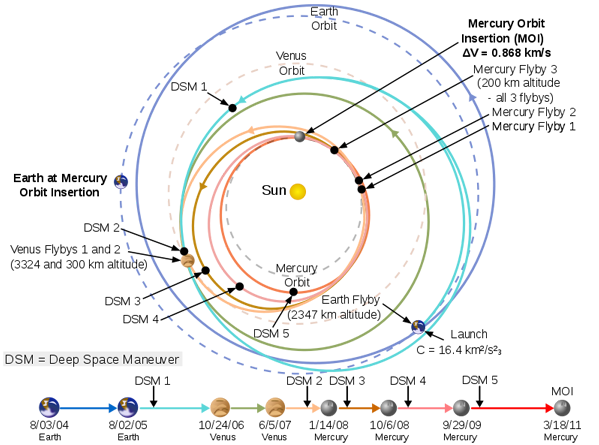
MESSENGER was launched aboard a Delta II rocket in August 2004. Its path involved a complex series of flybys - the spacecraft flew by Earth once, Venus twice, and Mercury itself three times, allowing it to decelerate relative to Mercury using minimal fuel. During its first flyby of Mercury in January 2008, MESSENGER became the second mission, after Mariner 10 in 1975, to reach Mercury.

MESSENGER于2004年8月搭乘Delta II火箭发射。其飞行路径涉及一系列复杂的飞掠任务——航天器飞掠地球一次,金星两次,水星自身三次,使其能够利用极少的燃料减速,相对于水星。在2008年1月首次飞掠水星时,MESSENGER成为继1975年Mariner 10之后第二个到达水星的探测器。

MESSENGER entered orbit around Mercury on March 18, 2011, becoming the first spacecraft to do so. It successfully completed its primary mission in 2012. Following two mission extensions, the spacecraft used the last of its maneuvering propellant to deorbit, impacting the surface of Mercury on April 30, 2015.

Messenger trajectory to Mercury
飞向水星的信使轨迹
Images from Messenger
信使号图像
MESSENGER于2011年3月18日进入水星轨道,成为首艘实现这一目标的航天器。它于2012年成功完成主要任务。在两次任务延长之后,航天器使用最后一批机动推进剂脱离轨道,于2015年4月30日撞击水星表面。
NASA 对 Messenger 在水星轨道上的概念设计
Index

Solar System Illustration

Solar System Concepts

Mercury Concepts

Messenger Wiki
索引太阳系示意图太阳系概念水星概念信使维基
 
HyperPhysics********** Astrophysics
HyperPhysics ********** 天体物理学
R Nave
Go Back
返回


Messenger to Mercury

向水星发送信使

The complex path of the Messenger spacecraft to its orbit around Mercury involved several gravity assist maneuvers designed to use the Earth, Venus, and Mercury itself to achieve the goal of orbiting around the planet.

信使号飞船绕水星轨道的复杂路径涉及几次重力辅助操作,旨在利用地球、金星和水星自身来实现绕行水星的目标。
Index

Solar System Illustration

Solar System Concepts
索引 太阳系示意图 太阳系概念
 
HyperPhysics********** Astrophysics
HyperPhysics ********** 天体物理学
R Nave
Go Back
返回


Messenger Images

梅森图像

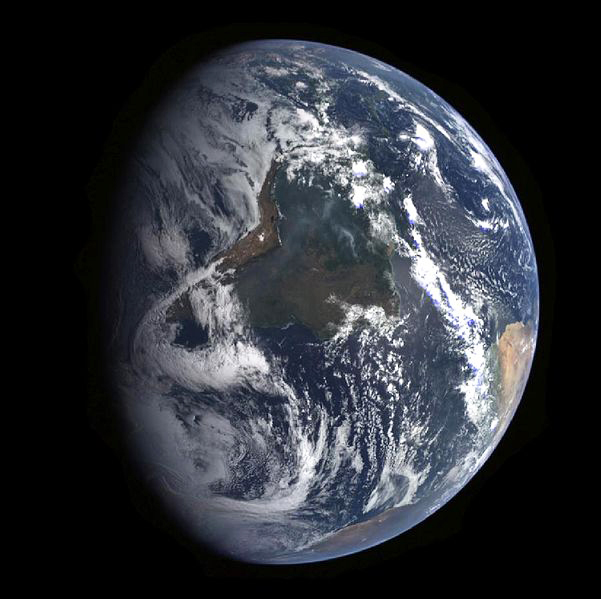
Messenger's trajectory brought it back around the Earth in a flyby, providing the opportunity for images of the Earth. NASA, October 11, 2005.

信使号的轨道使其在飞掠期间返回地球附近,提供了拍摄地球的机会。NASA,2005年10月11日。

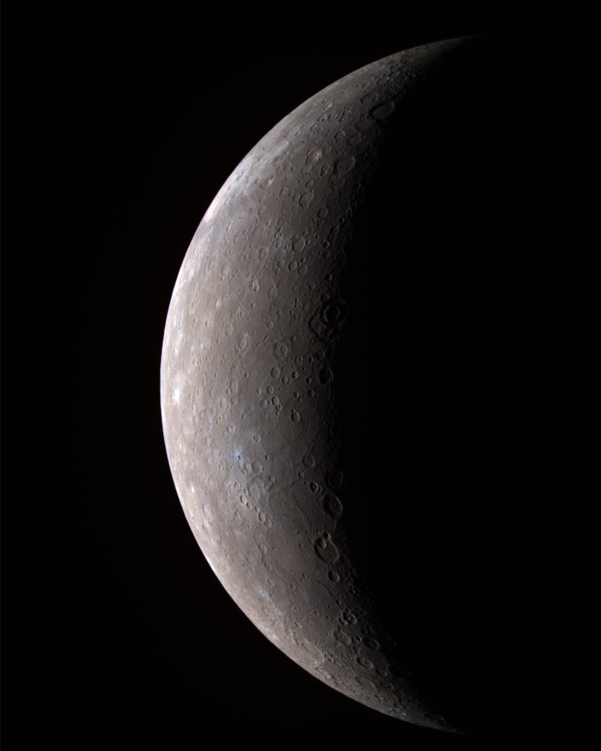
First full color picture of Mercury by Messenger.

信使号拍摄的水星首张全彩照片

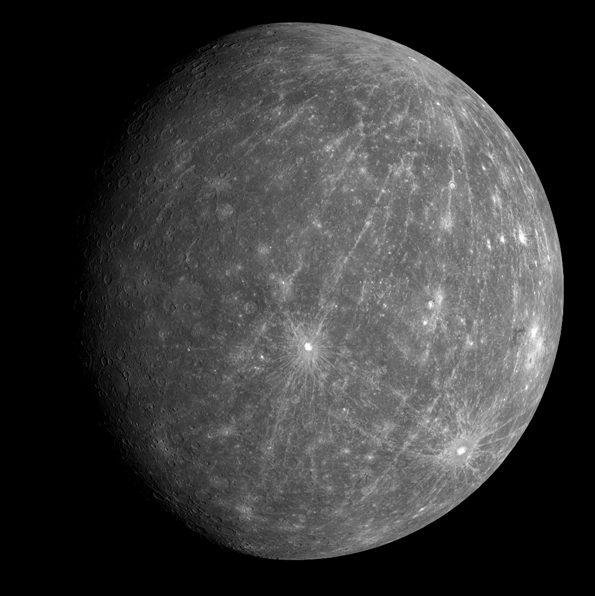
View from second flyby of Messenger in October 2008. Kuiper crater near center.

2008年10月水星第二次飞越时的视角。画面中心附近是库珀陨石坑。

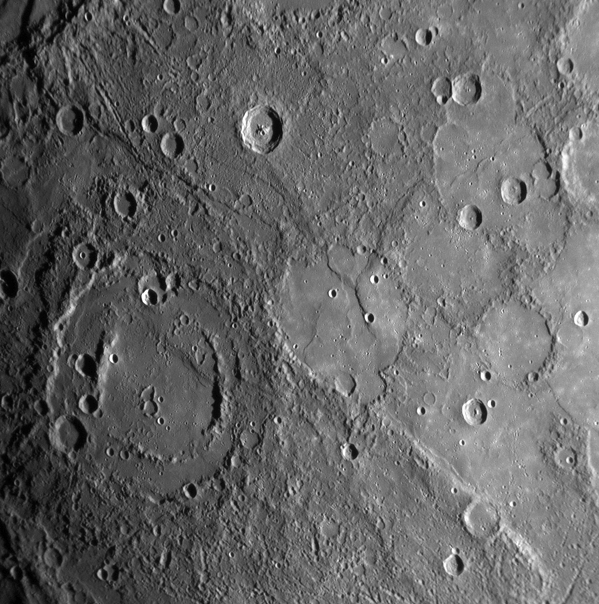
Closer view of previously unseen side of Mercury. Shortly following MESSENGERÕs closest approach to Mercury on January 14, 2008, this image was taken from a distance of about 18,000 kilometers (11,000 miles) from the surface of Mercury. This was about 58 minutes after the closest approach point of the flyby. The region shown is about 500 kilometers (300 miles) across, and craters as small as 1 kilometer (0.6 mile) can be seen in this image.

对水星未曾观测到的另一面的更清晰观察。在MESSENGER飞掠水星并接近水星的2008年1月14日之后不久,这张图片是在距离水星表面约18,000公里(11,000英里)处拍摄的。此时距离飞掠最近点约58分钟。图片所展示的区域宽约500公里(300英里),在此图片中可以看见直径仅1公里(0.6英里)的小陨石坑。
Index

Solar System Illustration

Solar System Concepts
索引 太阳系示意图 太阳系概念
 
HyperPhysics********** Astrophysics
HyperPhysics ********** 天体物理学
R Nave
Go Back
返回