Mariner Exploration Missions航海家探测任务
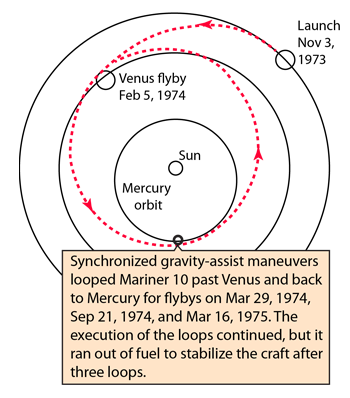
The Mariner series of U.S. spacecraft explored the inner solar system, obtaining information about Mercury, Venus, and Mars. Mariner 2 was the first successful space probe and the first spacecraft to visit a planet. It passed Venus at about 34,758 km on December 14, 1962. Mariner 4 explored Mars at low resolution in 1965 and Mariners 6 & 7 got a higher resolution look in 1969. Mariner 9 mapped entire surface of Mars in 1971 and 1972, sending back 7329 closeup pictures. Mariner 9 arrived into martian orbit on November 13, 1971 in the midst of an enormous dust storm which completely obscured the surface for weeks. When the dust cleared it found such remarkable features as a 24km (15 mile) high volcano named Olympus Mons, three times as high as Mt. Everest. Mariner 10 mapped surface of Mercury in 1974 as a part of a fortuitous slingshot orbit with Venus. 美国的马林号(Mariner)系列航天器探索了太阳系内侧,获取了关于水星、金星和火星的信息。马林2号是首个成功的太空探测器,也是首个访问行星的航天器。它于1962年12月14日飞掠金星,距离约为34,758公里。1965年,马林4号以低分辨率探索了火星;1969年,马林6号和7号提供了更高分辨率的观测。1971年和1972年,马林9号对火星整个表面进行了测绘,传回了7329张近距离照片。1971年11月13日,马林9号进入火星轨道时,正值一场巨大的沙尘暴,这场风暴持续数周,完全遮蔽了火星表面。当尘埃消散后,它发现了诸如奥利匹斯山(Olympus Mons)这样的显著特征,这座火山高24公里(15英里),是珠穆朗玛峰的三倍高。1974年,马林10号作为一次偶然的引力弹弓轨道的一部分,对水星表面进行了测绘。
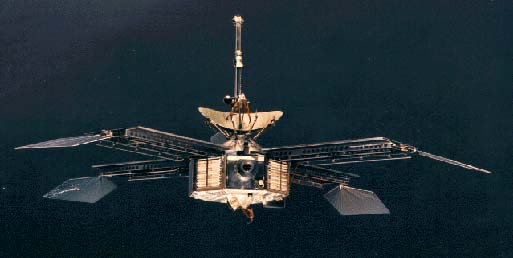
![]() 海员船(NASA图片) |
Index Solar System Illustration Solar System Concepts 索引 太阳系示意图 太阳系概念 | ||
|
Go Back
返回 |
Mariner 2海洋者2号
Mariner 2 was the first successful space probe and the first spacecraft to visit a planet. It collected data for three months, passing Venus at about 34,758 km on December 14, 1962. “旅行者2号”是第一个成功的太空探测器,也是第一个访问行星的航天器。它在三个月内收集了数据,于1962年12月14日飞掠金星,距离约为34,758公里。
Mariner 2 discovered the solar wind, the flux of charged particles escaping the Sun at supersonic speeds. “旅行者2号”发现了日风,即从太阳逃逸出的带电粒子的流,这些粒子以超音速逃逸。
The onboard magnetometer failed to measure a magnetic field for Venus, which was surprising since Venus must be similar in composition to the Earth. Venus has specific gravity 5.24 compared to the Earth's 5.5, so it must also have an iron core. The rotation period of Venus is 243 days, so it is apparently not fast enough to drive the dynamo effect which is credited with producing the Earth's magnetic field. onboard磁强计未能测量到金星上的磁场,这令人惊讶,因为金星的组成应与地球相似。金星的比重为5.24,而地球为5.5,因此它也应有一个铁核。金星的自转周期为243天,因此显然不足以驱动产生地球磁场的发电机效应。
|
Index Solar System Illustration Solar System Concepts 索引 太阳系示意图 太阳系概念 | ||
|
Go Back
返回 |
Mariner 9天文学家
A member of the extended Mariner series, Mariner 9 mapped entire surface of Mars in 1971 and 1972, sending back 7329 closeup pictures. Mariner 9 arrived into martian orbit on November 13, 1971 in the midst of an enormous dust storm which completely obscured the surface for weeks. When the dust cleared it found such remarkable features as a 24km (15 mile) high volcano named Olympus Mons, three times as high as Mt. Everest. 作为扩展的航海者系列成员,航海者9号于1971年和1972年对火星表面进行了全面测绘,传回了7329张近距离照片。航海者9号于1971年11月13日进入火星轨道,当时正处在一场巨大的沙尘暴中,这场沙尘暴完全遮蔽了表面数周。当尘埃消散后,它发现了许多显著特征,例如一座高达24公里(15英里)的火山,名为奥利匹斯山,高度是珠穆朗玛峰的三倍。
In retrospect, the massive dust storm did a great service for humanity. It was observed that the surface temperature of Mars dropped precipitously during the dust storm. At the time there was great debate about what the detonation of nuclear weapons would do to the Earth, and it was realized that nuclear weapons would put enormous clouds of dust into the atmosphere. The dust storm helped to make clear that a nuclear weapons exchange would drop the Earth's surface temperature in a scenario that came to be called "Nuclear Winter". These considerations undoubtedly helped in the process of nuclear weapons control. The resolution of Mariner 9's images was about 1 km. 火星9号的图像分辨率约为1公里。
回顾起来,这场大规模沙尘暴对人类来说是有益的。观察到在沙尘暴期间,火星的表面温度骤降。当时人们对于核武器爆炸对地球的影响存在很大争论,并意识到核武器会向大气层释放巨大的尘埃云。这场沙尘暴帮助人们认识到,核武器交换会导致地球表面温度骤降,这一情景后来被称为“核冬天”。这些考虑无疑在核武器控制的过程中起到了积极作用。 |
Index Mars Concepts Solar System Illustration Solar System Concepts 索引 火星概念 太阳系图示 太阳系概念 | ||
|
Go Back
返回 |
Mariner 10 Slingshots马林10号引力弹弓
|
Index Solar System Illustration Solar System Concepts 索引 太阳系示意图 太阳系概念 | |||
|
Go Back
返回 |