Spectrum of an Exoplanet
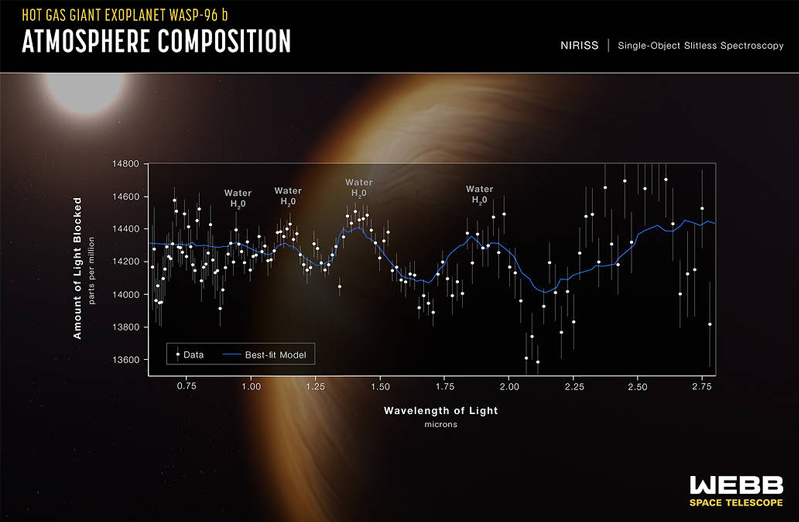
"WASP-96 b is one of more than 5,000 confirmed exoplanets in the Milky Way. Located roughly 1,150 light-years away in the southern-sky constellation Phoenix, it represents a type of gas giant that has no direct analog in our solar system. With a mass less than half that of Jupiter and a diameter 1.2 times greater, WASP-96 b is much puffier than any planet orbiting our Sun. And with a temperature greater than 1000°F, it is significantly hotter. WASP-96 b orbits extremely close to its Sun-like star, just one-ninth of the distance between Mercury and the Sun, completing one circuit every 3.5 Earth-days."
"The combination of large size, short orbital period, puffy atmosphere, and lack of contaminating light from objects nearby in the sky makes WASP-96 b an ideal target for atmospheric observations."
"On June 21, Webb's Near-Infrared Imager and Slitless Spectrograph (NIRISS) measured light from the WASP-96 system for 6.4 hours as the planet moved across the star. The result is a light curve showing the overall dimming of starlight during the transit, and a transmission spectrum revealing the brightness change of individual wavelengths of infrared light between 0.6 and 2.8 microns." (from NASA)
Credits: IMAGE: NASA, ESA, CSA, STScI, Joseph Olmsted (STScI)
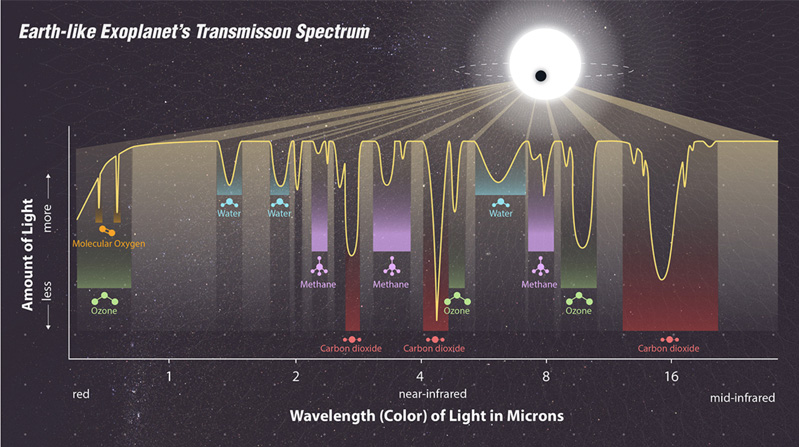
This is a simulation of the type of spectrum which might be collected from and Earth-like planet with the atmospheric constituents that would be associated with the existence of life on the planet. The data would be collected when the starlight passes through the atmosphere of an Earth-like exoplanet. As the exoplanet moves in front of the star, some of the starlight is absorbed by the gas in that exoplanet's atmosphere and some is transmitted through it. Each element or molecule in the atmosphere's gas absorbs light at a very specific pattern of wavelengths. This creates a spectrum with dips that show where the wavelengths of light are absorbed, as seen in the graph. Each dip is like a "signature" of that element or molecule. The transmission spectrum of an Earth-like planet's atmosphere shows wavelengths of starlight that molecules like the oxygen that we breathe, ozone, water, carbon dioxide, and methane absorb.
NASA's James Webb Space Telescope will be able to detect some of the most prominent absorption features of certain gas molecules. Even these features will be extremely faint. The more light Webb gathers while looking at the passing planet's atmosphere, the more confidently scientists can identify these features.
References:
Exoplanet spectrum from the Webb Telescope.
James Webb Images
Solar System Concepts
Telescopes
| HyperPhysics********** Astrophysics
HyperPhysics ********** 天体物理学 | R Nave |