Arecibo
The world's largest radio telescope consists of a 305 meter fixed dish located at Arecibo, Puerto Rico. It was constructed in 1963. The radius of curvature of the dish is also about 305 m. It has been used for observations at wavelengths as short as 4 cm. At this wavelength the Rayleigh criterion gives a limiting angular resolution of 1.6 x 10⁻⁴ radians or about 30 seconds of arc.
 | The receivers which detect the radiation focused by the large dish are suspended 300 m above the surface. As upgraded in 1997, the telescope can collect data at frequencies up to 5 GHz (wavelength 6 cm) with an angular resolution of 1 minute of arc. The fixed dish is restricted to about 20° from the vertical. 接收器悬挂在距离表面300米上方,用于接收由大天线聚焦的辐射。1997年升级后,望远镜能够接收至5 GHz(波长6厘米)的信号,角分辨率达到1分。固定天线只能在垂直方向上下约20°范围内移动。 |
One of Arecibo's contributions has been detailed mapping of the surface of Venus. It can obtain a resolution of a few kilometers on the surface and was combined with data obtained by the Venus spacecraft to provide the most accurate mapping of Venus until the Magellan spacecraft was deployed.
Solar System Illustration
Solar System Concepts
Telescopes
Arecibo official site
| HyperPhysics********** Astrophysics
HyperPhysics ********** 天体物理学 | R Nave |
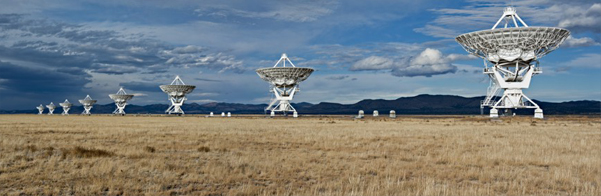 Image courtesy of NRAO/AUI and NRAO/AUI Photographer: Bob Tetro