Ceres
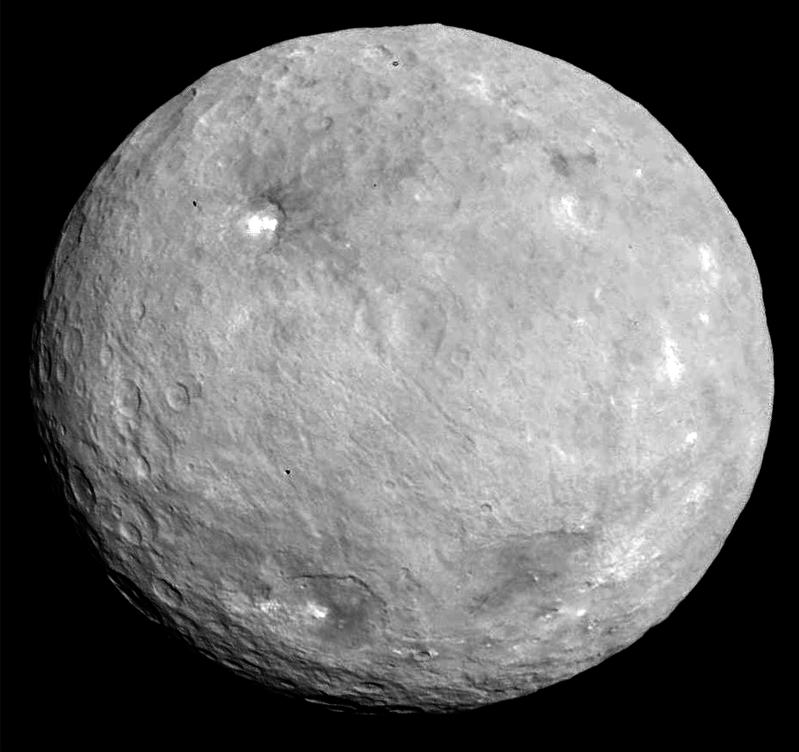
Image credit: NASA Dawn site
The Dawn spacecraft reached Ceres on March 6, 2015 and as of this writing in August 2015, it remains in orbit around Ceres.
Ceres is the largest of the asteroids and orbits the Sun in the main asteroid belt between the orbits of Mars and Jupiter. It is 940 kilometers in diameter and has about 1/10000 the mass of the Earth. With over 7000 asteroids catalogued, the total number may exceed 100,000. However, their combined mass is less than 1/10 that of the Earth's Moon. The Dawn spacecraft's measurement of Ceres' mass is 9.39 x 10²⁰kg, which would suggest that it contains about a third of the estimated mass of the asteroid belt, but amounts to about 4% of the mass of the Earth's moon. Reference Dawn Journal, 5/28/15
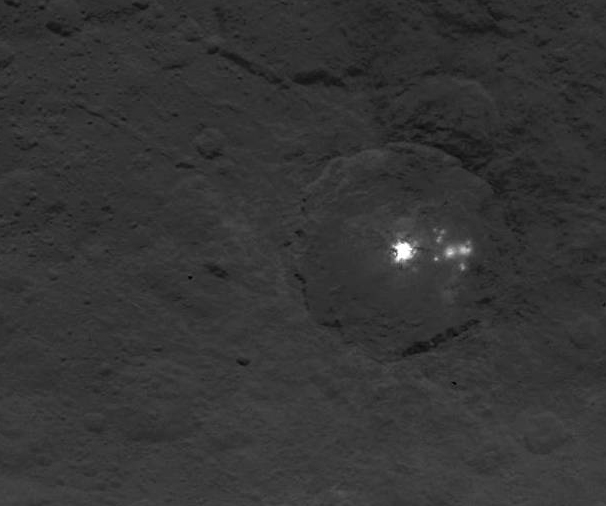 |
The feature that immediately drew attention were these bright spots in a crater named Occator. At least eight spots can be seen next to the largest bright area, which scientists think is approximately 6 miles (9 kilometers) wide. A highly reflective material is responsible for these spots -- ice and salt are leading possibilities, but scientists are considering other options, too. 最引人注目的特征是位于名为Occator的撞击坑中的这些明亮斑点。在最大的明亮区域旁边至少可以看见八个斑点,科学家认为该区域大约宽6英里(9公里)。这些斑点的成因是一种高反射率的物质——冰和盐是可能的解释,但科学家也考虑了其他可能性。
|
|
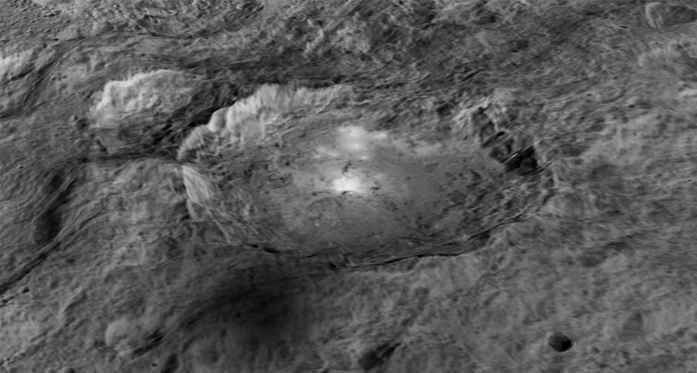
This enhanced image of the Occator crater is exaggerated by a factor of 5 in the vertical dimension. 这张增强的Occator撞击坑图像在垂直方向上被放大了5倍。 |
 |
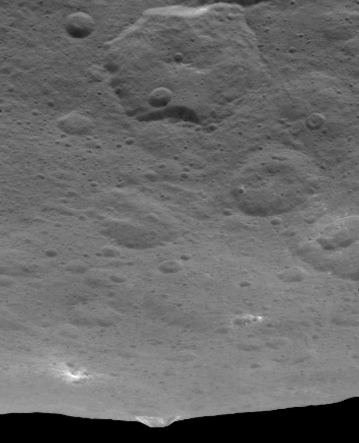 |
"In addition to the bright spots, the latest images also show a mountain with steep slopes protruding from a relatively smooth area of the dwarf planet's surface. The structure rises about 3 miles (5 kilometers) above the surface." NASA 除明亮的斑点外,最新图像还显示了一座山峰从矮行星表面相对平滑的区域突起,山体坡度陡峭。该结构高出表面约3英里(5公里)。NASA Maybe that bump on the bottom side of this photo doesn't look all that impressive, but it is a 3-mile-high mountain! 也许这张照片底部的那座山看起来并不那么壮观,但它高达3英里! |
Ceres was discovered on Jan. 1, 1801 by Giuseppe Piazzi of Italy. Ceres may have formed later than Vesta, and with a cooler interior. Current evidence suggests that Vesta only retained a small amount of water because it formed earlier, when radioactive material was more abundant, which would have produced more heat. Ceres, in contrast, has a thick ice mantle and may even have an ocean beneath its icy crust. Ceres, with an average diameter of 590 miles (950 kilometers), is also the largest body in the asteroid belt, the strip of solar system real estate between Mars and Jupiter. By comparison, Vesta has an average diameter of 326 miles (525 kilometers), and is the second most massive body in the belt.
Solar System Illustration
Solar System Concepts
Reference
Chaisson and McMillan
Ch 14
| HyperPhysics********** Astrophysics
HyperPhysics ********** 天体物理学 | R Nave |