Vesta
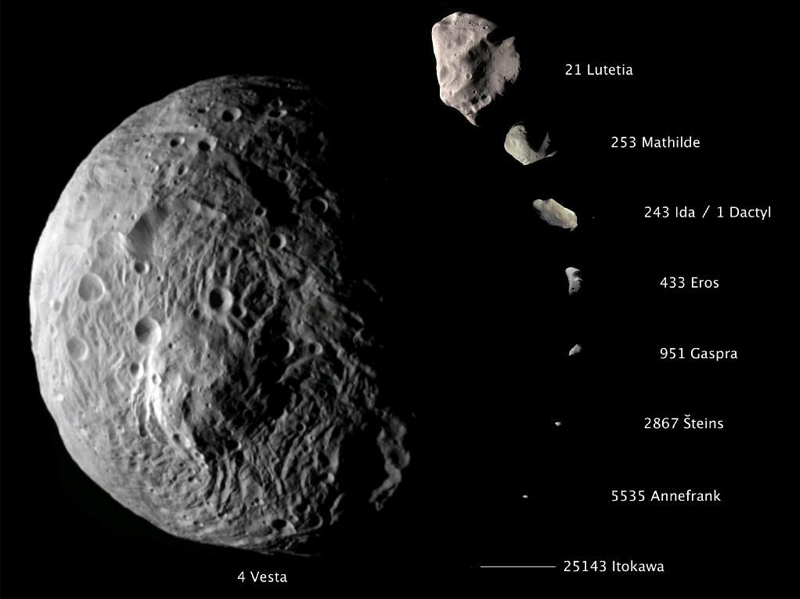
Image credit: NASA/JPL-Caltech/JAXA/ESA, source NASA/JPL
The asteroid Vesta is shown with size comparison to several other asteroids. This image of Vesta was taken by the Dawn spacecraft. When Dawn entered orbit around Vesta on July 15, 2011, it was the first probe to enter orbit around an object in the main asteroid belt between Mars and Jupiter.
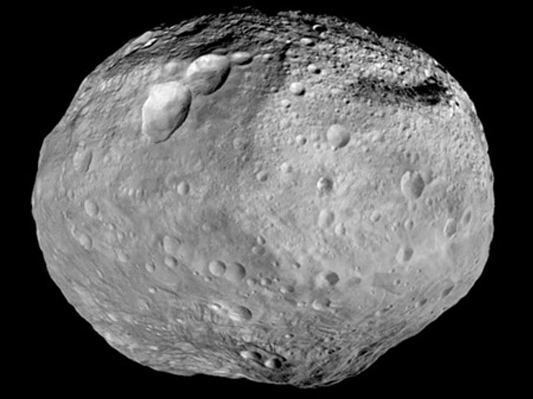 |
This image of Vesta was taken as Dawn was leaving its orbit around the asteroid. Vesta is 330 miles (530 kilometers) in diameter and the second most massive object in the asteroid belt after Ceres. Ground- and space-based telescopes have obtained images of Vesta for about two centuries, but they have not been able to see much detail on its surface. 这张照片是 Dawn 卫星在离开围绕小行星的轨道时拍摄的。维斯塔的直径为 330 英里(530 公里),是小行星带中仅次于谷神星的第二大天体。地面和空间望远镜在过去两个世纪中已经获得了维斯塔的图像,但尚未能清晰看到其表面的细节。
|
Minor planet (4) Vesta was first sighted through a telescope on March 29, 1807 by Heinrich Wilhelm Matthaus Olbers (1758-1840). Subsequent observations determined that the planetary body has an orbital period of 3.63 years, with a semi-major axis of around 2.36 AUs (slightly closer than Ceres's 2.77 AUs) and an eccentricity of 0.090 and an inclination of 7.14 degrees from the plane of the ecliptic. Its orbit places Vesta in the Main Asteriod Belt, but the object more closely resembles a small planet or Earth's Moon than another asteroid. 小行星(4)维斯塔于1807年3月29日首次通过望远镜被观测到,由海因里希·威廉·马atus·奥伯斯(1758-1840)发现。后续观测确定该天体的轨道周期为3.63年,半长轴约为2.36个天文单位(略小于谷神星的2.77个天文单位),偏心率为0.090,轨道倾角为7.14度,相对于黄道面。其轨道将维斯塔置于主小行星带中,但该天体更接近于一颗小行星或地球的月球,而非另一颗小行星。 | 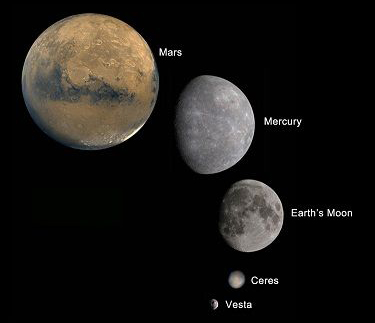 Image credit: Vesta site 图片版权:Vesta site |
Solar System Illustration
Solar System Concepts
Reference
Chaisson and McMillan
Ch 14
| HyperPhysics********** Astrophysics
HyperPhysics ********** 天体物理学 | R Nave |