Triple Eclipse on Jupiter
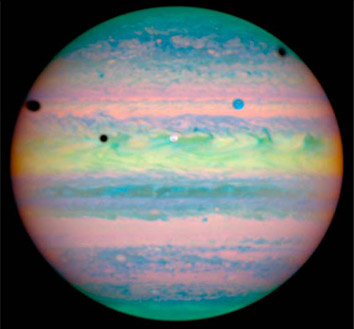 | A lunar eclipse on the Earth is an interesting phenomenon, but consider the variety of eclipse phenomena on Jupiter which has 16 moons! An image captured on March 28, 2004 by NASA's Hubble Space Telescope reveals a rare alignment of three of Jupiter's largest moons Ð Io, Ganymede, and Callisto Ð across the planet's face, producing a triple eclipse. 地球上的月食是一种有趣的现象,但考虑木星上有16颗卫星,其食现象的种类就更加多样了!2004年3月28日,由NASA的哈勃太空望远镜拍摄的一张图片显示,木星的三颗最大卫星——Io、 Ganymede和Callisto——恰好排列在木星表面的上方,形成了罕见的三重食现象。 |
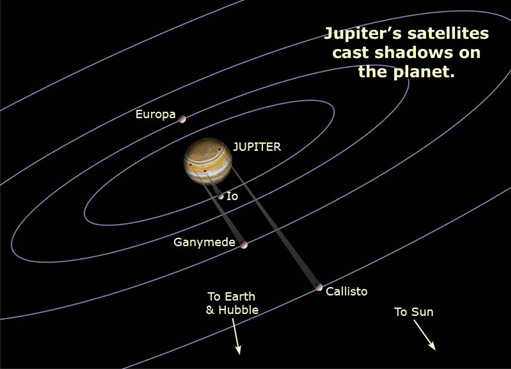
Io's shadow is located just above center and to the left; Ganymede's on the planet's left edge; and Callisto's near the right edge. Only two of the moons, however, are visible in this image. Io is the white circle in the center of the image, and Ganymede is the blue circle at upper right. Callisto is out of the image and to the right.
The NASA graphic below shows the relative positions of the moons.
The NASA graphic below labels the image of the eclipse.
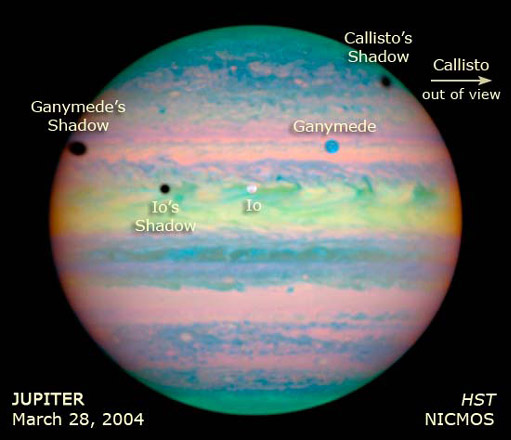
The image is credited to NASA, ESA and E. Karkoschka of the University of Arizona. The detailed web reference is http://hubblesite.org/newscenter/newsdesk/archive/releases/2004/30/
Solar System Illustration
Solar System Concepts
| HyperPhysics********** Astrophysics
HyperPhysics ********** 天体物理学 | R Nave |