Moons of Mars
火星的卫星

Phobos
Phobos(专名或术语) | Color image of Phobos, imaged by the Mars Reconnaissance Orbiter on 23 March 2008.
It was taken from a distance of about 6,800 kilometers (about 4,200 miles). Image credit NASA / JPL-Caltech / University of Arizona
2008年3月23日,火星勘测轨道器拍摄的火卫一彩色图像。该图像拍摄于约6,800公里(约4,200英里)的距离。图片版权:NASA / JPL-Caltech / 亚利桑那大学 |
Phobos has a mean radius of 11 km and is seven times as massive as the outer moon, Deimos.
"Phobos orbits 6,000 km (3,700 mi) from the Martian surface, closer to its primary body than any other known planetary moon. It is so close that it orbits Mars much faster than Mars rotates, and completes an orbit in just 7 hours and 39 minutes. As a result, from the surface of Mars it appears to rise in the west, move across the sky in 4 hours and 15 minutes or less, and set in the east, twice each Martian day."(from Wikipedia)
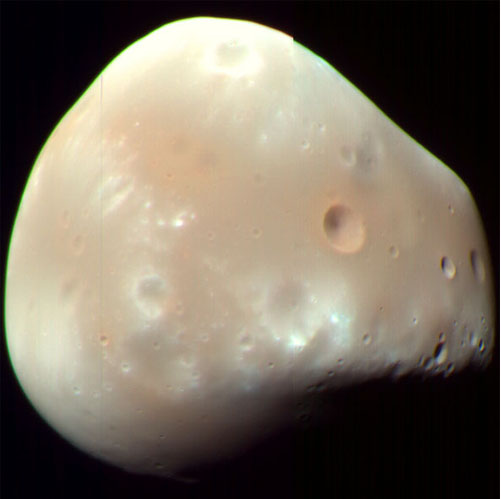
Deimos
德imos | Color-enhanced image of Deimos, a moon of Mars, captured by the HiRISE instrument on the Mars Reconnaissance Orbiter on 21 Feb 2009.
2009年2月21日,火星勘测轨道器上的HiRISE仪器拍摄了一张德imos(火星卫星)的彩色增强图像。 |
The small rocky moons of Mars, Deimos and Phobos, are irregular in shape and comparable in size to the asteroid Gaspra. The three objects are shown at the same scale and almost the same lighting conditions in the image linked below. All three bodies have irregular shapes, testament to their violent histories. Their surfaces are distinctly different, most likely because of very different impact histories.
火星的小岩石卫星德imos和福伯斯形状不规则,大小与小行星加斯普拉相当。下图显示了这三个天体在相同尺度和几乎相同光照条件下的图像。这三个天体都有不规则的形状,这证明了它们动荡的过去。它们的表面明显不同,很可能是因为撞击历史截然不同。
火卫一的平均半径为11公里,其质量是外卫德imos的七倍。火卫一绕火星表面6,000公里(3,700英里)运行,比已知任何其他行星卫星都更接近火星。由于距离太近,它绕火星运行的速度远快于火星自转速度,仅需7小时39分钟即可完成一次轨道运行。因此,从火星表面看,它似乎在西方升起,4小时15分钟内穿越天空,然后在东方落下,每天发生两次。 |
Index
Solar System Illustration
Solar System Concepts
索引 太阳系示意图 太阳系概念 |


