Mercury
|
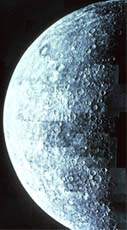
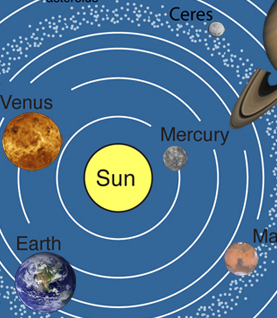 Mercury's small orbit keeps it so close to the Sun that, when viewed from Earth, Mercury is almost always seen in twilight. Mercury receives the maximum amount of sunlight, but its albedo is only 0.1 compared with 0.39 for the Earth, so it is not as bright as it would be with a higher albedo. 水星的轨道很小,使其始终接近太阳,因此从地球上看,水星几乎总是在日出或日落时出现。尽管水星接收到的阳光最多,但其反照率仅为0.1,相比之下地球的反照率为0.39,因此它并不像具有更高反照率时那样明亮。
|
The cliffs and craters (up to 800 miles across) of Mercury were first imaged by NASA's Mariner 10 which passed it at an estimated distance of 705 km on Mar 29, 1974. Mercury's wrinkled surface may be the result of the planet shrinking as it cooled after formation 4.5 billion years ago. Mariner 10 passed by again on Sep 21, 1974 at 48,069 km and a third time on Mar 16, 1975 at a distance of 307 km.
Next to the exceptional orbit of Pluto, Mercury has the orbit with the greatest eccentricity (e = .208) and the greatest inclination to the ecliptic plane ( 7°).
The planet Mercury is tidally coupled to the Sun but this does not produce the 1:1 ratio of orbit period to rotation period like the Earth's Moon. From the Mercury planetary data we find that the sidereal period of Mercury around the Sun is 87.969 days but the planet's period of rotation about its axis is 58.646 days. The planet makes an accurate 3/2 rotations in one orbital period of the planet. This is called a "tidal resonance" or a "spin-orbit resonance".
Solar System Illustration
Solar System Concepts
Mercury Concepts
| HyperPhysics********** Astrophysics
HyperPhysics ********** 天体物理学 | R Nave |