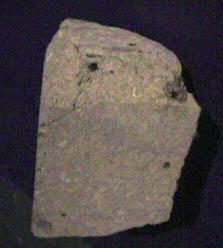
Mars Meteorite ALH 84001
火星陨石 ALH 84001
The meteorite designated ALH 84001 was found in Antarctica in 1984 by a member of the ANSMET meteor-collecting program of the U.S. Academy of Sciences, NASA, and the Smithsonian Institution. It was interesting enough at the time to be the first sample for the catalog for 1984. With a main rock body similar to lavas found just below the surface of the Earth, it nevertheless showed distinct differences leading to its identification as likely Martian in origin. The samarium-neodymium and rubidium-strontium ages of this meteorite were in the neighborhood of 4500 million years, much older than the other "Martian" meteorites. This led to its misclassification with the more abundant Antarctic meteorites that are presumably of asteroid belt origin. In 1994 it was retyped and attributed to martian origin. One of the criteria was the distribution of oxygen isotopes, very different from the meteorites of asteroid belt origin. Another distinction was a relatively short space exposure, as indicated by measurement of 3He, 21Ne, and 38Ar isotopic concentrations. These isotopes are produced by cosmic ray exposure in space and indicate a space exposure time in the range 12-17 million years. As another item of estimate chronology, a carbon-14 technique gives an estimate of 13,000 years for the time that ALH 84001 has been on the Earth's surface.
1984年,由美国科学院、NASA和史密松尼学会的ANSMET陨石收集计划成员在南极发现了被指定为ALH 84001的陨石。当时它足够引人注目,成为1984年目录中的第一份样本。尽管其主要岩石体与地球表面下发现的玄武岩相似,但它显示出显著差异,导致其被认定可能来自火星。该陨石的钐-钕年龄和铷-锶年龄均接近45亿年,比其他“火星”陨石要古老得多。这导致它被错误归类为更常见的南极陨石,这些陨石可能源自小行星带。1994年,它被重新分类并归因于火星起源。其中一个标准是氧同位素的分布,这与小行星带起源的陨石有很大不同。另一个区别是相对短的太空暴露时间,这通过测量3He、21Ne和38Ar同位素浓度来表明。这些同位素是由太空中的宇宙射线暴露产生的,表明太空暴露时间在12至17百万年之间。作为另一个估计年代的项目,碳-14技术估计ALH 84001在地球表面的时间为13,000年。
In 1996, ALH 84001 rose to prominence when a group of NASA scientists announced the discovery of possible fossils of microorganisms in this meteorite. This raised the possibility of confirming that life had existed on Mars. Subsequent studies failed to demonstrate anything that was a clear indication of life.
1996年,ALH 84001因一组NASA科学家宣布在该陨石中发现可能的微生物化石而备受关注。这一发现引发了生命曾在火星上存在的可能性。但后续研究未能证明有任何明确的生命迹象。
Reference: http://calspace.uscd.edu/Mars99/docs/library/science/mars_meteorites1.html
参考:http://calspace.uscd.edu/Mars99/docs/library/science/mars_meteorites1.html |