Sunspots and Solar Storms
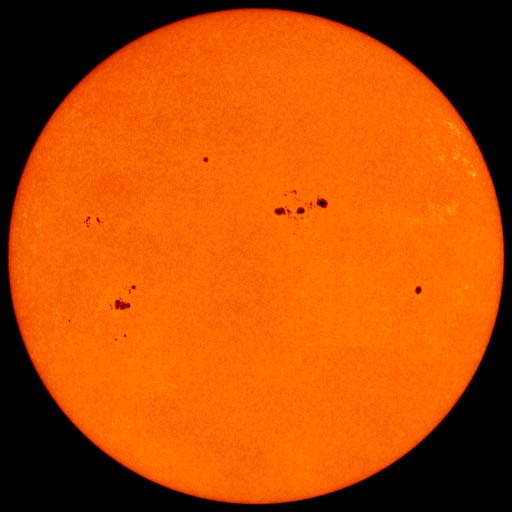
Galileo was the first to study dark spots on the Sun which we call "sunspots". They typically measure about 10,000 kilometers across, which makes them on the order of the size of the Earth. They often occur in groups, and come and go. At some times the Sun has hundreds of sunspots, while at other times it may have almost none. Individual spots may last from 1 to 100 days. A large group of spots typically lasts 50 days.
The obvious question is "What causes the sunspots?". One observation that is part of the answer is that intense magnetic fields are associated with the sunspots, and that sunspots generally occur in pairs with the magnetic field coming out of one and into the other. If you examine the nature of the magnetic field of a bar magnet, you see that this implies that they are like opposite poles of a magnet. The magnetic fields in the sunspot areas are about 1000 times stronger than the magnetic fields of surrounding, undisturbed areas of the photosphere. Apparently, the sunspot pairs represent points where the internal magnetic field penetrates the surface at one spot and re-enters at the other. All the sunspot pairs in a given hemisphere, north or south, of the sun have the same magnetic polarity. That is, if the re-entry spot is on the side toward the direction of rotation of the Sun, then all the others in that hemisphere will have that orientation as well. At the same time the sunspots in the other hemisphere will have the opposite polarity. This shows that there is a high degree of long-range order in the magnetic field of the Sun, even though the pattern of sunspots seems random.
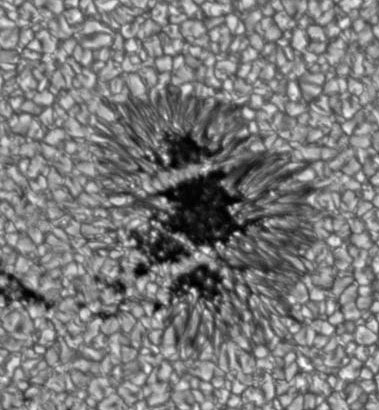 |
This NASA image shows the granulation of the convection cells on the Sun's surface, and the interruption of that pattern to show the darker sunspot. 这张NASA图片显示了太阳表面的对流细胞的粒状结构,以及该模式的中断,以展示较暗的太阳黑子。 Sunspots will generally have a darker center (umbra) surrounded by a ligher region (penumbra). The sunspots represent cooler regions on the Sun's surface. Chaisson & McMillan report typical temperatures of 4500K for the umbra and 5500K for the penumbra, compared to about 5780K as the effective surface temperature of the Sun's surface. 日珥通常有一个较暗的中心(本影),周围是较亮的区域(半影)。日珥代表太阳表面的较冷区域。Chaisson & McMillan报告本影的典型温度为4500K,半影为5500K,相比之下,太阳表面的有效温度约为5780K。
|
In the image at right, there are also bright areas which contrast with the Sun's background. Called faculae, these areas are also magnetic but are concentrated in much smaller bundles. According to the NASA Solar Physics website, these faculae have a greater effect on the solar luminosity than do the dark sunspots. At sunspot maximum, the faculae are also at maximum and make the Sun appear slightly (about 0.1%) brighter than at sunspot minimum. 在右图中,还有与太阳背景形成对比的明亮区域。这些区域被称为斑块(faculae),它们也具有磁性,但集中在 much 更小的束状区域中。根据 NASA 太阳物理学网站的说法,这些斑块对太阳辐射亮度的影响比暗的太阳黑子更大。在太阳黑子高峰期,斑块也达到最大,使太阳看起来略微(约 0.1%)比在太阳黑子低谷期更亮。
Sometimes there are active events called solar prominences associated with sunspots when loops or sheets of glowing gases are ejected from active regions. Even more active events called solar flares can eject material from the Sun into space. 有时,太阳黑子区域会爆发称为日冕物质抛射的活动事件,伴随着发光气体的环状或片状结构被抛射到空间中。更为剧烈的活动事件称为日冕爆发,可以将物质从太阳抛射到空间中。
|
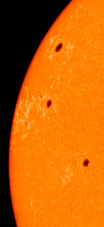 NASA image NASA图像 |
One model for the nature of the sunspots is that the intense magnetic fields inhibit or redirect the convective flow of the hot gases, which is normally toward the surface.
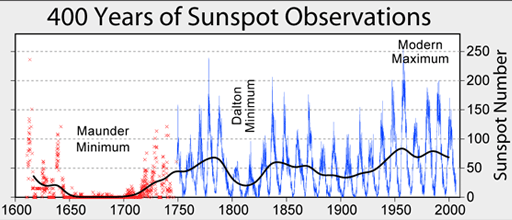
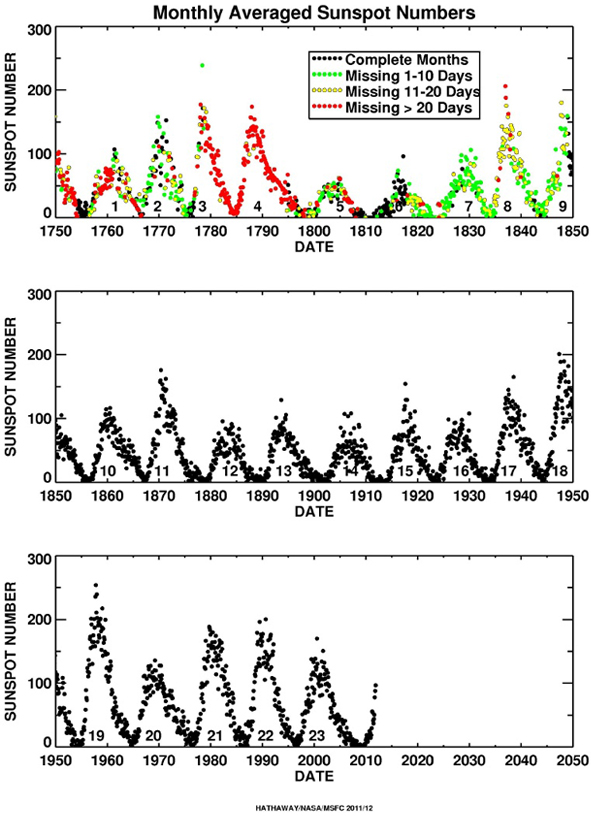
Centuries of observations have shown that there is about a 11 year cycle between maxima of sunspot activity. The exception is a period of exceptionally low activity called the Maunder Minimum.
References:
NASA Solar Science
Solar System Illustration
Solar System Concepts
Sun Concepts
Reference
Chaisson & McMillan
Sec 16.4
| HyperPhysics********** Astrophysics
HyperPhysics ********** 天体物理学 | R Nave |