Sun
|
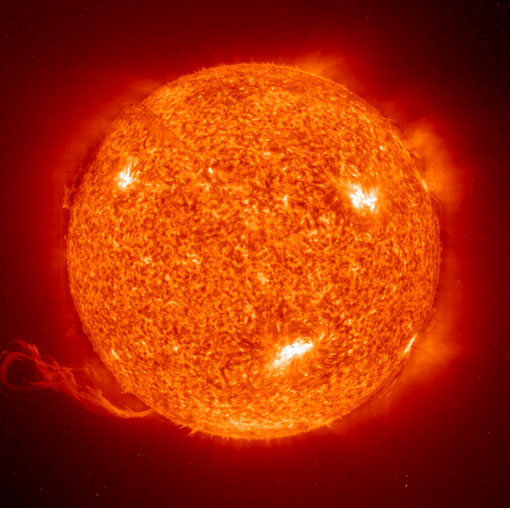
Earth's Sun is a medium-sized star which lies on the main sequence with 90% of the known stars. It has a effective surface temperature is 5780 K, putting it in spectral class G2. Its mass is 1.989 x 1030 kg and its mean radius is 6.96 x 10⁸ meters. The mass of the sun is over 99.8% of the mass of the entire known solar system, leading de Pater and Lissauer to refer lightly to the solar system as "the Sun plus some debris". 太阳是位于主序带的中等大小的恒星,占已知恒星的90%。它的有效表面温度是5780 K,属于光谱类G2。它的质量是1.989 x 10³⁰ kg,平均半径是6.96 x 10⁸米。太阳的质量占整个已知太阳系质量的99.8%,因此德帕特和利萨尔轻描淡写地将太阳系称为“太阳加一些碎片”。
Another interesting item of perspective is that "95% of all stars are less massive than the sun"(Ward & Brownlee). 另一个有趣的视角是,‘95%的所有恒星的质量都小于太阳’(Ward & Brownlee)。
The sun radiates energy at the rate of 3.85 x1026 watts. Just outside the earth's atmosphere solar energy is received, assuming normal incidence, at the rate of 1340 watts per square meter. 太阳以每秒3.85 x10 26瓦的速率辐射能量。在地球大气层外,假设正常入射,每平方米接收到的太阳能为1340瓦。
|
The orbit of Earth ranges from 1.47 to 1.52 x 10¹¹ meters from the Sun. The average light travel time to the earth is 8.3 minutes.
The radius of the sun at 696,000 km is 109 times the Earth's radius. Its surface gravity is 274 m/s2 or 28.0 times that of the Earth. Its mean density is 1410 kg/m3 or 0.255 times the mean density of Earth.
 |
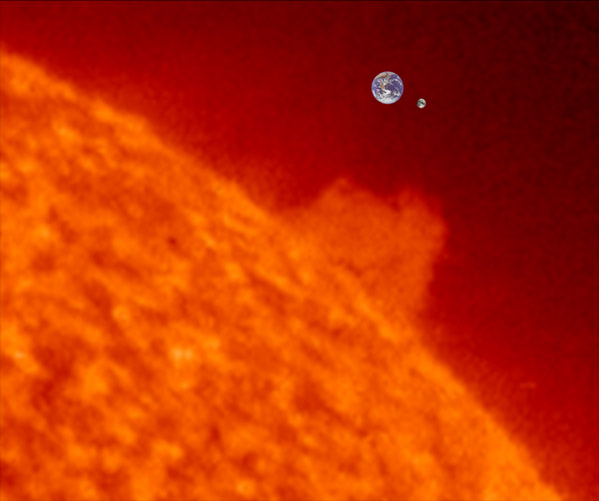
The Sun's diameter of 1,392,000 km is 109 times the Earth's equatorial diameter of 12,756 km. The distance to the Earth from the sun at 149,000,000 km = 1 AU is 107 times the diameter of the Sun and 388 times the Earth-Moon distance. The Earth-Moon distance is not shown to scale in the above composite. The diameter of the Sun is 3.6 times the Earth-Moon distance. Above, the Earth and Moon are scaled relative to an image of the Sun made by the SOHO satellite on January 12, 2007.
太阳的直径为1,392,000公里,是地球赤道直径12,756公里的109倍。太阳到地球的距离为149,000,000公里=1 AU,是太阳直径的107倍,也是地球-月球距离的388倍。上述复合图中未按比例显示地球-月球距离。太阳的直径是地球-月球距离的3.6倍。上述图中,地球和月球的尺寸是根据2007年1月12日SOHO卫星拍摄的太阳图像进行比例缩放的。 |
The composition of the sun is 71% hydrogen, 27.1% helium and less than 2% of all other elements.
The center temperature is modeled to be 15.5 million K. The Sun is fueled by the proton cycle of nuclear fusion.
Escape velocity = 618 km/s
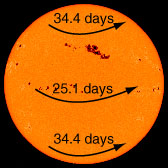 |
Being a gaseous body, the Sun does not have a single period of rotation like a rigid body. The sunspots provide a convenient reference for the measurement of the rotation period at different latitudes. The period of rotation averages 25.4 days, varying from 34.4 days at the poles to 25.1 days at the equator (Chaisson). Its axis is tilted 7.25° relative to the ecliptic. 作为气体天体,太阳不像刚体那样有一个固定的自转周期。太阳黑子为测量不同纬度处的自转周期提供了便利的参考。自转周期平均为25.4天,从极地的34.4天到赤道的25.1天有所变化(Chaisson)。其轴倾角相对于黄道面为7.25°。
|
The visible surface of the Sun (the photosphere) has a granular appearance with a typical dimension of a granule being 1000 kilometers. The image at right is from the NASA Solar Physics website and is credited to G. Scharmer and the Swedish Vacuum Solar Telescope. The granules are described as convection cells which transport heat from the interior of the Sun to the surface. 太阳的可见表面(光球层)呈现出颗粒状的外观,每个颗粒的典型尺寸约为1000公里。右图来自NASA太阳物理网站,由G. Scharmer和瑞典真空太阳望远镜提供。这些颗粒被描述为对流细胞,它们将热量从太阳内部输送到表面。 |  |
The Sun's apparent magnitude is -26.8 and its absolute magnitude is +4.8 . Its greatest angular diameter as seen from the Earth is 32.5' .
The sun is 7.7 kpc or 25,000 light years from the center of the galaxy and orbits the galaxy in about 200 million years. This corresponds to an orbital velocity of 230 km/s.
| Iradiance curve of the Sun
太阳的辐照度曲线 |
Solar System Illustration
Solar System Concepts
Sun Concepts
References
Chaisson & McMillan
Ch 16
de Pater and Lissauer
Ch 1
| HyperPhysics********** Astrophysics
HyperPhysics ********** 天体物理学 | R Nave |