Ideas Leading to the BCS Theory
导致BCS理论的观念
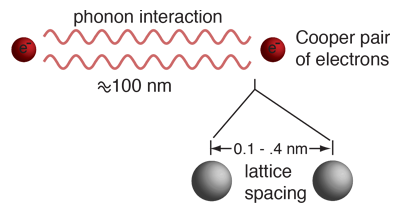 |
The BCS theory of superconductivity has successfully described the measured properties of Type I superconductors. It envisions resistance-free conduction of coupled pairs of electrons called Cooper pairs. This theory is remarkable enough that it is interesting to look at the chain of ideas which led to it. BCS超导理论成功描述了I型超导体的测量性质。它设想的是由称为库珀对的电子对在无电阻的情况下传导。这一理论足够引人注目,以至于值得考察导致它的思想链条。
|
- One of the first steps toward a theory of superconductivity was the realization that there must be a band gap separating the charge carriers from the state of normal conduction.
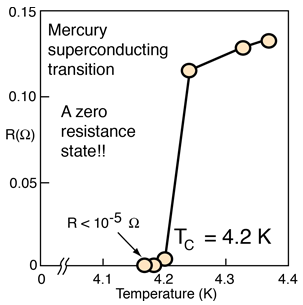
- A band gap was implied by the very fact that the resistance is precisely zero. If charge carriers can move through a crystal lattice without interacting at all, it must be because their energies are quantized such that they do not have any available energy levels within reach of the energies of interaction with the lattice.
晶体中存在带隙这一点,从电阻恰好为零的事实就可以推断出来。如果载流子可以在晶体晶格中毫无相互作用地移动,那必定是因为它们的能量是量子化的,使得它们的能量水平不在与晶格相互作用的能量水平的范围内。
- A band gap is suggested by specific heats of materials like vanadium. The fact that there is an exponentially increasing specific heat as the temperature approaches the critical temperature from below implies that thermal energy is being used to bridge some kind of gap in energy. As the temperature increases, there is an exponential increase in the number of particles which would have enough energy to cross the gap.
有人根据钒等材料的比热容提出存在带隙。当温度从下方接近临界温度时,比热容呈指数增长,这表明热能正在用于跨越某种能量间隙。随着温度升高,拥有足够能量跨越该间隙的粒子数量也呈指数增长。
建立超导理论的第一步是认识到,必须存在一个能隙,将载流子与正常导电状态分隔开来。 - A band gap was implied by the very fact that the resistance is precisely zero. If charge carriers can move through a crystal lattice without interacting at all, it must be because their energies are quantized such that they do not have any available energy levels within reach of the energies of interaction with the lattice.
- The critical temperature for superconductivity must be a measure of the band gap, since the material could lose superconductivity if thermal energy could get charge carriers across the gap.
超导的临界温度必须与能隙有关,因为如果热能足以使载流子跨越能隙,材料可能会失去超导性。
- The critical temperature was found to depend upon isotopic mass. It certainly would not if the conduction was by free electrons alone. This made it evident that the superconducting transition involved some kind of interaction with the crystal lattice.
临界温度被发现与同位素质量有关。如果仅由自由电子导电,它 certainly 不会如此。这表明超导相变涉及与晶体晶格的某种相互作用。
- Single electrons could be eliminated as the charge carriers in superconductivity since with a system of fermions you don't get energy gaps. All available levels up to the Fermi energy fill up.
单个电子可以被排除作为超导体中的载流子,因为在一个费米子系统中你不会得到能量间隙。所有可利用的能级都填满了费米能级。
- The needed boson behavior was consistent with having coupled pairs of electrons with opposite spins. The isotope effect described above suggested that the coupling mechanism involved the crystal lattice, so this gave rise to the phonon model of coupling envisioned with Cooper pairs.
所需的玻色子行为与电子成对耦合且自旋相反是一致的。上述同位素效应表明,耦合机制涉及晶体 lattice,因此产生了与库珀对设想相符的声子模型。
| Experimental evidence
实验证据 |
Superconductivity concepts
Reference Rohlf,Ch 15
索引 超导概念 参考 Rohlf,第15章
| HyperPhysics***** Condensed Matter
HyperPhysics ***** 凝聚态物理 | R Nave |
返回