Bilingual edition: English is preserved and Chinese follows each unit. Terminology uses the confirmed v20260916 glossary; automated semantic review remains traceable.
中英双语版:英文原文完整保留,中文紧随对应单元;术语采用 v20260916 确认表,自动语义审校结果可追溯。

Fermi Level

费米能级
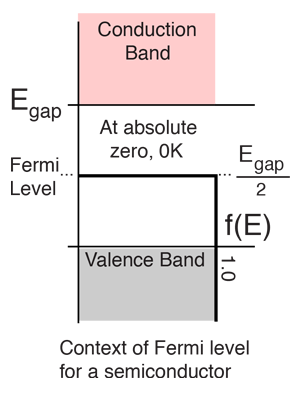
"Fermi level" is the term used to describe the top of the collection of electron energy levels at absolute zero temperature. This concept comes from Fermi-Dirac statistics. Electrons are fermions and by the Pauli exclusion principle cannot exist in identical energy states. So at absolute zero they pack into the lowest available energy states and build up a "Fermi sea" of electron energy states. The Fermi level is the surface of that sea at absolute zero where no electrons will have enough energy to rise above the surface. The concept of the Fermi energy is a crucially important concept for the understanding of the electrical and thermal properties of solids. Both ordinary electrical and thermal processes involve energies of a small fraction of an electron volt. But the Fermi energies of metals are on the order of electron volts. This implies that the vast majority of the electrons cannot receive energy from those processes because there are no available energy states for them to go to within a fraction of an electron volt of their present energy. Limited to a tiny depth of energy, these interactions are limited to "ripples on the Fermi sea".

At higher temperatures a certain fraction, characterized by the Fermi function, will exist above the Fermi level. The Fermi level plays an important role in the band theory of solids. In doped semiconductors, p-type and n-type, the Fermi level is shifted by the impurities, illustrated by their band gaps. The Fermi level is referred to as the electron chemical potential in other contexts.

在较高温度下,一定比例的粒子,由费米函数表征,将存在于费米电平之上。费米电平在固体的能带理论中起着重要作用。在掺杂半导体中,p型和n型半导体的费米电平因杂质而发生偏移,其示意图显示了它们的能带间隙。在其他情况下,费米电平被称为电子的化学势。

In metals, the Fermi energy gives us information about the velocities of the electrons which participate in ordinary electrical conduction. The amount of energy which can be given to an electron in such conduction processes is on the order of micro-electron volts (see copper wire example), so only those electrons very close to the Fermi energy can participate. The Fermi velocity of these conduction electrons can be calculated from the Fermi energy.

在金属中,费米能提供了关于参与普通电导的电子速度的信息。在这样的导电过程中,电子所能获得的能量大约为微电子伏(见铜线示例),因此只有那些接近费米能的电子才能参与其中。这些导电电子的费米速度可以从费米能计算得出。
Table

This speed is a part of the microscopic Ohm's Law for electrical conduction. For a metal, the density of conduction electrons can be implied from the Fermi energy.

这个速率是微观层面的欧姆定律的一部分。对于金属来说,导电电子的密度可以从费米能推导出来。

The Fermi energy also plays an important role in understanding the mystery of why electrons do not contribute significantly to the specific heat of solids at ordinary temperatures, while they are dominant contributors to thermal conductivity and electrical conductivity. Since only a tiny fraction of the electrons in a metal are within the thermal energy kT of the Fermi energy, they are "frozen out" of the heat capacity by the Pauli principle. At very low temperatures, the electron specific heat becomes significant.

费米能也在理解电子在常温下为何不显著贡献于固体的比热容的谜题中起着重要作用,而电子却是热导率和电导率的主要贡献者。由于金属中只有极少数的电子处于费米能附近的热能kT范围内,因此根据泡利原理,这些电子被“冻结”出了热容量。在极低温下,电子的比热容变得显著。
Fermi energies for metals
费米能级(金属)
Table of Fermi energies
费米能量表
'费米能级'是用来描述在绝对零度时电子能量级集合顶部的术语。这一概念源自费米-狄拉克统计。电子是费米子,根据泡利不相容原理,不能处于相同的能量状态。因此,在绝对零度时,电子会填充到最低的可用能量状态,形成一个‘费米海’的电子能量状态。费米能级是该海面在绝对零度时的表面,此时没有电子能够获得足够的能量跃迁到该表面之上。费米能量的概念对于理解固体的电学和热学性质至关重要。普通的电学和热学过程涉及的能量仅为电子伏特的很小分数。但是金属的费米能量则在电子伏特量级。这表明,大部分电子无法从这些过程中获得能量,因为它们在当前能量附近没有可用的能量状态可供跃迁。这些相互作用仅限于‘费米海上的微小波动’。
Index

Semiconductor concepts

Semiconductors for electronics
索引 半导体概念 半导体在电子学中的应用
 
HyperPhysics***** Condensed Matter ***** Electricity and Magnetism
HyperPhysics ***** 凝聚态物理 ***** 电磁学
R Nave
Go Back
返回


Fermi Function

费米函数
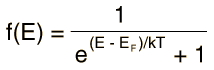
The Fermi function f(E) gives the probability that a given available electron energy state will be occupied at a given temperature. The Fermi function comes from Fermi-Dirac statistics and has the form

The basic nature of this function dictates that at ordinary temperatures, most of the levels up to the Fermi level EF are filled, and relatively few electrons have energies above the Fermi level. The Fermi level is on the order of electron volts (e.g., 7 eV for copper), whereas the thermal energy kT is only about 0.026 eV at 300K. If you put those numbers into the Fermi function at ordinary temperatures, you find that its value is essentially 1 up to the Fermi level, and rapidly approaches zero above it.

这个函数的基本性质决定了,在普通温度下,大多数位于费米能级E_F以下的能级都被填充,而仅有少量电子具有高于费米能级的能量。费米能级的量级是电子伏特(例如,铜的费米能级约为7 eV),而热能kT在300K时仅约0.026 eV。如果你将这些数值代入费米函数,在普通温度下,你会发现其值在费米能级以下基本上为1,而在费米能级以上则迅速趋近于零。

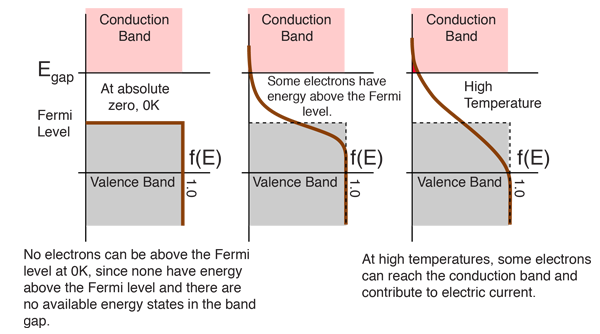
The illustration below shows the implications of the Fermi function for the electrical conductivity of a semiconductor. The band theory of solids gives the picture that there is a sizable gap between the Fermi level and the conduction band of the semiconductor. At higher temperatures, a larger fraction of the electrons can bridge this gap and participate in electrical conduction.

下面的图示展示了费米函数对半导体电导率的影响。固体的带理论表明,半导体的费米能级与导带之间存在较大的空隙。在较高温度下,更多的电子能够跨越这个空隙并参与电导。

Note that although the Fermi function has a finite value in the gap, there is no electron population at those energies (that's what you mean by a gap). The population depends upon the product of the Fermi function and the electron density of states. So in the gap there are no electrons because the density of states is zero. In the conduction band at 0K, there are no electrons even though there are plenty of available states, but the Fermi function is zero. At high temperatures, both the density of states and the Fermi function have finite values in the conduction band, so there is a finite conducting population.

请注意,尽管费米函数在禁带内有有限的值,但那些能量处没有电子(这就是你所说的禁带)。电子的分布取决于费米函数与电子密度态的乘积。因此,在禁带内没有电子,因为密度态为零。在0K时,导带中即使有大量可用状态,也没有电子,但费米函数为零。在高温下,导带中的密度态和费米函数都有有限的值,因此有有限的导电电子分布。
Fermi-Dirac distribution as a function of temperature
费米-狄拉克分布随温度的变化
费米函数f(E)给出了在给定温度下,某个可用的电子能量态被占据的概率。费米函数来源于费米-狄拉克统计,其形式为
Index

Semiconductor concepts

Semiconductors for electronics

Reference
Simpson
Sec 4.7
索引 半导体概念 半导体在电子学中的应用 参考 Simpson 第4.7节
 
HyperPhysics***** Condensed Matter ***** Electricity and Magnetism
HyperPhysics ***** 凝聚态物理 ***** 电磁学
R Nave
Go Back
返回


Density of Energy States

能量态密度
The Fermi function gives the probability of occupying an available energy state, but this must be factored by the number of available energy states to determine how many electrons would reach the conduction band. This density of states is the electron density of states, but there are differences in its implications for conductors and semiconductors. For the conductor, the density of states can be considered to start at the bottom of the valence band and fill up to the Fermi level, but since the conduction band and valence band overlap, the Fermi level is in the conduction band so there are plenty of electrons available for conduction. In the case of the semiconductor, the density of states is of the same form, but the density of states for conduction electrons begins at the top of the gap.

Electron energy density function
电子能量密度函数
费米函数给出了占据可用能量状态的概率,但必须考虑可用能量状态的数量,以确定多少电子会到达导带。这种状态密度是电子的状态密度,但在导体和半导体中的含义有所不同。对于导体,状态密度可以认为从价带底部开始,填充到费米能级,但由于导带和价带重叠,费米能级位于导带中,因此有大量电子可供导电。在半导体的情况下,状态密度形式相同,但导带电子的状态密度从禁带顶部开始。
Index

Semiconductor concepts

Semiconductors for electronics

Reference
Simpson
Sec 4.7
索引 半导体概念 半导体在电子学中的应用 参考 Simpson 第4.7节
 
HyperPhysics***** Condensed Matter ***** Electricity and Magnetism
HyperPhysics ***** 凝聚态物理 ***** 电磁学
R Nave
Go Back
返回


Population of Conduction Band for a Semiconductor

半导体导带中的载流子数

The population of conduction electrons for a semiconductor is given by

半导体中传导电子的数量由以下公式给出
Show
显示

where

For a semiconductor with bandgap eV (1.1 eV for Si, 0.72 eV for Ge)

对于带隙为eV的半导体(硅为1.1 eV,锗为0.72 eV)
中文译文中的待填/计算数值依次对应:1:eg。实际数值以上方原输入框为准。

at temperature K = °C

在温度 K = °C
中文译文中的待填/计算数值依次对应:1:t 2:tc。实际数值以上方原输入框为准。

the conduction electron population is x10^ electrons/m3.

传导电子的数密度为 $10^3$ 个电子/立方米。
中文译文中的待填/计算数值依次对应:1:pb 2:pp。实际数值以上方原输入框为准。

You could use this calculation to verify that the conduction electron population Ncb in germanium doubles for about a 13 degree rise in temperature. For silicon, Ncb doubles for about an 8 degree rise in temperature. Because of the larger band gap, there will be fewer conduction electrons in silicon than germanium for any given temperature.

你可以用这个计算来验证,在温度升高约13度时,锗中的导带电子数N_cb大约翻倍。对于硅来说,N_cb在温度升高约8度时翻倍。由于禁带宽度更大,对于任何给定的温度,硅中的导带电子数都比锗少。
其中
Index

Semiconductor concepts

Semiconductors for electronics

Reference
Simpson
Sec 4.7
索引 半导体概念 半导体在电子学中的应用 参考 Simpson 第4.7节
 
HyperPhysics***** Condensed Matter ***** Electricity and Magnetism
HyperPhysics ***** 凝聚态物理 ***** 电磁学
R Nave
Go Back
返回