Bilingual edition: English is preserved and Chinese follows each unit. Terminology uses the confirmed v20260916 glossary; automated semantic review remains traceable.
中英双语版:英文原文完整保留,中文紧随对应单元;术语采用 v20260916 确认表,自动语义审校结果可追溯。

BCS Theory of Superconductivity

BCS超导理论

The properties of Type I superconductors were modeled successfully by the efforts of John Bardeen, Leon Cooper, and Robert Schrieffer in what is commonly called the BCS theory. A key conceptual element in this theory is the pairing of electrons close to the Fermi level into Cooper pairs through interaction with the crystal lattice. This pairing results from a slight attraction between the electrons related to lattice vibrations; the coupling to the lattice is called a phonon interaction.

I型超导体的性质成功地由约翰·巴里顿、伦·科珀和罗伯特·施里弗的努力所建模,这通常被称为BCS理论。该理论的一个关键概念要素是电子在费米能级附近通过与晶体晶格的相互作用形成库珀对。这种配对源于电子之间微弱的吸引力,这种吸引力与晶格振动有关;电子与晶格的耦合称为声子相互作用。

Pairs of electrons can behave very differently from single electrons which are fermions and must obey the Pauli exclusion principle. The pairs of electrons act more like bosons which can condense into the same energy level. The electron pairs have a slightly lower energy and leave an energy gap above them on the order of .001 eV which inhibits the kind of collision interactions which lead to ordinary resistivity. For temperatures such that the thermal energy is less than the band gap, the material exhibits zero resistivity.

成对的电子行为与单个电子(费米子)截然不同,后者必须遵守泡利不相容原理。这些成对的电子更像玻色子,可以凝聚到同一个能级。电子对具有略低的能量,并在它们之上留下约0.001 eV的能量间隙,这种间隙抑制了导致普通电阻率的碰撞相互作用。当热能小于带隙时,材料表现出零电阻率。

Bardeen, Cooper, and Schrieffer received the Nobel Prize in 1972 for the development of the theory of superconductivity.

巴德、库珀和施里弗因发展超导理论而获得了1972年的诺贝尔奖。

Ideas leading to the BCS theory
导致BCS理论的观念
Experimental evidence
实验证据
Index

Superconductivity concepts

Reference Rohlf,Ch 15
索引 超导概念 参考 Rohlf,第15章
 
HyperPhysics***** Condensed Matter
HyperPhysics ***** 凝聚态物理
R Nave
Go Back
返回


Experimental Support: BCS Theory

实验支持:BCS理论

Electrons acting as pairs via lattice interaction? How did they come up with that idea for the BCS theory of superconductivity? The evidence for a small band gap at the Fermi level was a key piece in the puzzle. That evidence comes from the existence of a critical temperature, the existence of a critical magnetic field, and the exponential nature of the heat capacity variation in the Type I superconductors.

电子通过晶格相互作用成对作用?他们是如何提出BCS超导理论的?在费米能级处存在一个小的能带隙的证据是解开谜题的关键。这一证据来自临界温度的存在、临界磁场的存在,以及I型超导体中热容量变化的指数性质。

The evidence for interaction with the crystal lattice came first from the isotope effect on the critical temperature.

与晶体相互作用的证据首先来自临界温度的同位素效应。

The band gap suggested a phase transition in which there was a kind of condensation, like a Bose-Einstein condensation, but electrons alone cannot condense into the same energy level (Pauli exclusion principle). Yet a drastic change in conductivity demanded a drastic change in electron behavior. Perhaps coupled pairs of electrons with antiparallel spins could act like bosons?

带隙暗示了一种相变,其中存在一种类似玻色-爱因斯坦凝聚的冷凝现象,但单个电子无法凝聚到同一个能级(泡利不相容原理)。然而,导电性发生了剧烈变化,要求电子行为也发生剧烈变化。或许,自旋相反的电子对可以像玻色子一样行为?

Band gap energy vs temperature
带隙能量与温度的关系
Index

Superconductivity concepts

Reference Rohlf,Ch 15
索引 超导概念 参考 Rohlf,第15章
 
HyperPhysics***** Condensed Matter
HyperPhysics ***** 凝聚态物理
R Nave
Go Back
返回


Measured Superconductor Bandgap

测得的超导体能隙

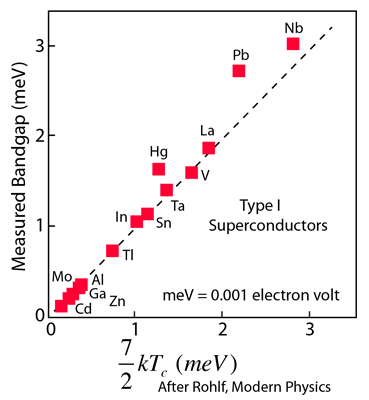
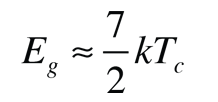
The measured bandgap in Type I superconductors is one of the pieces of experimental evidence which supports the BCS theory. The BCS theory predicts a bandgap of

在I型超导体中测得的能隙是支持BCS理论的一条实验证据。BCS理论预测一个能隙为

where Tc is the critical temperature for the superconductor. The energy gap is related to the coherence length for the superconductor, one of the two characteristic lengths associated with superconductivity.

Energy gap variations with temperature
能量间隙随温度的变化
其中Tc是超导体的临界温度。能隙与超导体的相干长度有关,这是与超导性相关的两个特征长度之一。
Index

Superconductivity concepts

Reference Rohlf,Ch 15
索引 超导概念 参考 Rohlf,第15章
 
HyperPhysics***** Condensed Matter
HyperPhysics ***** 凝聚态物理
R Nave
Go Back
返回


Energy Gap in Superconductors as a Function of Temperature

超导体中的能隙作为温度函数

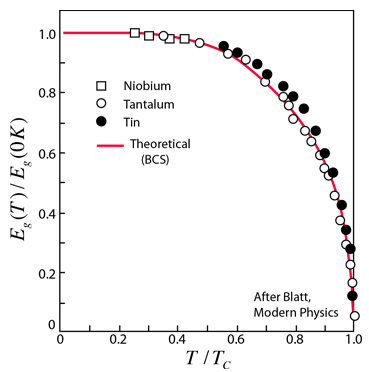
The effective energy gap in superconductors can be measured in microwave absorption experiments. The data at left offer general confirmation of the BCS theory of superconductivity. The data is attributed to Townsend and Sutton.

超导体的有效能隙可以通过微波吸收实验测量。左图数据对BCS超导理论提供了普遍确认。这些数据归因于Townsend和Sutton。

The reduction of the energy gap as you approach the critical temperature can be taken as an indication that the charge carriers have some sort of collective nature. That is, the charge carriers must consist of at least two things which are bound together, and the binding energy is weakening as you approach the critical temperature. Above the critical temperature, such collections do not exist, and normal resistivity prevails. This kind of evidence, along with the isotope effect which showed that the crystal lattice was involved, helped to suggest the picture of paired electrons bound together by phonon interactions with the lattice.

当你接近临界温度时,能量间隙的减小可以被视为电荷载体具有某种集体性质的迹象。也就是说,电荷载体必须由至少两种相互结合的成分组成,而随着你接近临界温度,结合能正在减弱。在临界温度以上,这样的集合体并不存在,正常电阻率占主导。这种证据,加上显示晶体格点参与的同位素效应,有助于提出电子通过声子与晶格的相互作用而结合在一起的图像。
Index

Superconductivity concepts

References
Blatt,
Ch 13

Kittel,
Solid State, Ch 12
索引 超导概念 参考文献 Blatt ,第13章 Kittel ,固体物理,第12章
 
HyperPhysics***** Condensed Matter
HyperPhysics ***** 凝聚态物理
R Nave
Go Back
返回


Vanadium Heat Capacity

钒的比热容

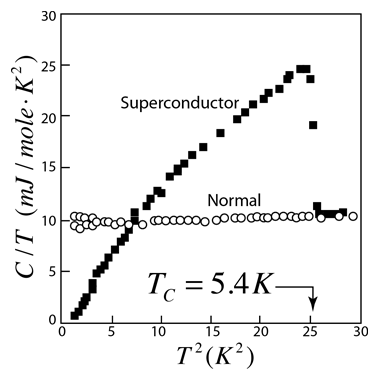
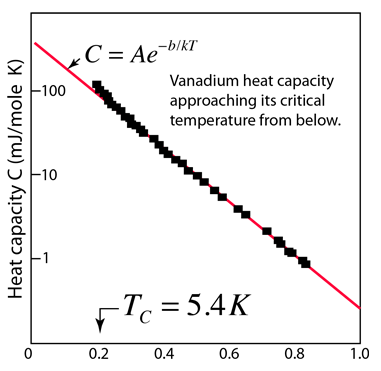
The heat capacity of superconducting vanadium is very different from that of vanadium which is kept in the normal state by imposing a magnetic field on the sample. The exponential increase in heat capacity near the critical temperature suggests an energy bandgap for the superconducting material.

超导钒的热容量与在样品上施加磁场使其保持正常态的钒的热容量有很大不同。接近临界温度时热容量的指数增长表明超导材料存在一个能量带隙。

This evidence for a bandgap is one of the pieces of experimental evidence which supports the BCS theory of superconductivity.

这种证据表明存在能隙,是支持BCS超导理论的实验证据之一。
Index

Superconductivity concepts

Reference Rohlf, Ch 15
索引 超导概念 参考 Rohlf,第15章
 
HyperPhysics***** Condensed Matter
HyperPhysics ***** 凝聚态物理
R Nave
Go Back
返回


Exponential Heat Capacity

指数热容量

As it is warmed toward its critical temperature, the heat capacity of vanadium increases 100-fold in just 4 K. This exponential increase suggests an energy gap which must be bridged by thermal energy. This energy gap evidence was part of the experimental motivation for the BCS theory of superconductivity.

当钒被加热至其临界温度时,其热容在4 K内增加100倍。这种指数增长表明存在一个能量间隙,必须由热能来克服。这一能量间隙的证据是BCS超导理论实验动机的一部分。

From comparisons with other methods of determining the band gap, it is found that the constant "b" in the exponential heat capacity expression is one-half the band gap energy. If the slope of the line in the illustration is determined by scaling, it is about b=7.4k, corresponding to an energy gap of about 1.3 meV. This is slightly lower than the value obtained by other methods. The value predicted for vanadium from its critical temperature of 5.38 K by the BCS theory is 1.6 meV, and the measured value is close to that.

与其它确定带隙的方法相比,发现指数热容量表达式中的常数“b”是带隙能量的一半。如果根据图中的斜率进行标定,那么b≈7.4k,对应带隙能量约为1.3 meV。这个值略低于其他方法得到的值。根据BCS理论,由钒的临界温度5.38 K预测的带隙能量为1.6 meV,而测量值接近这个数值。
Compare heat capacity of normal and superconducting vanadium.
比较正常和超导钒的热容量


Data from W. S. Korak, et al., Phys. Rev. 102, 656 (1956)
W. S. Korak 等人,Phys. Rev. 102, 656 (1956) 的数据
Index

Superconductivity concepts

Reference Rohlf,Ch 15
索引 超导概念 参考 Rohlf,第15章
 
HyperPhysics***** Condensed Matter
HyperPhysics ***** 凝聚态物理
R Nave
Go Back
返回