|
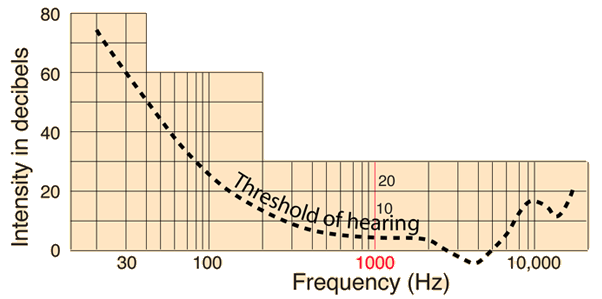
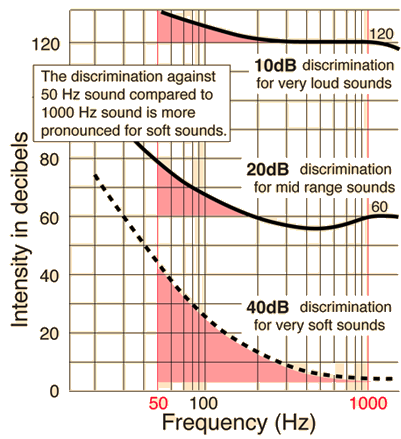
For very soft sounds, near the threshold of hearing, the ear strongly discriminates agains low frequencies. For mid-range sounds around 60 phons, the discrimination is not so pronounced and for very loud sounds in the neighborhood of 120 phons, the hearing response is more nearly flat. 对于非常柔和的声音,接近听阈时,耳朵对低频有很强的分辨能力。对于约60phon的中等强度声音,分辨能力不那么明显;而对于约120phon的非常响亮的声音,听觉响应近似平坦。
对低频的逐步歧视 |
One of the implications of this aspect of human hearing is that you will perceive a progressive loss of bass frequencies as a given sound becomes softer and softer. For example if you are listening to a recording of an orchestra and you turn the volume down, you will find that the bass instruments are less and less prominent. This is the purpose of the so-called "loudness contours" on audio amplifiers; they allow you to boost the bass frequencies when you are listening at low sound levels to give you a more realistic balance of the high and low frequencies in the music.
This aspect of human hearing has important implications for the design of auditoriums for music performance. As the sound gets softer toward the back of the auditorium, the listener will perceive a loss of bass frequencies, an undesirable condition. To overcome this "bass loss problem", auditorium designs must attempt to provide some reinforcement of the low frequencies.
| Equal loudness curves
等响度曲线 |
Hearing concepts
| HyperPhysics***** Sound
HyperPhysics ***** 声音 | R Nave |