Masking遮蔽
我知道我听不到你说话,当水在流的时候!
This statement carries the essentials of the conventional wisdom about sound masking. Low-frequency, broad banded sounds (like water running) will mask higher frequency sounds which are softer at the listener's ear (a conversational tone from across the room). For a single frequency masking tone, masking curves can be determined experimentally. Also, from the idea of the just noticeable difference in sound intensity, one can approximately calculate the amount of a added second sound that would exceed the jnd and thus be audible. 这一陈述包含了关于声音遮蔽的常识。低频、宽带的声音(如流水声)会遮蔽在听众耳中较弱的高频声音(如从房间另一端传来的对话声)。对于单一频率的遮蔽音,可以通过实验确定遮蔽曲线。此外,从声音强度的可察觉差这一概念出发,可以近似计算出添加的第二个声音的强度,使其超过可察觉差并因此被听见。
Broadband white noise tends to mask all frequencies, and is approximately linear in that masking. By linear you mean that if you raise the white noise by 10 dB, you have to raise everything else 10 dB to hear it. 宽带白噪声倾向于掩盖所有频率,并且在该掩盖过程中近似呈线性关系。所谓线性,是指如果你将白噪声提高10 dB,就必须将其他所有内容也提高10 dB才能听到。
|
Index Loudness concepts Hearing concepts Reference Backus Ch 5 索引 响度概念 听觉概念 参考 Backus 第5章 | ||
|
Go Back
返回 |
Masking Curves掩膜曲线
Shown are the masking effects of 1200 Hz tones of various intensities. Note that it is effective in masking sounds above it in frequency, but not below. The dips at 1200 and 2400 come from the effects of beats, which make the masked tone easier to detect. 图中显示了不同强度的1200 Hz音调的掩蔽效应。请注意,它能有效掩蔽其频率以上的声音,但不能掩蔽频率以下的声音。1200 Hz和2400 Hz处的凹陷来自拍频效应,这种效应使被掩蔽的音调更容易被检测到。
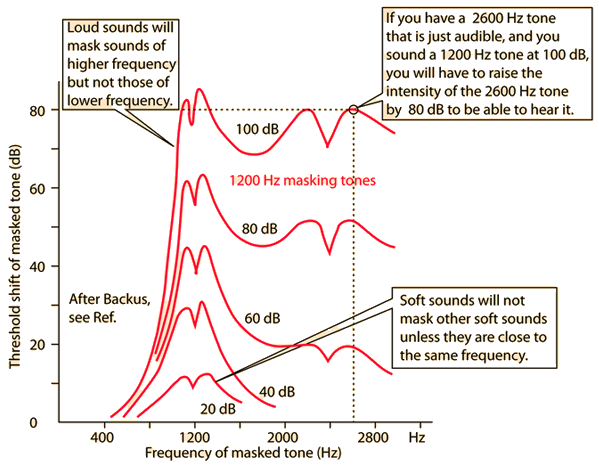
![]() Backus credits this data to Harvey Fletcher in "Speech and Hearing in Communication", p155" Backus 将这些数据归因于 Harvey Fletcher 在《Speech and Hearing in Communication》一书中,第155页。 Although masking is a complex phenomena, the experience of masking of higher frequency sounds by strong low frequency sounds is common experience and of considerable significance to orchestration. It is easy to create circumstances where a strong bass brass section can mask the softer, higher frequency sounds of the woodwind section. 尽管掩蔽现象复杂,但高频率声音被强低频率声音掩蔽的经验是一种常见现象,对编曲具有重要意义。很容易创造出一种情境,使得强低音铜管声部可以掩蔽木管声部中较弱的高频声音。 |
Index Loudness concepts Hearing concepts Reference Backus Ch 5 索引 响度概念 听觉概念 参考 Backus 第5章 | ||
|
Go Back
返回 |
Audibility Threshold, Second Sound可听阈,第二声
If the general Just Noticeable Difference for sound intensity is taken to be one decibel, then the addition of a second sound would have to raise the total intensity by 1 dB to be heard. This is roughly a 25% increase, so the second sound would have to have about 1/4 the intensity, or about 6 dB less than the existing, masking sound. While this approach is not an adequate treatment of the complex subject of masking, it does permit a calculation of the amount of a second sound required to meet any criterion which is stated in terms of the decibel increase in the sound field. 如果将声音强度的普通可察觉差别取为1分贝,那么添加一个第二声音就必须使总强度增加1分贝才能被听见。这大约是25%的增加,因此第二个声音的强度必须约为现有掩蔽声音的四分之一,或者大约比现有掩蔽声音低6分贝。虽然这种方法并不是对掩蔽这一复杂主题的充分处理,但它允许计算出满足任何以分贝增加量为标准的第二声音的强度。
The real test of any model is its comparison with experiment, and if you compare this calculation with the experimental curves for masking by pure tones above, you will find that it does not agree well. One of the things this suggests is that using a 1 dB increase in overall sound field intensity as the just noticeable difference is an oversimplification. In fact, it tells you that you should be quite wary of using the 1 dB JND at all except for the assessment of how much you should increase the dB level of the same sound to produce an audible difference.
任何模型的真正检验在于其与实验的比较,如果你将这一计算结果与上述纯音掩蔽的实验曲线进行比较,会发现两者并不十分吻合。这表明,将整体声场强度的1 dB增加作为可察觉差异来处理是一种过于简化的做法。事实上,这说明你应当谨慎地仅在评估同一声音增加多少dB才能产生可听见差异时,才使用1 dB的JND。
如果存在一个电平为dB的掩蔽声,且要使这种变化被听见,总声场必须增加dB,那么如果另一个声音的电平低于dB,它将被掩蔽。 中文译文中的待填/计算数值依次对应:1:i 2:a 3:db。实际数值以上方原输入框为准。 |
Index Loudness concepts Hearing concepts Reference Backus Ch 5 索引 响度概念 听觉概念 参考 Backus 第5章 | ||
|
Go Back
返回 |
Calculation Details, Masking Threshold计算细节,掩蔽阈值
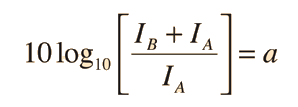
If the amount of sound B which must be added to pre-existing sound A must increase the overall decibel level by an amount a in decibels, that requirement can be stated as 如果必须将已有的声音A加上声音B,以使总声级提高a个分贝,则这一要求可以表述为
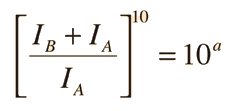
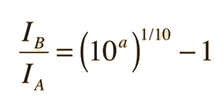
![]() ![]() Solving for the ratio of the two intensities 求解两种强度的比值
![]() This ratio in decibels can be subtracted from the level IA in dB to get the threshold for IB which could just be heard. 这个以分贝为单位的比值可以从I A的电平中减去,以得到I B的阈值,即人耳刚刚能听到的水平。
根据对数的性质,两边都可以表示为10的幂: |
Index Loudness concepts Hearing concepts 索引 响度概念 听觉概念 | ||
|
Go Back
返回 |