Bilingual edition: English is preserved and Chinese follows each unit. Terminology uses the confirmed v20260916 glossary; automated semantic review remains traceable.
中英双语版:英文原文完整保留,中文紧随对应单元;术语采用 v20260916 确认表,自动语义审校结果可追溯。

Equalization

等化

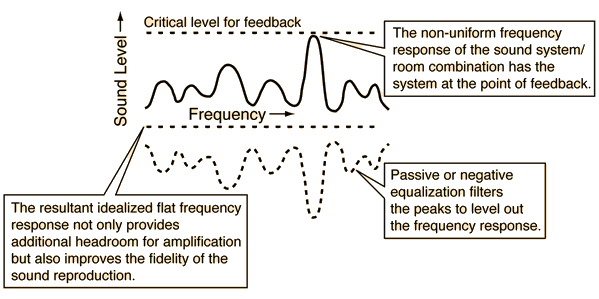
One of the most powerful tools for increasing the potential acoustic gain of a sound amplification system is the production of a "mirror image" filter to level the frequency response of the system. The process of equalizing an auditorium also improves the fidelity of the sound. The process of leveling out the frequency response of the sound system removes the peaks which will ring the system before sufficient gain is achieved.

增强声音放大系统潜在声学增益的一种最强大工具是产生一个‘镜像’滤波器以平衡系统的频率响应。对礼堂进行均衡处理也提高了声音的保真度。对声音系统频率响应的平衡处理会消除那些在未达到足够增益之前就会使系统产生回响的峰值。
Ways to increase Potential Acoustic Gain
提高潜在声增益的方法
Index

Sound reproduction concepts
索引 声学再现概念
 
HyperPhysics***** Sound
HyperPhysics ***** 声音
R Nave
Go Back
返回


Equalization Process

均化过程

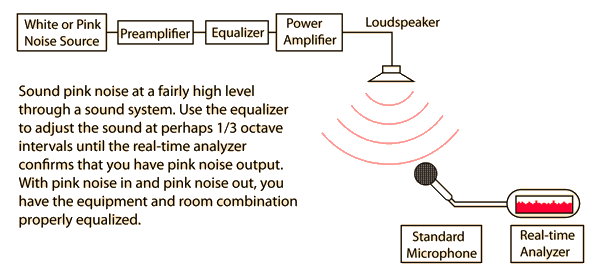
The basic idea of room equalization is for the sound system to produce in the room exactly the same signal which is put into the system. So if you put pink noise in and get pink noise out, you are close to that goal. A real-time analyzer can be set so that a pink noise input produces a straight horizontal line on its display. With pink noise input, the equalizer is then adjusted to get a straight line output. The sound system is then equalized to the room.

房间均衡的基本思想是让声音系统在房间内产生与输入信号完全相同的信号。因此,如果你将粉红噪声输入系统并得到粉红噪声输出,你就接近实现了这个目标。一个实时分析仪可以设置成,当粉红噪声输入时,其显示上会出现一条水平直线。在粉红噪声输入的情况下,均衡器则被调整以得到一条水平直线输出。此时,声音系统就已根据房间进行了均衡处理。
Index

Sound reproduction concepts
索引 声学再现概念
 
HyperPhysics***** Sound
HyperPhysics ***** 声音
R Nave
Go Back
返回


White Noise

白噪声

For processes of testing and equalizing rooms and auditoriums, it is convenient to have broad-band noise signals. Typically, white noise or pink noise is used.

对于房间和礼堂的测试和平衡过程,使用宽带噪声信号是方便的。通常使用白噪声或粉噪声。
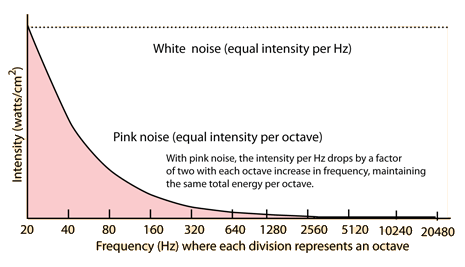
White noise is noise whose amplitude is constant throughout the audible frequency range. It is described as "white" by analogy to white light, which is a mixture of all visible wavelengths of light. It is fairly easy to produce white noise - it is often produced by a random noise generator in which all frequencies are equally probable. The illustration above includes the entire standard audio frequency range. The sound of white noise is similar to the sound of steam escaping from an overheated steam boiler. The ear is aware of a lot of high frequency sound in white noise since the ear is more sensitive to high frequencies. Since each successive octave of frequency will have twice as many Hz in its range, the power in white noise will increase by a factor of two for each octave band. Twice the power corresponds to a 3 decibel increase, so white noise is said to increase 3 dB per octave in power.

Representing the differences between white and pink noise in dB makes the difference seem less drastic.

用分贝表示白噪声和粉噪声的差异,会使这种差异显得不那么剧烈。
白噪声是一种在可听频率范围内幅度恒定的噪声。它被称作‘白噪声’,是类比于白光的,白光是所有可见光波长的混合物。产生白噪声相对容易,通常由一个随机噪声发生器产生,其中所有频率的概率相等。上图包含了标准音频频率范围。白噪声的声音类似于过热蒸汽锅炉中蒸汽逸出的声音。由于人耳对高频声音更敏感,人耳在白噪声中能感知到很多高频声音。由于每个后续的八度频率范围内的Hz数是前一个八度的两倍,因此白噪声的功率在每个八度带中会增加一倍。两倍的功率对应3分贝的增加,因此白噪声的功率每八度增加3分贝。
Index

Sound reproduction concepts
索引 声学再现概念
 
HyperPhysics***** Sound
HyperPhysics ***** 声音
R Nave
Go Back
返回


Pink Noise

粉红噪声

Pink noise, rather than white noise, is often the choice for testing and equalizing rooms and auditoriums. Broad-band noise signals are desirable for such testing.

粉红噪声,而不是白噪声,常被用于测试和校准房间和礼堂。宽频带噪声信号对于此类测试是理想的。

Whereas white noise is defined as sound with equal power per Hz in frequency, pink noise is filtered to give equal power per octave or equal power per 1/3 octave. Since the number of Hz in each successive octave increases by two, this means the power of pink noise per Hz of bandwidth decreases by a factor of two or 3 decibels per octave.

尽管白噪声被定义为频率上每赫兹具有相等的功率,粉红噪声则经过滤波处理,使得每 octave(倍频程)或每 1/3 octave 的功率相等。由于每个倍频程中赫兹数增加一倍,这意味着粉红噪声在每赫兹带宽中的功率会减少一半或每 octave 降低 3 分贝。

Since pink noise has relatively more bass than white noise, it sounds more like the roar of a waterfall than like the higher hissing sound of white noise.

由于粉红噪声比白噪声更强调低频部分,因此听起来更像瀑布的轰鸣声,而不是白噪声那种更高频的嘶嘶声。

When pink noise is chosen for equalizing auditoriums, real-time analyzers can be set up so that they display a straight horizontal line when they receive pink noise. With pink noise input to the sound system, the response curve can be adjusted to produce pink noise in the auditorium as measured by the real-time analyzer. This provides optimum fidelity as well as increases the potential acoustic gain of the sound amplification system.

当选择粉色噪声用于均衡礼堂时,可以设置实时分析仪,使其在接收到粉色噪声时显示一条水平直线。当粉色噪声输入到音响系统中时,可以调整响应曲线,使礼堂中的噪声呈现为粉色噪声,这由实时分析仪测量。这可以提供最佳保真度,并增加音响放大系统的潜在声学增益。
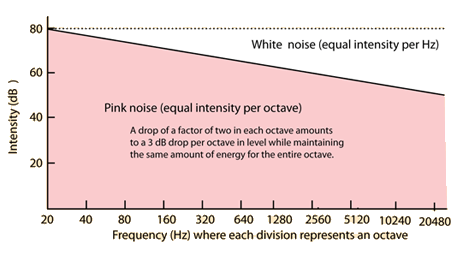
With pink noise, the intensity is filtered to drop 30 dB over the 10 octave audible frequency range.

在粉红噪声中,强度被滤波处理,使其在10个 octave的可听频率范围内降低30 dB。

The difference between pink noise and white noise is exaggerated in the top illustration by the process of making the vertical axis linear with intensity. The reason is that the ear is definitely not linear in its response to sound. The sound intensity of pink noise drops by a factor of 1000 over the audible frequency range, and that sounds very drastic. That drop should be considered in light of the "rule of thumb" for loudness perception: the fact that dropping the sound intensity by a factor of 10 or 10dB results in a sound that is perceived to be half as loud to the human ear. If each 10dB of drop results in a sound half as loud, then a 30dB drop will result in a sound perceived as 1/8 as loud - significantly less, to be sure, but not as drastic as the factor of 1/1000 in intensity would imply.

粉红噪声与白噪声之间的差异在顶部示意图中被夸大,这是通过将垂直轴线性化以强度为单位来实现的。原因在于,人耳对声音的响应绝非线性。粉红噪声在可听频率范围内声音强度下降1000倍,这听起来非常剧烈。然而,这一下降应结合“经验法则”来考虑:即声音强度下降10倍或10分贝会使声音被感知为一半响度。如果每下降10分贝会使声音听起来只有原来的一半响度,那么下降30分贝会使声音被感知为原来的1/8,虽然确实明显减少,但不如强度下降1000倍所暗示的那样剧烈。
Index

Sound reproduction concepts
索引 声学再现概念
 
HyperPhysics***** Sound
HyperPhysics ***** 声音
R Nave
Go Back
返回