Cassiopeia A
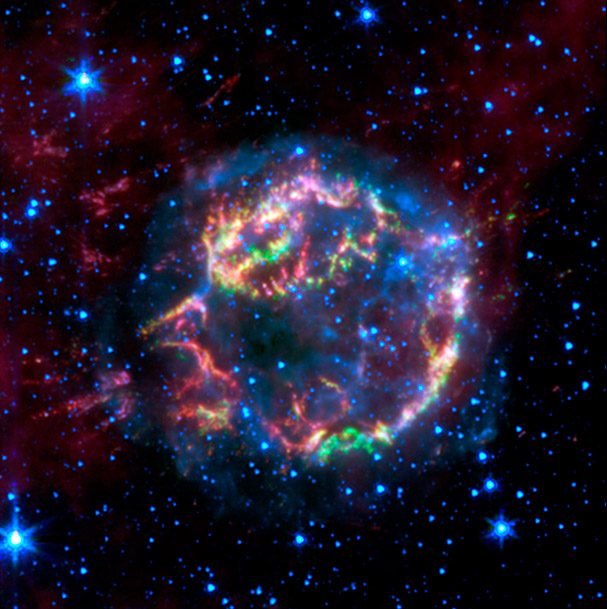
Credit: NASA/JPL-Caltech/L. Rudnick(University of Minnesota)
The above image was made by the Spitzer Space Telescope. Images were made through filters 3.6-micron light (blue); 4.5-micron light (green); and 8.0-micron light (red). Exposures were made on 20 November 2003 & 2 December 2004
Cassiopeia A is a supernova remnant at distance 11,000 light-years in our galaxy in the consellation Cassiopeia. The original star, about 15 to 20 times more massive than our sun, died in a cataclysmic "supernova" explosion relatively recently in our own Milky Way galaxy. Using the additional information from the infrared capability of Spitzer, researchers could piece together the details of the explosion, layer by layer. "Now we can better reconstruct how the star exploded," said Dr. William Reach of NASA's Spitzer Science Center, Pasadena, Calif. "It seems that most of the star's original layers flew outward in successive order, but at different average speeds depending on where they started."
Cassiopeia A provided excellent data for studying the anatomy of a supernova explosion. Because it is young and relatively close to our solar system, it can be observed carefully with many instruments. In a few hundred years or so, Cas A's scattered remains will have completely mixed together, forever erasing important clues about how the star lived and died.
It is thought that the associated supernova may have occurred near 1680 when a star near that location was recorded by , but later could not be found. Cassiopeia A is the strongest radio source in the sky outside the solar sytem. The supernova remnant was found among the earliest discrete radio sources, in 1947 by radio astronomers from Cambridge, England. This radio source was first named Cassiopeia A and later cataloged 3C 461. Its optical counterpart coudn't be found until a more precise position was obtained, by radio interferometry in 1950. Consequently, David Dewhirst of Cambridge obtained first deep optical photos of this region in the sky and discovered a strange faint nebula, which was then investigated by Walter Baade and Rudolph Minkowski with the then-new Palomar 5-meter telescope (Baade & Minkowski, 1954). Spectroscopic observations soon confirmed its nature as the rapidly expanding shell of a supernova remnant, also cataloged as G111.7-2.1. Within two years, American astronomers were able to determine its angular expansion rate, and calculated back that the expansion must have started around the year AD 1667.
Sources
- NASA Spitzer article
NASA Spitzer文章
- Cassiopeia A SEDS article
Cassiopeia A SEDS文章
- NASA Krause Cassiopeia A
NASA 哈罗德·克劳斯 柱状星云 A
Star Concepts
Star Classification
| HyperPhysics***** Astrophysics
HyperPhysics ***** 天体物理学 | R Nave |