索引
| HyperPhysics***** Astrophysics
HyperPhysics ***** 天体物理学 | R Nave |
返回
|
|
Index
索引 | ||
|
Go Back
返回 |
Supernovae超新星
Supernovae are classified as Type I or Type II depending upon the shape of their light curves and the nature of their spectra. 超新星根据其光变曲线的形状和光谱的性质被分类为I型或II型。
 The synthesis of the heavy elements is thought to occur in supernovae, that being the only mechanism which presents itself to explain the observed abundances of heavy elements. 重元素的合成被认为发生在超新星中,因为这是解释观测到的重元素丰度的唯一机制。
|
Index Supernova concepts Reference Cowen 索引超新星概念参考Cowen | ||||
|
Go Back
返回 |
Type I and Type II SupernovaeI型和II型超新星
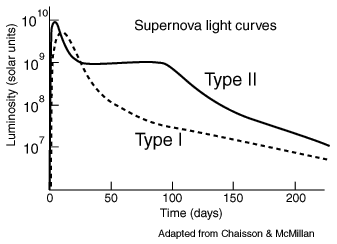
Supernovae are classified as Type I if their light curves exhibit sharp maxima and then die away gradually. The maxima may be about 10 billion solar luminosities. Type II supernovae have less sharp peaks at maxima and peak at about 1 billion solar luminosities. They die away more sharply than the Type I. Type II supernovae are not observed to occur in elliptical galaxies, and are thought to occur in Population I type stars in the spiral arms of galaxies. Type I supernovae occur typically in elliptical galaxies, so they are probably Population II stars. 超新星被分类为I型,如果它们的光变曲线表现出急剧的峰值,然后逐渐消失。峰值可能达到约100亿倍太阳光度。II型超新星的峰值不那么尖锐,峰值约为10亿倍太阳光度。它们的衰减比I型更迅速。II型超新星不被观测到出现在椭圆星系中,而被认为发生在螺旋星系的旋臂中的Population I型恒星中。I型超新星通常出现在椭圆星系中,因此可能与Population II型恒星有关。
 With the observation of a number of supernova in other galaxies, a more refined classification of supernovae has been developed based on the observed spectra. They are classified as Type I if they have no hydrogen lines in their spectra. The subclass type Ia refers to those which have a strong silicon line at 615 nm. They are classified as Ib if they have strong helium lines, and Ic if they do not. Type II supernovae have strong hydrogen lines. These spectral features are illustrated below for specific supernovae. 通过观测其他星系中的多颗超新星,人们基于观测到的光谱对超新星进行了更细致的分类。如果光谱中没有氢线,则被归类为I型超新星。其中,Ia亚型是指在615纳米处有强硅线的那些。如果光谱中有强氦线,则被归类为Ib型;如果没有氦线,则归类为Ic型。II型超新星则具有强氢线。这些光谱特征如下图所示,具体针对某些超新星进行了说明。
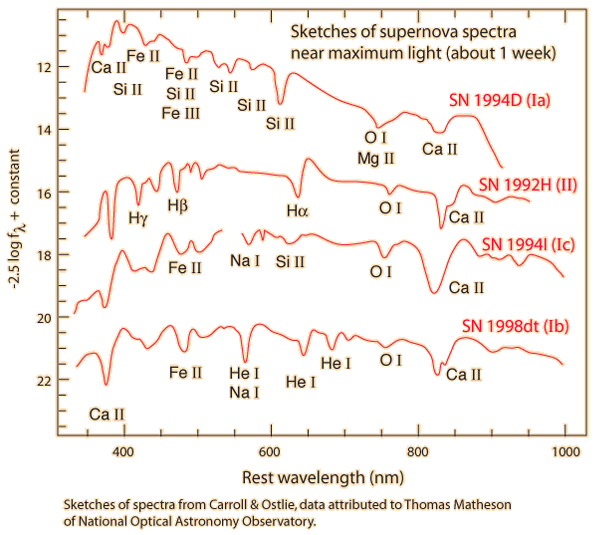 Supernovae are classified as Type I if their light curves exhibit sharp maxima and then die away smoothly and gradually. The model for the initiation of a Type I supernova is the detonation of a carbon white dwarf when it collapses under the pressure of electron degeneracy. It is assumed that the white dwarf accretes enough mass to exceed the Chandrasekhar limit of 1.4 solar masses for a white dwarf. The fact that the spectra of Type I supernovae are hydrogen poor is consistent with this model, since the white dwarf has almost no hydrogen. The smooth decay of the light is also consistent with this model since most of the energy output would be from the radioactive decay of the unstable heavy elements produced in the explosion. 超新星被分类为I型,如果它们的光变曲线表现出急剧的峰值,然后逐渐平滑地衰减。I型超新星的起始模型是当白矮星在电子简并压力下坍缩时发生碳的爆炸。假设白矮星吸积了足够的质量,超过白矮星的钱德勒极限(1.4个太阳质量)。I型超新星光谱中氢含量低的事实与这一模型一致,因为白矮星几乎不含氢。光的平滑衰减也与这一模型一致,因为大部分能量输出来自爆炸中产生的不稳定的重元素的放射性衰变。
Type II supernovae are modeled as implosion-explosion events of a massive star. They show a characteristic plateau in their light curves a few months after initiation. This plateau is reproduced by computer models which assume that the energy comes from the expansion and cooling of the star's outer envelope as it is blown away into space. This model is corroborated by the observation of strong hydrogen and helium spectra for the Type II supernovae, in contrast to the Type I. There should be a lot of these gases in the extreme outer regions of the massive star involved. II型超新星被建模为大质量恒星的内爆-爆炸事件。它们在爆发后几个月显示出光变曲线中的特征平台。这个平台可以通过计算机模型再现,这些模型假设能量来自恒星外层包层的膨胀和冷却,当它被吹向空间时。这个模型得到了II型超新星观测到的强氢和氦谱线的证实,这与I型超新星形成对比。在涉及的 massive 星的极端外层区域应该有大量的这些气体。
Type II supernovae are not observed to occur in elliptical galaxies, and are thought to occur in Population I type stars in the spiral arms of galaxies. Type Ia supernovae occur in all kinds of galaxies, whereas Type Ib and Type Ic have been seen only in spiral galaxies near sites of recent star formation (H II regions). This suggests that Types Ib and Ic are associated with short-lived massive stars, but Type Ia is significantly different. . II型超新星未在椭圆星系中被观测到,而被认为发生在螺旋星系的旋臂中的I型星(Population I型星)。Ia型超新星发生在所有类型的星系中,而Ib和Ic型超新星仅在螺旋星系中靠近近期恒星形成区域(H II区域)被观测到。这表明Ib和Ic型超新星与寿命较短的大质量恒星有关,但Ia型超新星则显著不同。
|
Index Supernova concepts References Chaisson & McMillan Ch. 21 Carroll & Ostlie Sec 15.2 索引 超新星概念 参考文献 Chaisson & McMillan 第21章 Carroll & Ostlie 第15.2节 | ||
|
Go Back
返回 |
Type Ia SupernovaeIa型超新星
Type Ia supernovae have become very important as the most reliable distance measurement at cosmological distances, useful at distances in excess of 1000 Mpc. Ia型超新星已成为测量宇宙学距离最可靠的方法,适用于1000 Mpc以上的距离。
 One model for how a Type Ia supernova is produced involves the accretion of material to a white dwarf from an evolving star as a binary partner. If the accreted mass causes the white dwarf mass to exceed the Chandrasekhar limit of 1.44 solar masses, it will catastrophically collapse to produce the supernova. Another model envisions a binary system with a white dwarf and another white dwarf or a neutron star, a so-called "doubly degenerate" model. As one of the partners accretes mass, it follows what Perlmutter calls a "slow, relentless approach to a cataclysmic conclusion" at 1.44 solar masses. A white dwarf involves electron degeneracy and a neutron star involves neutron degeneracy. 一种解释Ia型超新星形成的过程的模型涉及一个白矮星从伴星那里吸积物质。如果吸积的物质使白矮星的质量超过钱德勒极限(1.44个太阳质量),它将 catastrophic 地坍缩并产生超新星。另一种模型设想的是一个双星系统,其中包含一个白矮星和另一个白矮星或中子星,称为“双简并”模型。当其中一个伙伴吸积物质时,它遵循Perlmutter所说的“缓慢但无情地接近灾难性结局”的过程,最终达到1.44个太阳质量。白矮星涉及电子简并,而中子星涉及中子简并。
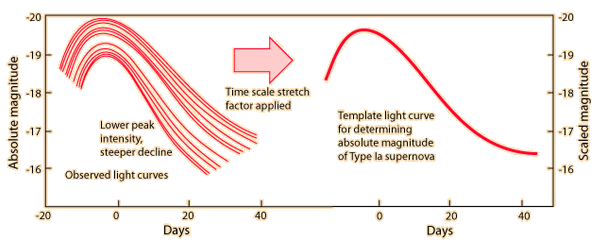
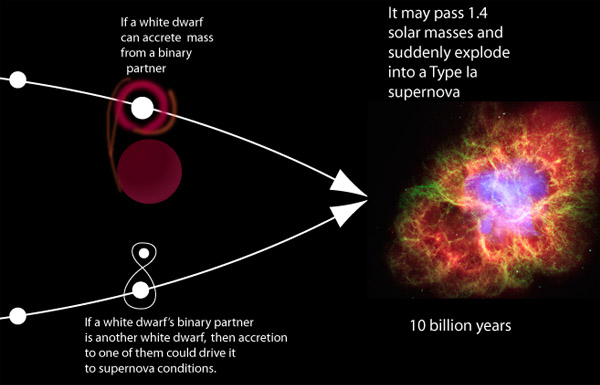 A critical aspect of these models is that they imply that a Type Ia supernova happens when the mass passes the Chandrasekhar threshold of 1.44 solar masses, and therefore all start at essentially the same mass. One would expect that the energy output of the resulting detonation would always be the same. It is not quite that simple, but they seem to have light curves that are closely related, and can be related to a common template. 这些模型的一个关键方面是,它们暗示Ia型超新星爆发发生在质量通过钱德勒阈值(1.44个太阳质量)时,因此所有爆发都始于几乎相同的质量。人们可能会预期由此产生的爆炸的能量输出总是相同的。但事实并非如此简单,但它们的光变曲线似乎密切相关,可以与一个共同的模板相关联。
Carroll and Ostlie summarize the character of a Type Ia supernova with the statement that at maximum light they reach an average maximum magnitude in the blue and visible wavelength bands of  Carroll 和 Ostlie 总结了 Ia 型超新星的特性,指出在最大光度时,它们在蓝光和可见光波段的平均最大视星等为 ,其典型波动范围小于约 0.3 个星等。它们的光变曲线呈现出系统性变化:峰值亮度及其后续衰减速率成反比。
 Carroll and Ostlie give as an example of distance determination the Type Ia supernova SN 1963p in the galaxy NGC 1084 which had a measured apparent blue magnitude of B = m = 14.0 at peak brilliance. There was a measured extinction of A = 0.49 magnitude. Using the template maximum of M=19.6 as a standard candle gives a distance to the supernova  where d = distance in parsecs and the quantities in the exponent are in magnitudes. Note that the value of M for the source supernova is a negative number, -19.3 magnitude, so that the contribution to the exponent is positive. Distance uncertainties for Type Ia supernovae are thought to approach 5% or an uncertainty of just 0.1 magnitude in the distance modulus, m-M. 其中,d 以秒差距为单位,指数中的量以星等为单位。需要注意的是,Ia型超新星的源星等M是一个负数,-19.3星等,因此对指数的贡献是正的。人们认为Ia型超新星的距离不确定性接近5%,或仅在距离模数m-M中存在0.1星等的不确定性。
Carroll和Ostlie以Type Ia超新星SN 1963p为例,该超新星位于NGC 1084星系,其峰值亮度时测得的视蓝光 magnitude 为B = m = 14.0。测得的消光值为A = 0.49 magnitude。使用模板最大值M=19.6作为标准烛光,可计算出该超新星的距离。
上述示意图是Perlmutter在《物理学通报》56卷第4期,第53页,2003年报道的数据的定性草图。它展示了对Ia型超新星光变曲线的仔细研究结果,从而导致了两种标准化这些曲线的方法。上述曲线展示了“拉伸方法”,其中曲线在时间上被拉伸或压缩,标准化的峰值亮度由拉伸因子确定。通过这样的拉伸,左侧的所有观测曲线都收敛到右侧的模板曲线,散射非常小。另一种标准化曲线的方法称为多色光变曲线形状(MCLS)方法。它将光变曲线与一组参数化光变曲线进行比较,以确定超新星在最大亮度时的绝对星等。MCLS方法允许检测并去除星际尘埃的红化和变暗效应。 |
Index Supernova concepts References Carroll & Ostlie Sec 18.5, Sec 27.1 Eagle "Estimating the distance .. Cowen Perlmutter 索引 超新星概念 参考文献 Carroll & Ostlie 第18章第5节,第27章第1节 Eagle "估计距离 ... Cowen Perlmutter | ||
|
Go Back
返回 |