Bilingual edition: English is preserved and Chinese follows each unit. Terminology uses the confirmed v20260916 glossary; automated semantic review remains traceable.
中英双语版:英文原文完整保留,中文紧随对应单元;术语采用 v20260916 确认表,自动语义审校结果可追溯。

Moment of Inertia: Thin Disk

转动惯量:薄盘

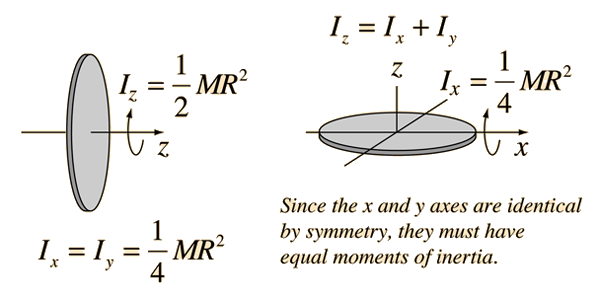
The moment of inertia of a thin circular disk is the same as that for a solid cylinder of any length, but it deserves special consideration because it is often used as an element for building up the moment of inertia expression for other geometries, such as the sphere or the cylinder about an end diameter. The moment of inertia about a diameter is the classic example of the perpendicular axis theorem For a planar object:

薄圆盘的转动惯量与任何长度的实心圆柱体的转动惯量相同,但因其常被用作构建其他几何体转动惯量表达式的元素,如球体或以端面直径为轴的圆柱体,因此值得特别考虑。关于直径的转动惯量是垂直轴定理的经典例子。对于平面物体:
Index

Moment of inertia concepts
索引 转动惯量概念
 
HyperPhysics***** Mechanics ***** Rotation
HyperPhysics ***** 力学 ***** 转动
R Nave
Go Back
返回


Superposition of Moments of Inertia

惯性矩的叠加
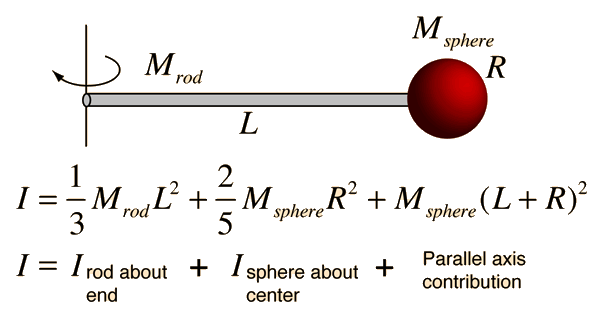
The moment of inertia of a composite object can be obtained by superpositon of the moments of its constituent parts. The Parallel axis theorem is an important part of this process. For example, a spherical ball on the end of a rod:
For rod length L = m and rod mass = kg,
sphere radius r = m and sphere mass = kg:
Irod about end = kg m2


I rod about end = kg m²
中文译文中的待填/计算数值依次对应:1:ird。实际数值以上方原输入框为准。
Isphere about center = kg m2


以中心为球心的力矩矩等于 kg m²
中文译文中的待填/计算数值依次对应:1:isp。实际数值以上方原输入框为准。
Parallel axis contribution = kg m2


平行轴定理的贡献为 kg m²
中文译文中的待填/计算数值依次对应:1:ipa。实际数值以上方原输入框为准。
The composite moment of inertia is given by the sum of the contributions shown at left. The moment of inertia is
I = kg m2

It may be instructive to compare this moment of inertia with that of a rod or sphere alone. If the total mass of kg were concentrated in the sphere, the moment of inertia would be
I(sphere) = kg m2.

If the entire mass were concentrated in the rod and it was extended to the location of the center of the sphere at m, then the moment of inertia would be
I(rod) = kg m2.
组合的转动惯量由左边所示的贡献之和给出。转动惯量为 I = kg m²。或许有启发性的是将此转动惯量与仅由杆或球体单独构成的转动惯量进行比较。如果总质量 kg 集中在球体上,那么球体的转动惯量为 I(sphere) = kg m²。如果整个质量集中在一个杆上,并且该杆延伸到球体中心的位置 m,那么杆的转动惯量为 I(rod) = kg m²。
中文译文中的待填/计算数值依次对应:1:ito 2:m 3:its 4:L 5:itr。实际数值以上方原输入框为准。
复合物体的转动惯量可以通过其各个组成部分的转动惯量叠加得到。平行轴定理是这一过程的重要部分。例如,一个球体固定在杆的一端:对于长度为 L = m 的杆,杆的质量为 kg,球体半径 r = m,球体质量为 kg:
中文译文中的待填/计算数值依次对应:1:rl 2:rm 3:sr 4:sm。实际数值以上方原输入框为准。
Index

Moment of inertia concepts
索引 转动惯量概念
 
HyperPhysics***** Mechanics ***** Rotation
HyperPhysics ***** 力学 ***** 转动
R Nave
Go Back
返回


Principal Axes

主轴
The use of Newton's second law for rotation involves the assumption that the axis about which the rotation is taking place is a principal axis. Since most common rotational problems involve the rotation of an object about a symmetry axis, the use of this equation is usually straightforward, because axes of symmetry are examples of principle axes. A principal axis may be simply defined as one about which no net torque is needed to maintain rotation at a constant angular velocity. The issue is raised here because there are some commonly occurring physical situations where the axis of rotation is not a principal axis. For example, if your automobile has a tire which is out of balance, the axle about which it is rotating is not a principal axis. Consequently, the tire will tend to wobble, and a periodic torque must be exerted by the axle of the car to keep it rolling straight. At certain speeds, this periodic torque may excite a resonant wobbling frequency, and the tire may begin to wobble much more violently, vibrating the entire automobile.
在使用牛顿第二定律处理旋转问题时,假设旋转轴是主轴。由于大多数常见的旋转问题都涉及物体绕对称轴旋转,因此使用该方程通常是直接的,因为对称轴是主轴的例子。主轴可以简单地定义为一个轴,绕该轴旋转时不需要净力矩来维持恒定的角速度。这里提出这个问题,是因为存在一些常见的物理情况,其中旋转轴不是主轴。例如,如果您的汽车轮胎不平衡,其旋转轴就不是主轴。因此,轮胎会倾向于振动,必须由汽车的轴施加周期性力矩以保持直线滚动。在某些速度下,这种周期性力矩可能会激发共振振动频率,轮胎可能会开始剧烈振动,振动整个汽车。
Index

Moment of inertia concepts
索引 转动惯量概念
 
HyperPhysics***** Mechanics ***** Rotation
HyperPhysics ***** 力学 ***** 转动
R Nave
Go Back
返回