Bilingual edition: English is preserved and Chinese follows each unit. Terminology uses the confirmed v20260916 glossary; automated semantic review remains traceable.
中英双语版:英文原文完整保留,中文紧随对应单元;术语采用 v20260916 确认表,自动语义审校结果可追溯。

Conduction Cooling of Body

体的传导冷却
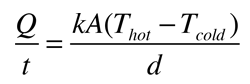
The basic heat transfer equation for conduction is

导热的基基本传热方程是

where in this case A would be the area of the human body and k the thermal conductivity of the air surrounding the body.

其中,A在这里是指人体的表面积,k是周围空气的热导率。
A typical body area according to physiology texts:

Thermal conductivity for still air:

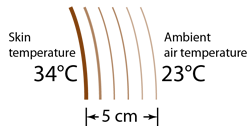
Assuming a distance from the skin at which the temperature drops to the ambient temperature:
根据生理学教材中的典型体表面积:静止空气的热导率:假设皮肤温度降至环境温度的间距:
Calculation with other model parameters
使用其他模型参数进行计算
Discussion of the "wall thickness" assumption
关于‘壁厚’假设的讨论
Modeling the cooling of the human body
人体冷却的建模
Index

Heat transfer concepts

Heat transfer examples
索引 热传递概念 热传递示例
 
HyperPhysics***** Thermodynamics
HyperPhysics ***** 热力学
R Nave
Go Back
返回


Convection Cooling of Body

人体的对流冷却

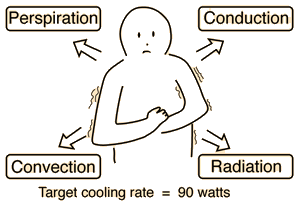
In estimating the effect of convection on the cooling of the body, it is lumped in with conduction. Together, they are not generally adequate for cooling.

在估计对流对身体冷却的影响时,它被与传导合并在一起考虑。两者共同作用通常不足以实现有效的冷却。

As one of the basic heat transfer mechanisms, convection involves the transport of energy by means of the motion of the heat transfer medium, in this case the air surrounding the body. The best approach to an estimate of heat loss by this mechanism may be to calculate the heat loss by conduction and to adjust the effective wall thickness used in the conduction calculation to take in to account the fact that air motion will strip away the heated layer surrounding the skin and increase the transfer of heat to the air.

作为基本的热传递机制之一,对流涉及通过热传递介质的运动来传输能量,这种介质是包围身体的空气。为了估算通过该机制的热量损失,可能的最佳方法是计算通过导热的热量损失,并调整导热计算中使用的有效壁厚,以考虑空气运动会剥离皮肤周围的加热层,并增加热量向空气的传递。
Modeling the cooling of the human body
人体冷却的建模
Index

Heat transfer concepts

Heat transfer examples
索引 热传递概念 热传递示例
 
HyperPhysics***** Thermodynamics
HyperPhysics ***** 热力学
R Nave
Go Back
返回


"Wall Thickness" in Heat Loss

传热中的壁厚

The wall thickness d in the heat transfer equation for conduction:

导热方程中的壁厚 d :

has a specific meaning when dealing with heat loss across the wall of a house or through a given thickness of material, but for the conduction loss from a hot object in air there is no identifiable wall thickness. In examples like the cooling of the human body, some insight can be gained by defining the wall thickness as the distance into the surrounding medium where the temperature has fallen to the ambient temperature.

在处理房屋墙壁的热损失或通过特定厚度材料的热损失时,‘壁厚’具有特定含义,但对于从热物体在空气中传导损失的情况,却无法确定具体的壁厚。在像人体冷却这样的例子中,可以通过将壁厚定义为温度降至环境温度的周围介质中的距离来获得一些启示。
While the assumption that the temperature drops from 34 C to ambient air temperature in a distance of 5 cm for still air is nothing more than a guess, it does serve to point out this important concept. If a fan were blowing air over the skin, stripping away the warmed layer of air, the conduction loss would be significantly greater. This can also be discussed in terms of convection.
尽管假设在静止空气中,温度从34°C降至环境空气温度仅在5厘米的距离内发生,这不过是一个猜测,但它确实指出了这个重要的概念。如果风扇在皮肤上吹风,剥离温暖的空气层,传导损失会显著增加。这也可以从对流的角度进行讨论。
Modeling the cooling of the human body
人体冷却的建模
Index

Heat transfer concepts

Heat transfer examples
索引 热传递概念 热传递示例
 
HyperPhysics***** Thermodynamics
HyperPhysics ***** 热力学
R Nave
Go Back
返回


Conduction Cooling of Body

体的传导冷却
The basic heat transfer equation for conduction is

导热的基基本传热方程是
where in this case A would be the area of the human body and k the thermal conductivity of the air surrounding the body.

其中,A在这里是指人体的表面积,k是周围空气的热导率。

Data may be entered for any of the parameters below, and the heat loss rate by conduction will be calculated. Default values will be entered for unspecified parameters, but all values may be changed.

可以为以下任何参数输入数据,计算通过导热的散热率。未指定的参数将输入默认值,但所有值均可更改。

For a skin area A = m2

对于面积为 A = m² 的皮肤
中文译文中的待填/计算数值依次对应:1:a。实际数值以上方原输入框为准。

and air thermal conductivity
k = x 10^ cal/cm C s = x 10^J/cm C s,

以及空气的热导率 k = x 10^ cal/cm·°C·s = x 10^ J/cm·°C·s,
中文译文中的待填/计算数值依次对应:1:kb 2:kp 3:kb2 4:kp2。实际数值以上方原输入框为准。

if the effective distance to ambient temperature air is d = cm

如果有效距离到环境空气为 d = cm
中文译文中的待填/计算数值依次对应:1:d。实际数值以上方原输入框为准。

and the temperatures are Tskin = C and Tambient= C

并且皮肤温度为 T_skin = C,环境温度为 T_ambient = C
中文译文中的待填/计算数值依次对应:1:ts 2:ta。实际数值以上方原输入框为准。

then the heat loss rate will be

那么热损失率将为

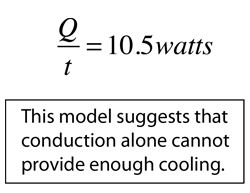
Q/t = watts.
Example of model parameters
模型参数示例
Discussion of the "wall thickness" assumption
关于‘壁厚’假设的讨论
Modeling the cooling of the human body
人体冷却的建模
Q/t 等于瓦特。
中文译文中的待填/计算数值依次对应:1:q。实际数值以上方原输入框为准。
Index

Heat transfer concepts

Heat transfer examples
索引 热传递概念 热传递示例
 
HyperPhysics***** Thermodynamics
HyperPhysics ***** 热力学
R Nave
Go Back
返回