Bilingual edition: English is preserved and Chinese follows each unit. Terminology uses the confirmed v20260916 glossary; automated semantic review remains traceable.
中英双语版:英文原文完整保留,中文紧随对应单元;术语采用 v20260916 确认表,自动语义审校结果可追溯。

Cooling of the Human Body

人体的冷却
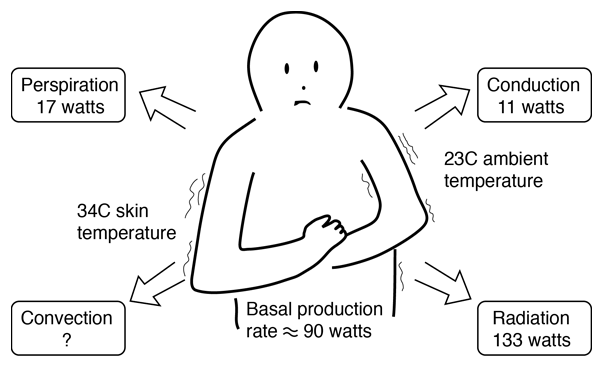
This is an active graphic. Click on one of the heat transfer mechanisms for a discussion of its role in cooling the human body.

This is a simplified model of the process by which the human body gives off heat. Even when inactive, an adult male must lose heat at a rate of about 90 watts as a result of his basal metabolism. One implication of the model is that radiation is the most important heat transfer mechanism at ordinary room temperatures. This model indicates that an unclothed person at rest in a room temperature of 23 Celsius or 73 Fahrenheit would be uncomfortably cool. Select one of the cooling mechanisms for further details about how the model numbers were obtained. The skin temperature of 34 C is a typical skin temperature taken from physiology texts, compared to the normal core body temperature of 37 C.

这是一个简化模型,用以说明人体散热的过程。即使在静止状态下,成年男性也必须以约90瓦的速率散热,这是由于基础代谢率所致。该模型的一个推论是,在普通室温下,辐射是最重要的散热机制。该模型表明,如果一个人在23摄氏度(73华氏度)的室温中静坐,不穿衣服,将会感到不适。请选择一种散热机制,以获取有关模型数值的更多细节。34摄氏度的皮肤温度是来自生理学教材的典型皮肤温度,与正常的核心体温37摄氏度相比。
What if the ambient temperature is above body temperature??
如果环境温度高于体温呢?
Physiology of temperature regulation
体温调节的生理学
这是一个动态图形。点击一种热传递机制,了解其在人体冷却中的作用。
Index

Heat transfer concepts

Heat transfer examples
索引 热传递概念 热传递示例
 
HyperPhysics***** Thermodynamics
HyperPhysics ***** 热力学
R Nave
Go Back
返回


Cooling of the Human Body

人体的冷却
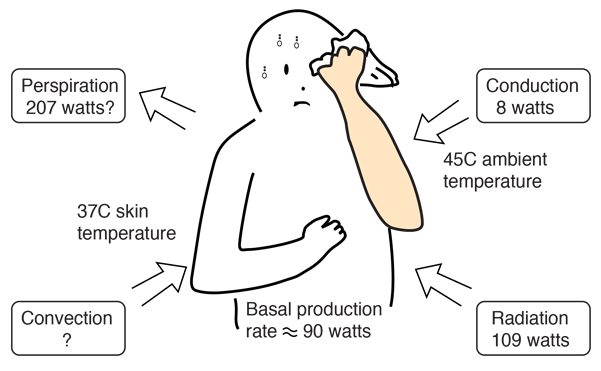
This is an active graphic. Click on one of the heat transfer mechanisms for a discussion of its role in cooling the human body.

Even when inactive, an adult male must lose heat at a rate of about 90 watts as a result of his basal metabolism. This becomes a problem when the ambient temperature is above body temperature, because all three standard heat transfer mechanisms work against this heat loss by transferring heat into the body. Our ability to exist in such conditions comes from the efficiency of cooling by the evaporation of perspiration. At a temperature of 45 Celsius or 113 Fahrenheit the evaporation process must overcome the transfer of heat into the body and give off enough heat to accomplish a 90 watt net outward flowrate of energy. Because of the body's temperature regulation mechanisms, the skin temperature would be expected to rise to 37°C at which point perspiration is initiated and increases until the evaporation cooling is sufficient to hold the skin at 37°C if possible. With those assumptions about the temperatures, the Stefan-Boltzmann law for an area of 2 m2 and emissivity 0.97 gives a net input power of 109 watts to the body. The perspiration cooling must overcome that and produce the net outflow of 90 watts for equilibrium.

即使处于静息状态,成年男性也必须以约90瓦的速率失去热量,这是由于基础代谢率所致。当环境温度高于体温时,这种情况会成为问题,因为三种标准的热传递机制会对抗这种热量损失,将热量传入体内。我们能够在这种条件下生存,得益于出汗蒸发的冷却效率。在45摄氏度或113华氏度的温度下,蒸发过程必须克服热量传入体内的过程,并释放出足够的热量,以实现90瓦的净热量外流。由于体温调节机制,皮肤温度预计会上升到37°C,此时出汗开始并持续增加,直到蒸发冷却足够维持皮肤温度在37°C(如果可能)。在这些温度假设下,对于2平方米的面积和0.97的发射率,斯蒂芬-玻尔兹曼定律给出的净输入功率为109瓦。出汗冷却必须克服这一输入,并产生净输出90瓦以达到平衡。
What if the ambient temperature is below body temperature??
如果环境温度低于体温呢?
Physiology of temperature regulation
体温调节的生理学
这是一个动态图形。点击一种热传递机制,了解其在人体冷却中的作用。
Index

Heat transfer concepts

Heat transfer examples
索引 热传递概念 热传递示例
 
HyperPhysics***** Thermodynamics
HyperPhysics ***** 热力学
R Nave
Go Back
返回